Test Prep Insight is reader-supported. When you buy through links on our site, we may earn an affiliate commission. Learn more
Best Apps To Learn Italian
Discover the best way to learn Italian through our reviews of the top-rated programs online
Once you’ve decided to learn to speak Italian, the next choice is how to learn. And given that language apps tend to be the most practical, affordable, and frankly, effective means of learning to speak a new language, this is likely the route you will go. But with dozens of online programs, how do you know which one is best for you? In this comprehensive guide, we cover our list of the top five Italian apps.
In the video above, Lara from the Test Prep Insight team walks you through each Italian language app to make our best list, including why we think these particular programs are so good. For more detail regarding each Italian language app, be sure to continue reading our full written guide below.
Learn Italian Fast: What Actually Works?
If you’re serious about becoming conversational quickly, the right tools make all the difference. Apps like Rocket and Pimsleur offer guided audio practice, grammar support and voice recognition, which combine to accelerate your growth. Unlike simple vocab apps, they simulate real conversations and teach structure alongside vocabulary.
Are Paid Italian Apps Better Than Free Ones?
Free tools like Duolingo are good for casual learners and vocab basics, but they often skip grammar and real speaking practice. Paid apps such as Rocket and Pimsleur build a fuller skillset with structured lessons, audio training, and cultural context. If fluency is your goal, investing in a proper course can save time long term.
After reviewing more than a dozen Italian apps over the course of several weeks, Rocket Italian rose to the top of our list. Here are a few reasons why.
Audio Lessons Develop Your Verbal Skills
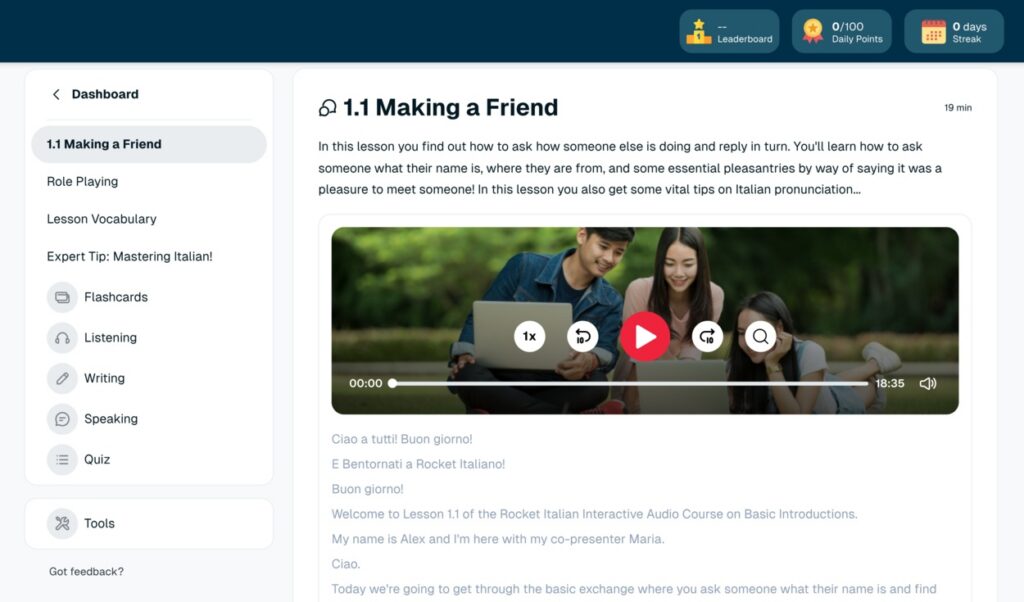
One of the most prominent features of Rocket’s program and its clearest highlight is the framework of interactive audio lessons. In these half-hour long exercises, you listen to and engage with fluent speakers within the construct of a guided conversation.
This mock dialogue is at the heart of each Rocket Italian lesson, and is effective for improving your listening comprehension and speaking skills. No other app (apart from maybe Pimsleur), comes this close to simulating real world experience (not even Rosetta Stone).
Rocket Italian’s audio lessons are powerful
Rather than focusing on the typical drills and exercises that we saw with other apps, which don’t necessarily boost your conversational skills, Rocket focuses on just that: actually listening and speaking. And given that you’re likely picking up the language to, you know, speak Italian, we love the emphasis on output.
Diverse Set of Practice Drills to Drive Home Retention
Another one of our favorite features was the practice drills. Backstopping all of the audio lessons, Rocket provides a slate of reinforcement exercises. These drills take place right after you complete the audio portion, and are intended to drive home the material you just learned.
These exercises include things like flashcards, fill-in-the-blanks, writing drills, and speed quizzes. The point is to get you to interact with new words and phrases from different perspectives, thus increasing retention.
In essence, Rocket takes the types of drills that other apps use as the basis of their program and layers them in behind their audio lessons to double up on content instruction. And while this may make the coursework take a little longer, they are also more comprehensive and in-depth because of this.
You’re also getting extra tools outside of the main lessons, like survival kits that cover all the core vocab you need to get around.
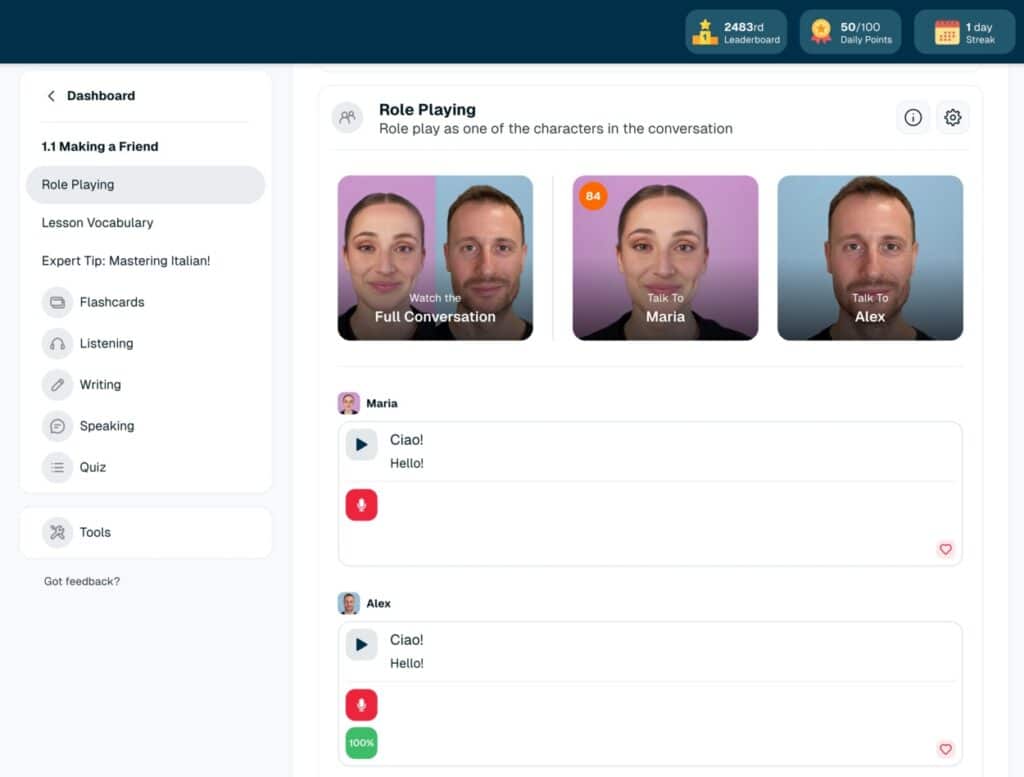
My personal favorite features is the option to participate in an extended role play. Essentially, you work back through the same conversation you just listened to, except this time, you take the place of one of the main speakers. It isn’t for the faint of heart, but if you’re willing to take on a challenge in order to get truly conversational in Italian, this exercise alone makes Rocket stand out among all Italian language apps.
Accurate Speech Recognition Technology
For me, a clear highlight of the Rocket Italian program is their speech recognition software. As you complete the audio lessons and accompanying exercises, Rocket uses Google’s web speech API to record your voice and grade your pronunciation.
Rocket’s use of Google’s speech software is smart
It will rate your pronunciation on a scale from 1 to 100 and provide feedback in an effort to help you improve your accent. While this isn’t unique to Rocket (most other apps do this as well), their use of Google’s tech is very smart given its quality.
Helpful Grammar Instruction
Lastly, Rocket’s emphasis on grammar instruction within its coursework is noteworthy. Not all apps focus on grammar, which can be detrimental to your developing speech patterns.
The Rocket Italian audio lessons, as well as the supplemental “language & culture lessons” are full of helpful explanations and tips to help you master all the different grammar rules and principles of the Italian language. It is much more in-depth than we have seen with other apps.
Rocket may be our highest-rated Italian program, but it doesn’t come cheap. With lifetime only packages that run into the hundreds of dollars, it might simply be too expensive for some people. For those looking for a value-driven app with a low monthly subscription price, Babbel is our pick for the following reasons.
Cheap Price Point
Babbel costs about $8 to $15 per month (depending on which package you go with), making it one of the most affordable language learning tools on the market.
This is particularly true if you can find Babbel’s Italian course on sale, which they run pretty regularly. Plus, the discounts usually stay in place on a monthly basis so long as you stay subscribed. In short, we love Babbel’s value proposition.
Yet, we don’t love Babbel only because of their low cost. If that was the only factor, Busuu, Duolingo and others would have to make this list as well. We also love Babbel for their lesson format and content delivery, as discussed further below.
Short, Engaging Lessons
From a substantive standpoint, our absolute favorite feature of the Babbel program is the design of their short, engaging lessons. Taking about 10-15 minutes each, Babbel’s lessons are perfect for busy people squeezing work in here and there where they can.
The Babbel exercises are fast and fun
The lessons are diverse, fast-moving, and fun. Within each one, you’ll usually work through a dozen or more different exercises, covering everything from fill-in-the-blanks to short, mock conversations.
Plus, Babbel even includes quick daily review sessions for increased recall. These sessions take just 2-3 minutes per day and are great for improving retention.
Awesome Speech Recognition Technology
Much like Rocket, Babbel’s speech recognition technology is also top-notch. They frequently have you repeat words and phrases within the app, then judge your pronunciation.
The Babbel speech tech
While Babbel Italian doesn’t give you a grade from 1 to 100 like Rocket, they will provide more qualitative feedback like “you’re a pro” or “needs improvement.” While not quite as good, we found this generally helpful and thought their tech was very accurate (better than the tech from Mondly).
Personally, I also like their AI conversation partner, Babbel Speak. How it works: you get structured, step-by-step guidance through a scripted dialogue, with visual cues, hints, and instant pronunciation feedback along the way. This is a great tool for beginners or anyone who gets self-conscious when it comes to speaking, as Babbel provides so much support that you’re never left wondering what to say next.
Easy to Understand Grammar Content
Babbel sneaks grammar instruction into their program in a very subtle way. Rather than hitting you over the head with text-heavy lessons, they use little “tip” popups. As you work through an exercise, tips will pop up about conjugating verbs, modifying adjectives, and other important points.
Babbel deftly teaches grammar content
This sleek means of grammar delivery is smart, because you pick up the nuances of tricky phrases without even feeling like you’re learning. Because it’s carried out mainly with once-sentence instructions and examples, it’s super easy to digest.
Sleek, Easy-to-Use Digital Platform
The last noteworthy feature of Babbel’s program is the platform itself. Babbel’s user interface and experience overall is one of the best we’ve seen. It’s modern, fun, and easy to navigate. I’m fairly sure my tech-illiterate uncle could use it.
If you want to talk with a real human to learn Italian, Preply matches you up with fluent Italian speakers for customized sessions. Filters help you quickly sort through tutors based on your goals. Maybe you’re planning a trip to Italy. Within minutes, you can narrow the list down to tutors in Rome or Venice who can help you learn how to get around independently in Italy.
If you try out a tutor and feel like they’re not a fit, you can rebook a free replacement lesson with someone else.
Subscription Model Keeps You Accountable
The recurring subscription lets you decide how many sessions you want per week. Whenever something comes up, you can reschedule up to 12 hours before a session or even pause the plan for a few weeks. The subscription renews automatically until you cancel, which keeps you accountable to learning. Unused sessions don’t roll over, so falling behind means you’re leaving money on the table. While that might be annoying, if you’re serious about learning Italian, having money as a motivator might be what keeps you going.
Most tutors charge between $15 and $25 per hour, depending on their experience.
Human Tutor + AI Tools
Preply provides lots of structured learning activities for tutors to use, so even newer tutors have plenty of resources to keep the session moving.
My favorite feature was all the AI tools built into the platform. I didn’t have to take notes, as I knew the AI would give me ready-made notes and a vocab list based on our conversation. That helped me focus on what my tutor was saying, and at the end of each session, I got personalized homework to keep me learning on my own.
Preply works for learners at every level, since your tutor simply sees where you’re at with Italian and helps you build from there. They’re great for people wanting to develop strong conversation skills or prepare for an Italian language exam.
Similar to Rocket, Pimsleur is one of our favorite Italian language programs because of their focus on speaking and listening. And though Pimsleur grades ever-so-slightly lower than Rocket, it might actually be a better fit for you based on this program’s subtle differences. Here’s why Pimsleur makes our list.
Interactive Audio Lessons
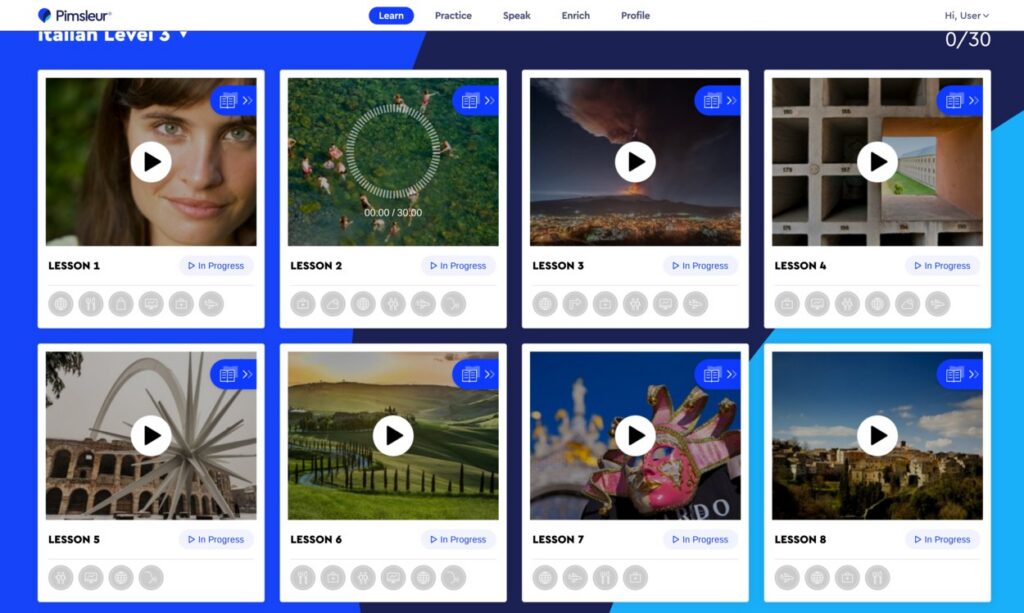
Much like Rocket, Pimsleur’s Italian program is also founded on audio lessons. They are the bedrock of this course. To begin every Pimsleur lesson (there are roughly 150 in the entire course), you listen to a 30-minute audio exercise.
The Pimsleur audio lessons are deep and effective
These exercises are guided conversations where a moderator speaking in English walks you through the exchange step-by-step. She tells you what exactly you’re about to hear and why, and then frequently pauses to explain things and provide tips. It’s sort of like listening to an Italian podcast with English breakdowns.
Additionally, you’re frequently called upon to speak yourself. Pimsleur wants to get you talking, and as such, will have you practice your verbal skills right alongside the fluent speakers. These lessons are powerful at getting you talking, and fast (unlike the Italian lessons from Duolingo).
Effective Practice Exercises
The audio focus isn’t the only way in which Pimsleur’s course tracks with Rocket. Pimsleur too uses a diverse set of drills to backstop their audio lessons.
These drills include speed games, flashcards, matching pairs, and listening exercises. The intent is to improve your comprehension by seeing the same material through multiple perspectives. And it works.
These reinforcement exercises make the Pimsleur program comprehensive and deep. It’s one of the main reasons why Pimsleur nabs such a high grade.
Outside of the lessons, Pimsleur has added a new Challenges and Rewards program for whenever you want a little extra practice. For anyone who does well with games, points, and prizes, Pimsleur gives you the opportunity to mix up your learning and feel the satisfaction of making measurable progress.
Special Driving Mode
One big difference between Pimsleur and Rocket (apart from the lifetime vs monthly payment structure), is that Pimsleur offers users a special driving mode for their app, while Rocket does not.
We loved everything about Pimsleur’s platform
In essence, because the bulk of the Pimsleur lessons are audio-based, you can complete them without having to look at a screen. So why not do them while driving? It’s no different than a podcast.
So if you have a long daily commute, or simply find yourself driving quite a bit for whatever reason, this offers a distinct advantage. You can kill two birds with one stone and make the most of your time by enabling the driving mode feature to knock out coursework on the go.
Free Trial Period
Unlike most other apps, Pimsleur actually offers a free trial period. Rather than having to input your credit card and commit to some level of purchase, you can use the Pimsleur program for 7 days risk free. This is great for kicking the tires on the course and seeing if you like it before diving straight in.
If you’re looking for a departure from the usual language learning apps (i.e., those described above), LingoPie offers a very unique alternative to more traditional, programmatic educational styles.
Learning Through Entertainment
LingoPie takes a new approach by integrating Italian TV shows and movies into its platform. Similar to Rosetta Stone’s immersive technique, LingoPie believes in learning through immersion, allowing users to naturally absorb the language.
LingoPie has a deep content library
With a diverse library of Italian media content, including shows, movies, and music videos, LingoPie goes beyond basic subtitles. Plus, they’re constantly updating the content library, with hundreds of new shows and movies added across all languages in 2025. Their YouTube integration also means you can import your own videos and use all the LingoPie tools to create your own learning materials.
Unique Learning Features
LingoPie offers several helpful features, such as color-coded subtitles that highlight sentence structures, adjustable playback speeds for learners of all levels, a looping feature for repeated viewing, an auto-flashcard generator for review, and an AI-driven grammar coach for comprehensive support.
These features provide tangible educational benefits, making the experience more than just watching subtitles. I was honestly shocked at how much I used these tools and how effective they actually were for enhancing my learning.
A Varied Content Library
Unlike other language tools that often feature outdated shows or free YouTube videos, LingoPie’s content is engaging and diverse. LingoPie offers content that is both educational and entertaining, aligning with what users would choose to watch.
LingoPie’s grammar coach
Affordable Pricing
Despite its extensive features and polished interface, LingoPie remains affordable at about $6 per month. This competitive pricing makes it one of the most cost-effective options among Italian language apps, offering exceptional value for money. LingoPie can be a valuable addition to other programs, enriching the overall learning experience.
Visual learners will find a ton of value in Rosetta Stone. As one of the oldest language learning apps (Rosetta Stone has been doing their thing since the 1990s), they have a ton of name recognition.
They’re also constantly updating the program. The latest version, called Rosetta Stone Sapphire, has a redesigned interface that’s more modern and more intuitive, with better progress tracking. You’re basically getting the latest tech tools combined with a tried-and-true educational method that has helped language learners for decades.
All About Italian Immersion
A defining characteristic of Rosetta Stone is its immersive educational philosophy. The program aims to immerse users in new vocab from the outset.
Rosetta Stone Italian practice drill
Unlike conventional methods that rely on translations into English, Rosetta Stone challenges you to directly engage with the language, fostering a deeper understanding and retention of the material. The immersion aspect is challenging, but effective.
Visuals Everywhere
Another notable aspect of Rosetta Stone’s approach is its emphasis on visual learning. Nearly every activity in the app incorporates imagery, which serves to reinforce vocabulary and concepts.
For instance, when presenting the word “cloud,” the app pairs the written word with a corresponding image of a cloud. This visual association is particularly beneficial for visual learners, as it encourages them to think in the target language without resorting to translations.
Nice Supplemental Learning Tools
Lastly, Rosetta Stone offers a variety of supplementary resources, including on-demand video lessons, phrasebooks, and stories. These resources provide you with extra practice and exposure to Italian, creating a more comprehensive experience (much more so than Memrise or Duolingo).
I also have to call out the Sapphire Studio. This is where you get access to some really fun AI features. You can create your own flashcard sets and matching games that align with your unique interests, or you might use the Chat Missions to engage in practice conversations about everyday topics. Then if you’re already using Italian for work, you’ll appreciate getting a little AI help while composing professional emails.
The AI tools let you generate your own custom matching games
In summary, Rosetta Stone’s immersive approach, focus on images, and wealth of supplementary resources make it an ideal choice for visual learners trying to master Italian.
I fell in love with Italian at age 16 on a family trip to Italy – but mastering Italian proved unexpectedly challenging. The vocabulary was a mouthful, and the native speakers talked incredibly fast. Still, Italian’s rolling R’s and bouncy tones were so enchanting that I decided to press on.
Here’s what helped me start making real progress. First, I established a habit of spending 30 minutes on my language learning app every night after dinner. As I worked through lessons, I wrote new vocab on Post-It notes that I put all over my apartment. This helped me constantly review, without taking up extra time. Other tricks that helped: watching Italian children’s TV shows (the simple conversations are easy to follow) and listening to Italian podcastson the way to work (another time saver).
When I finally headed back to Italy, I was definitely nervous to chat with the locals. Thankfully, Italians always want to talk – and loudly! Meeting so many fun people helped me come out of my shell, and soon, I found myself confidently making friends.
My advice: consistency is the key to mastering Italian. Stay optimistic, use your resources, have fun, and keep using your Italian learning app every day.
FAQ
What is the best app to learn Italian?
Among the more than dozen Italian language apps we’ve tested and reviewed, Rocket Italian is our #1 pick. With deep audio lessons, reinforcement drills, insightful grammar tips, and a sleek platform, Rocket offers the complete package. Babbel is also good as a value option, Preply connects you with fluent Italian speakers, and Pimsleur is great for commuters needing to learn on the go.
How much do Italian language courses cost?
A good Italian language app usually costs anywhere from about $7 per month to $150 upfront for a lifetime package. On average though, most Italian programs cost somewhere in the range of $8-$15 per month.
Are online language programs effective for learning Italian?
Yes, assuming you dedicate the time and stay consistent with your learning, online language programs can be highly effective. Like most learned skills, consistency and practice are key.
How long does it take to learn Italian?
If you are consistently using a language app, it should take you about 30 to 50 weeks to become conversationally proficient.
What is the best free app to learn Italian?
Duolingo is a popular choice for free Italian lessons, but it doesn’t teach you much Italian. For more effective real-world learning, you’ll have to pay for a program like Rocket Italian, Babbel, or Pimsleur.
Is Rocket Italian good for beginners?
Yes, Rocket Italian starts with beginner modules and gradually builds toward advanced conversational fluency. It’s great for structured learning.
Can I learn Italian in 3 months?
With consistent daily study using tools like Rocket or Pimsleur, many learners reach beginner conversational level within 3 months.
 Editor's Choice
 Value Pick