Test Prep Insight is reader-supported. When you buy through links on our site, we may earn an affiliate commission. Learn more
Best Apps To Learn Japanese
After using a dozen apps, our team breaks down the best Japanese language learning programs in detail
Once you’ve decided to learn Japanese, the next choice is naturally how to learn. Given that language apps tend to be the most practical, affordable, and efficient means of learning to speak Japanese, this is likely the route you will go. But with dozens of online Japanese learning programs, how do you know which one is best? In this detailed guide, we cover our list of the top four Japanese apps, and discuss how different programs may be best for different types of learners.
In the video above, Lara (from the TPI team) walks you through each of the best Japanese learning apps to make our list, including why we think these particular Japanese learning programs are so good. For more detail regarding each Japanese language app, be sure to continue reading below.
The time it takes to become fluent in Japanese depends on your study habits, goals, and starting level. The US Foreign Service Institute (FSI) classifies Japanese as a Category IV language, which is one of the most difficult for native English speakers.
On average:
Basic conversational fluency: 6-12 months with daily study.
Intermediate reading and writing fluency: 12-18 months.
Full fluency (including Kanji): 2+ years of structured learning.
Apps like Rocket Japanese and Pimsleur offer immersive, progressive tracks to shorten this timeline with consistent effort.
Why Rocket Languages Makes Our Best Japanese Apps List
Our pick for best overall Japanese app (after reviewing around a dozen programs), is Rocket Japanese. It is a bit of close call with our second pick, Pimsleur (discussed below), but generally speaking, when comparing all of these different Japanese programs side-by-side, Rocket is clearly the best.
In terms of the design of their program and the depth of their lessons, they simply have the most well-rounded Japanese app from top to bottom. To better explain this, I want to cover three key points.
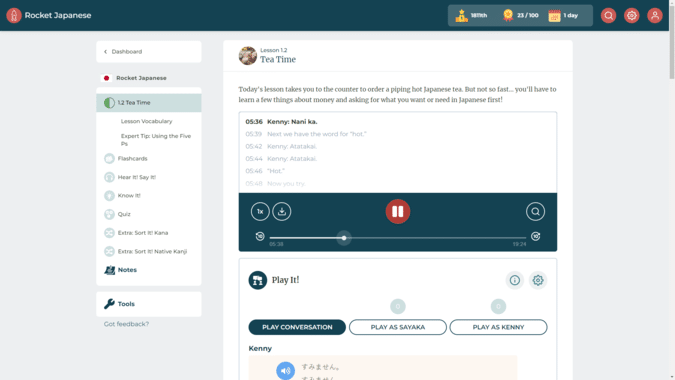
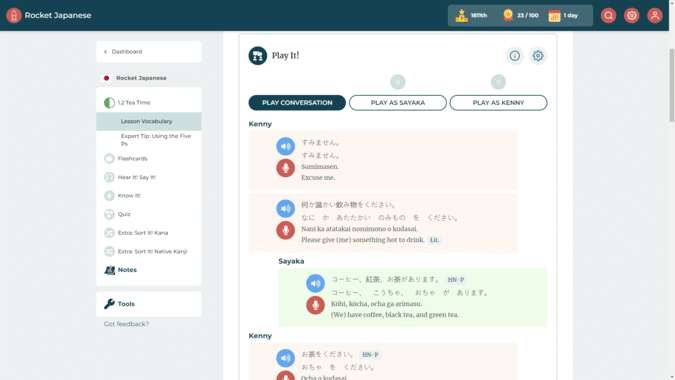
The first highlight is Rocket’s use of interactive audio lessons. In these exercises that kick off each unit, English speaking moderators slowly walk you through a guided conversation step-by-step and break things down verbally. In my opinion, this audio lesson, which makes up the heart of each unit, is really powerful for improving your listening comprehension and speaking skills.
Rocket Japanese audio lesson
No other app, apart from maybe Pimsleur, offers this level on in-depth verbal practice and instruction. Most other apps tend to focus on basic drills and exercises that don’t necessarily boost your conversational skills, whereas Rocket places a massive focus on the most important part of language learning: heavy doses of listening and speaking. And we really like this.
Then after each audio lesson, Rocket makes you work through a series of reinforcement exercises and drills to really drive home what you just learned. It’s similar to class followed by homework. These drills get you to interact with the new Japanese words and phrases you just learned in a non-verbal way, which really increases retention, because you’re learning from multiple perspectives.
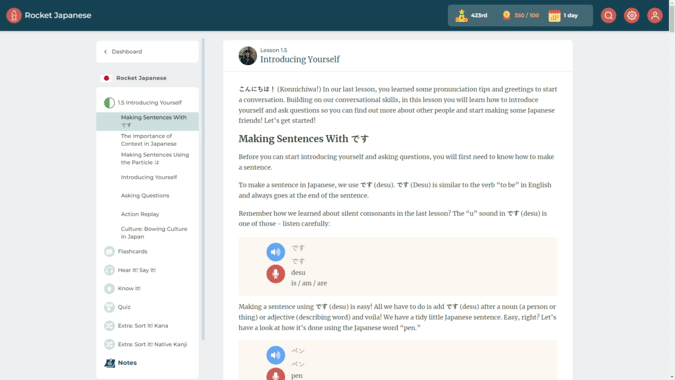
Rocket Languages Japanese language and culture lesson
Lastly, the third thing I want to highlight about Rocket is how they emphasize grammar instruction in their coursework. Grammar isn’t fun, but the reality is that it’s half the battle when learning a new language. Maybe even more than half the battle with a language like Japanese.
It’s not just about learning new vocabulary, and the main audio lessons in their program, as well as the supplemental “language & culture” lessons, are full of helpful teaching points and tips to help you internalize all the different Japanese grammar rules and principles.
The best drill by far: the chance to enter into the conversation you just listened to, but this time as one of the main speakers. I have to say, of all the language exercises I’ve done, this one is by far the most powerful. You’re truly experiencing an extended conversation and generating original phrases and sentences based on what you know, just like you would in real life. No other app gives you this opportunity.
Rocket Japanese drills are pretty diverse
To be honest, there aren’t many negatives we could find with Rocket Japanese. They even offer reading and writing lessons for Kana and Kanji, which no other apps really do. Add in survival kits covering basic vocab for everyday topics, like time and money, plus a mobile app that lets you access the entire course from any device, and Rocket really has it all.
If there is anything to knock, it’s just the price. Rocket only sells lifetime plans, and they are a bit pricier than other options on the market. Level 1, for example, costs about $150. However, in all fairness, those prices on their site are a little misleading, as Rocket Languages is almost always running some sort of deal or special promotion. So just make sure to check for coupon codes before buying.
Best App for JLPT (Japanese Language Proficiency Test) Prep
If you’re studying for the JLPT, from beginner N5 through to the advanced N1 level – you’ll want a Japanese language app that mirrors the exam’s structure: focused grammar, vocabulary, reading comprehension and listening.
Rocket Japanese is our top pick for JLPT preparation. Here’s why:
It offers in-depth grammar instruction essential for N5-N3 levels
The interactive audio lessons sharpen listening comprehension, a major part of the JLPT
The built-in Kana and Kanji modules support reading and writing fluency
Reinforcement drills are ideal for long-term memorisation of key structures
Unlike more casual apps, Rocket gives you the foundational building blocks needed to pass JLPT stages methodically – not just random vocab practice or gamified fluff.
While other apps like LingoDeer (N5/N4 grammar) and BunPro (SRS grammar decks) can be great supplements, Rocket Japanese offers the most complete one-stop solution to study for and pass the JLPT
As noted above, the second course on our best list is Pimsleur Japanese. The interesting thing about Pimsleur is that they’re the runner-up because their program is so much like the course from Rocket Languages.
For one, Pimsleur also builds their course around interactive audio lessons that use a guided conversation to help develop your listening comprehension and conversational skills. The lessons are even about the same length at a half hour long, so very similar.
Second, Pimsleur also reinforces their audio lessons with more typical drills and exercises like matching pairs and fill-in-the-blanks. Plus, they both use speech recognition software to give you feedback on your pronunciation.
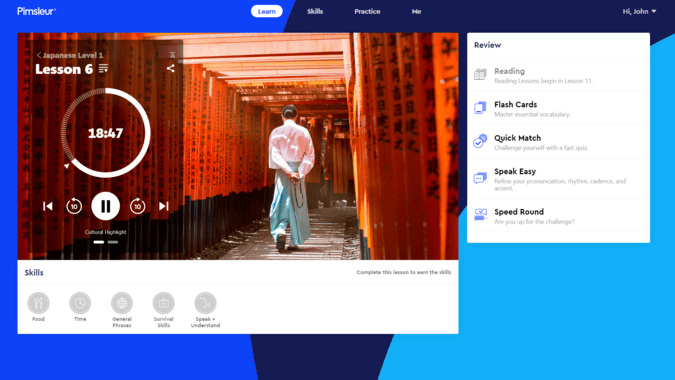
Pimsleur Japanese audio lesson
So overall, Rocket and Pimsleur are very, very similar. However, Pimsleur does differ from Rocket in a few ways, and there’s a reason we give Rocket Japanese the edge.
First, the Pimsleur lessons don’t use any transcripts with their audio lessons; it’s pure audio. Frankly, we really like the transcript. It makes it easier to follow along, see spellings of words, and digest the teaching points.
Secondly, the Rocket program allows you to go back and replay the mock dialogue from the audio lesson as one of the two fluent speakers for extra practice, which is helpful. Third, Rocket offers much more in-depth grammar instruction.
Altogether, these additional features just make the Rocket program feel a little deeper and more comprehensive. However, that’s not to say Pimsleur doesn’t have some advantages of its own.
For one, the Pimsleur audio lessons are equipped with a special driving mode feature so you can be productive with your time in the car and knock out lessons on your commute. I think that’s a major bonus.
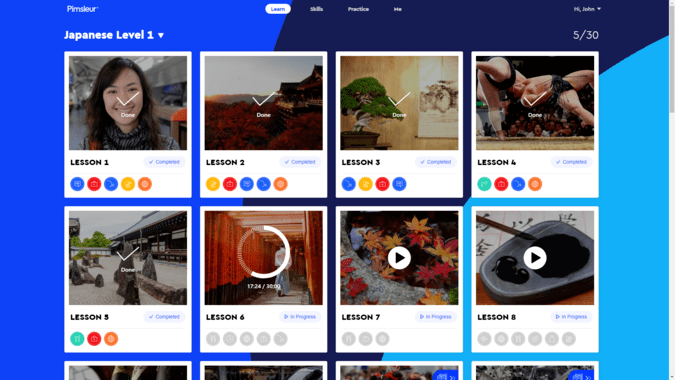
The Pimsleur Japanese dashboard
Second, I think the Pimsleur interface is better. It’s about the best user experience we’ve seen in language learning. And one important point for budget shoppers is that Pimsleur offers monthly subscription plans for about $20 per month, rather than one-time purchase plans like Rocket.
One more feature I have to call out: Pimsleur gamifies things just a little more than Rocket. Their Challenges and Rewards feature, for example, gives you a phrase in English and prompts you to say that phrase out loud in Japanese, without any hints. Get it right, and you earn points and badges, which is pretty motivating for certain kinds of learners.
Thus, if you want to take things slow and test out your course before fully committing, Pimsleur will be the cheaper option to start. Plus, Pimsleur even offers a free 7-day trial period, so you can try this course before dropping any money.
Why Rosetta Stone Makes Our Best Japanese Apps List
Our third pick for learning Japanese is Rosetta Stone (or Rosetta Stone Sapphire, as the latest 2026 version is called). Although we didn’t find Rosetta Stone’s lessons to go as deep as those from Rocket Japanese or Pimsleur, it does offer some unique advantages.
The Rosetta Stone learning method is all about immersion and imagery. Just about every practice exercise and teaching point in the Rosetta Stone Japanese program contains some sort of picture. Of all the more traditional Japanese language learning apps we’ve purchased and tested, it’s definitely the most visual.
Plus, the recently updated interface creates an even more aesthetic experience, with a dark modern look and more intuitive controls. Rosetta Stone Sapphire has heavily invested in their tech, with better progress tracking and more culturally relevant images added in.
Typical Rosetta Stone Japanese drill
Moreover, they combine this visual basis with a more immersive framework, where there is very little use of English. Rosetta Stone immerses you in Japanese with no translations and a bunch of visuals to replicate how you would learn in the real world if you were dropped into Japan.
Rosetta Stone hammers a variety of image-based practice drills which immerse you in the language.
The Rosetta Stone Japanese dashboard
Finally, Rosetta Stone Japanese does a great job providing you with lots of resources and extras. The Sapphire Studio gives you some unique AI tools for drafting work emails, practicing simple conversations through the Chat Missions, and generating flashcard sets and drills aligned to your personal interests. Other fun features worth mentioning: on-demand videos provide a different approach to learning, and the stories read by native speakers help you develop an ear for the language.
Bottom line, if you’re more of a visual learner, then Rosetta Stone should be a good match for your learning style. Plus, from a pricing perspective, the Rosetta Stone subscription plans are actually pretty affordable. The app costs around $10 to $15 per month, or $150 for their lifetime plan with a coupon code, which isn’t too bad.
LingoPie is not a conventional language learning program. There is no distinct learning path or set lesson plan. Instead, LingoPie is a video-on-demand platform that uses TV shows and movies to help you learn Japanese.
For learning Japanese specifically, this can be a great fit. One big reason why people learn Japanese is so that they can watch anime without subtitles. Don’t get me wrong; I’m not saying that’s the only use case for LingoPie. Not at all. However, if that is the reason why you’re learning Japanese, then this app is tailor made for you.
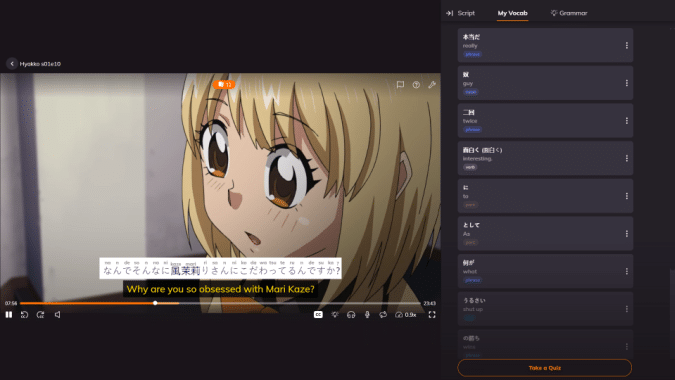
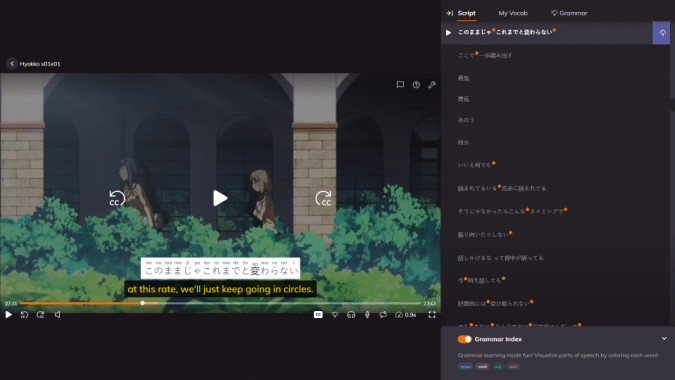
LingoPie is great for watching anime
Here’s how it works. LingoPie has a massive library of Japanese video content that they’re constantly expanding, and once you start watching a specific show or movie, there are color-coded subtitles in both English and Japanese. They’ve done a great job including something for everyone, with hundreds of new shows and movies added in 2025 and a YouTube integration that lets you import over trending language videos.
LingoPie doesn’t just give you subtitles, either. There are a ton of tools and features layered in to help you understand and learn. This includes playback speed controls, color-coded subtitles, loop settings, a grammar coach tool, a tool that auto-generates video-based flashcards, and a few other small features.
Overall, we were just super impressed with the LingoPie platform and learning tools. This is a lot more than just getting Japanese shows with subtitles.
LingoPie makes for a great supplemental tool also
Their content library is amazing; the tools they layer on are truly useful; and their subscription plans are surprisingly cheap (as low as $6 per month).
Thus, if you want a more authentic, immersive type of experience to learn, or you just want to supplement another app like Rosetta Stone to accelerate your learning, LingoPie is a great option.
One more Japanese course worth highlighting: Mondly, which is a solid budget pick. This isn’t the most in-depth Japanese course on the market, but if you’re considering super affordable options like Duolingo, Mondly gives you much more bang for your buck.
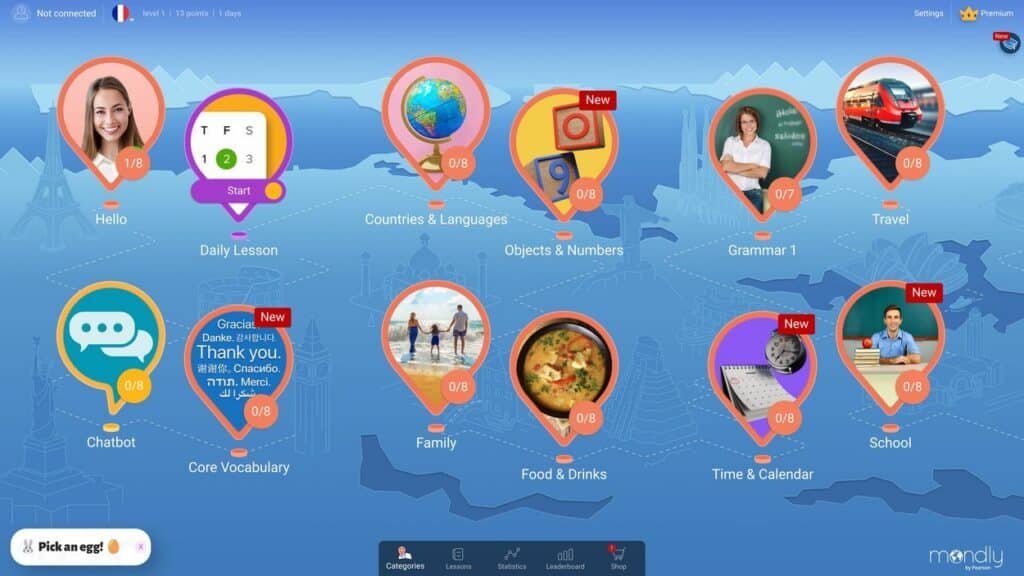
The Mondly dashboard
They offer a decent variety of practice drills so you’re not bored doing the same thing over and over, and everything is gamified, which makes vocab memorization actually fun. Lessons only take about 10 minutes to complete, which makes Mondly doable for anyone, and the accurate speech recognition tech helps you improve your pronunciation.
The biggest downside: Mondly doesn’t offer much speaking and listening practice, like Rocket or Pimsleur. It’s definitely a limited app primarily targeted at beginners, but if you’re just wanting to get your feet wet and see if Japanese is right for you, Mondly is a decent option, especially at about $5 per month.
What is the best app or online course for learning Japanese? It just depends on what level of fluency you’re trying to obtain, how much you want to spend, and what type of learner you are.
If you have a bit of a foundation in Japanese, are learning primarily to understand anime, or you just want to learn in an immersive video-based environment, then LingoPie is an awesome, non-traditional app. It’s also fairly cheap and makes for a great supplement. Our other budget pick is Mondly, which is a good introductory tool for beginners trying to decide if Japanese is something you want to commit to.
If you want more of a traditional language learning app, but that isn’t built on audio lessons, then Rosetta Stone is our pick for that. It’s a great program for visual learners that want a clear learning path with lessons that progress steadily.
However, if you’re looking for the most well-rounded app out there to learn Japanese, we really liked Rocket Japanese and Pimsleur. The audio lessons from both of these companies are just so powerful and important to developing you speaking and listening skills. In the opinion of our team, they are by far and away the best two apps for learning Japanese in the space, with Rocket Japanese having the edge over Pimsleur thanks to the overall depth and effectiveness of their coursework.
Ultimately, the single best product out there for learning Japanese would have to be Rocket. In our experience, Rocket Japanese offers everything you need to reach an intermediate to advanced level of fluency, especially if you’re wanting to achieve conversational proficiency.
FAQ
What is the best app to learn Japanese?
After reviewing a dozen different Japanese language apps, we believe Rocket Japanese is the best on the market. With audio lessons and in-depth reinforcement drills, it is the most comprehensive Japanese learning program.
How much do Japanese apps cost?
Japanese language apps range from totally free (like Duolingo) to $400+ for full blown Japanese courses.
How long does it take to learn Japanese?
The length of time it takes to learn Japanese is directly correlated with your input. Using a Japanese language app everyday, doing perhaps 20-30 minute of studying, it might take 6 months to become fluent at an intermediate level.
Are there any free apps I can try in 2025 to learn Japanese?
If you’re on a tight budget or just testing the waters, here are some of the top-rated free Japanese language apps:
Duolingo Japanese – Completely free, gamified lessons, good for beginners.
Tandem or HelloTalk – Free conversation exchange with native speakers.
NHK World Easy Japanese – Free public broadcaster lessons with grammar + audio.
JLPT Sensei – Free grammar and JLPT-focused flashcards and tips.
LingoDeer (Free Tier) – Offers a strong Japanese beginner module at no cost.
 Editor's Choice