Test Prep Insight is reader-supported. When you buy through links on our site, we may earn an affiliate commission. Learn more
Blueprint vs Kaplan LSAT
Determine which LSAT prep course is better for you in this comprehensive comparison of Kaplan and Blueprint
After using and reviewing the LSAT prep courses from Blueprint and Kaplan, we have some serious and detailed thoughts on how the varying strengths and weaknesses of each program would impact different types of learners. In this comparison, we cover how each company’s prep materials stack up, so you can make an informed decision as to which LSAT course is best for you.
Given this is a lengthy, comprehensive comparison, we’ve included jump-to links above for easy navigation.
Video Review: Which LSAT Prep Course Is Better?
In the above video, team member John provides our team’s thoughts on how these two LSAT prep courses stack up. Please keep reading for more detail and analysis.
Should You Go with Kaplan LSAT or Blueprint LSAT?
Kaplan is our top pick for LSAT prep due to their really organized learning plan and abundance of official practice materials. Here’s who should choose Kaplan:
Structured learners wanting an in-depth, step-by-step curriculum with tons of resources
Anyone who prefers live instruction or needs set deadlines to stay accountable
People who learn best by reading high-quality written review guides
Blueprint shines for their pre-recorded video instruction, which works well for independent learners. Here’s who we recommend Blueprint for:
Visual learners who like super engaging recorded content
People looking for the most efficient study approach and great adaptive analytics
To compare the LSAT courses from Blueprint and Kaplan, let’s break down the strengths and weaknesses of each program. Let’s start with the major advantages of using Kaplan to help you prepare for the LSAT.
Our Analysis of the Kaplan LSAT Study Materials
Kaplan doesn’t leave anything to chance; at first, you’re almost overwhelmed by the sheer volume of study materials. There are literally hundreds of hours of lessons, assessments, practice problem tests, drills, and problem explanations.
However, there’s clear logic behind the structure, and it works. Kaplan’s course curriculum is clearly designed by experienced teachers, and it has been perfected over decades. Their learning sessions closely mirror the different sections of the LSAT and are further broken down into units with their own video lessons, assessments, and additional coursework.
Whether you choose the On Demand Course or the Live Online Course, Kaplan provides 30+ hours of core lesson instruction. Plus, you get over 60 hours of video content through their LSAT Channel.
The LSAT Channel is a key feature of Kaplan’s study materials. It provides supplemental video lessons that drill down into more complex concepts and problem types.
Example Kaplan LSAT video lecture
Personally, I found all of Kaplan’s study materials to be extremely well-designed and incredibly detailed. The video lessons generally last about 20 to 30 minutes. They alternate between showing an expert instructor who talks you through the material and a digital whiteboard marked up with notes, highlights, and constantly changing graphics to illustrate what you’re learning.
The videos are genuinely insightful and dynamic, and they provide solid actionable strategies.
In addition to the core curriculum, Kaplan offers a practice library full of advanced resource material based on past official LSAT questions designed to help you master advanced subjects and problem types.
Throughout the coursework, Kaplan is constantly assessing your progress. You are required to take four full-length diagnostic tests under LSAT exam-like conditions.
Following each test, you receive a “Performance Report” that provides detailed feedback outlining where you performed well and where you might need a little additional help.
On top of that, Kaplan provides you with access to every official practice question released by LSAC, the makers of the exam. This means you’re getting the most realistic practice work out there, so you shouldn’t be surprised on test day.
The Kaplan LSAT channel
As with most major LSAT prep course providers, every Kaplan student receives a detailed digital review book. The books closely follow the course lessons and provide additional practice questions and drills. They even include tools for note-taking, bookmarking, and highlighting.
I found the books to be thoughtful and well-written, and a helpful complement to the course lessons. If you prefer flipping through a physical review book, Kaplan also lets you order hardcopy versions of their books at an additional cost. For the record, Blueprint no longer offers printed prep books for its students, so this is a clear advantage for Kaplan.
The biggest highlight of Kaplan’s LSAT prep course is their live classes, which I believe are the best in the industry. There are several reasons for this.
First, the lesson plans for each live class are incredibly efficient and thoughtfully designed, cutting straight to the core concepts you need to master, efficiently and without filler. Second, the instructors are outstanding – they know Kaplan’s teaching framework and strategies inside and out and have a knack for breaking down even the toughest concepts in an easy-to-understand way.
Third, the live classes are seamlessly integrated with the rest of the curriculum, so everything, from the classes to the books and assigned practice work, fits together in a cohesive, logical progression.
A look at the Kaplan LSAT Channel’s offerings
Lastly, the class sizes are small, typically fewer than 10 students, which creates a workshop-like environment that fosters deeper learning and personalized attention.
If live classes are going to play a central role in your study plan, whether because you prefer guided instruction or value the accountability that comes with them, Kaplan’s approach gives them a clear edge over competitors like Blueprint.
This combination of interactive teaching and excellent written materials appeals to students who prefer a classroom-style approach and want reliable study resources alongside online lessons. If you’re a big reader or more of a text-based learner, just know that Kaplan’s digital books are some of the most thorough guides out there.
Kaplan LSAT Pricing
Kaplan’s LSAT courses generally sit in the mid-to-high price range, with self-paced packages, live online classes, and in-person options available. The key value lies in the structure. Students get a fixed timetable, exceptional review books, and Kaplan’s higher score guarantee.
For students who want clear milestones and official LSAC practice materials included in the price, Kaplan delivers solid value compared to more stripped-down competitors.
Now that you have a better idea of the areas in which Kaplan wins over Blueprint, let’s turn the tables and discuss the major advantages of using Blueprint to help prepare you for the LSAT exam.
Our Assessment of the Blueprint LSAT Prep Materials
Blueprint’s self-paced course is anchored by hundreds of short video lessons. These videos are purposefully presented in a very unique style – to be highly engaging.
They’ve designed the videos in this manner with the goal of holding your attention, and thus improve the learning experience and retention of the course material.
In this respect, they exceeded my expectations. I found the videos to be smart, highly entertaining, and presented in a clean format. Instructors appear on screen as graphics, notes, and cartoons appear around them.
These videos make for an interesting learning experience. The video lessons are then followed in the study materials by assessments and quizzes, detailed homework assignments, drills, and practice problems.
Blueprint LSAT video lesson example
The video lessons, assessments, and homework methodically break down all the complex concepts in great detail. Blueprint also lets you customize explanations to your learning preference.
Overall, I found the quality and quantity of Blueprint’s primary study materials to be some of the best of any LSAT prep course we have reviewed.
Blueprint’s classroom coursework offers students 12 virtual classroom lessons, meeting two days per week, with two of Blueprint’s LSAT instructors. In addition, there are several proctored exams.
I thought the instructors were excellent at analyzing complex concepts and problems, all while keeping the lesson fast-paced and light. They would often break away to speak about different law schools, career goals, and other questions posed by students.
Like Kaplan, Blueprint connects students to the LawHub program, where you get access to official past LSAT practice tests.
Blueprint LSAT problem review
Studies show that practicing on official past LSAT exams leads to greater relevance and better scores. In this regard, Kaplan and Blueprint are equal – although only Kaplan provides official LSAC practice questions in their Qbank as well.
After every practice exam, Blueprint also provides students with a detailed score report. This tool breaks down how you performed on every component of the test and flags where you need additional work.
Through their analytics, not only does Blueprint know what problems or questions you got wrong; they know why you got them wrong. I found such feedback to be extremely valuable.
Blueprint Adaptive Practice and Analytics
Their system tracks your performance across sections, then generates targeted quizzes and assignments to shore up weak areas. Visual dashboards make it easy to see progress at a glance, while the adaptive engine ensures your study plan evolves with you. For students who want personalized, insight-driven prep, Blueprint’s analytics are a major advantage over more traditional programs.
Blueprint uses a proprietary learning platform to tie the whole user experience together. The platform uses an advanced algorithm to produce the most optimal learning methodology and schedule for each student. The platform captures data on every interaction with the course material and analyzes your performance against dozens of metrics.
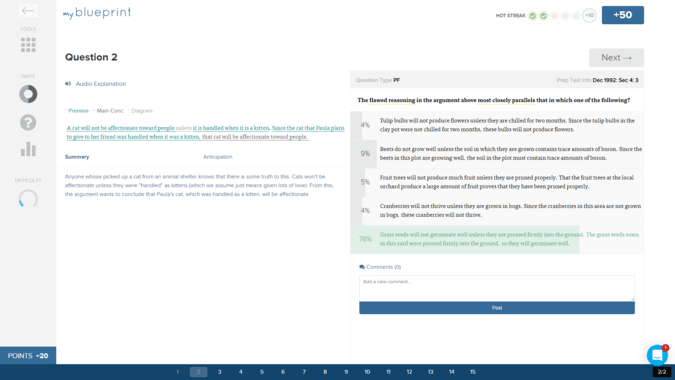
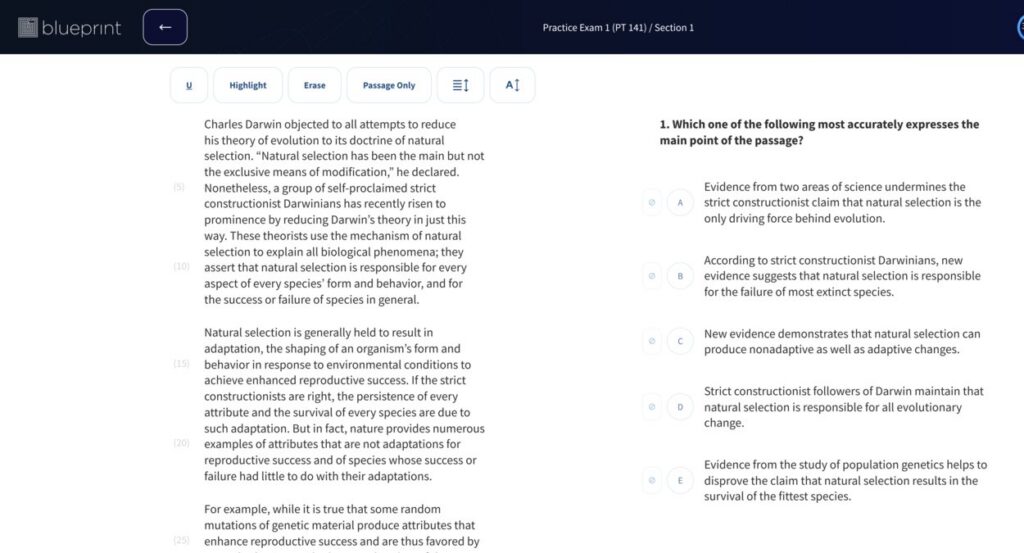
Blueprint LSAT practice question
Overall, combining Blueprint’s quality content with its learning platform makes for one of the most user-friendly experiences of any LSAT prep course.
The video lessons are based on the idea that test prep can actually be entertaining. In essence, that you learn and retain more when you’re having some fun.
The video lessons from Blueprint are top-notch
In my opinion, Blueprint’s cutting-edge video production actually makes the learning experience enjoyable. The videos roll through a series of dynamic notes, images and diagrams, are fast-paced, and use game-like features and other software tools to keep your attention throughout the entire video lesson.
Their LSAT video instructors are masters at making dense and intimidating material actually understandable. Blueprint has built their reputation on the ability to help students understand very complex material, and their video lessons definitely enhance that goal.
Deciding between Blueprint and Kaplan for the LSAT course isn’t easy. They both excel in different ways, appealing to distinct types of learners. Kaplan is best for students who want structure, accountability, and the reassurance of a fixed study schedule with clear milestones.
Blueprint, on the other hand, is best for visual learners who thrive on interactive lessons, adaptive analytics, and a flexible learning pace.
Overall though, I give the edge to Kaplan. They provide the most realistic practice materials in the industry, along with some of the best review books you can find. If you’re looking for a highly structured yet engaging online course with both engaging and efficient materials, go with Kaplan for your LSAT prep.
Which LSAT prep course is better, Kaplan or Blueprint?
In my opinion, Kaplan has a slightly better LSAT course given the company’s engaging and intimate live classes. With that said, it is a very close call. Some people may prefer Blueprint depending on the type of learner you are (e.g., visual).
Which LSAT prep course is more affordable, Blueprint or Kaplan?
Both Blueprint and Kaplan offer several different LSAT course options that are very similar in terms of pricing. However, the companies do offer special promotions regularly, so the answer to which course is cheaper largely depends on timing.
Do Blueprint and Kaplan offer LSAT score guarantees?
Yes, Blueprint and Kaplan both offer higher score guarantees for students. Keep in mind, there are conditions and qualifiers to those guarantees.
Is Kaplan LSAT good for live classes?
Yes. Kaplan’s LSAT live online program is well-structured, with a fixed timetable, experienced instructors, and digital prep books. Classes are interactive and designed to keep you accountable week to week. For students who learn best with scheduled sessions, homework assignments, and physical study resources, Kaplan’s live classes remain one of the most reliable options on the market.
 Editor's Choice