Test Prep Insight is reader-supported. When you buy through links on our site, we may earn an affiliate commission. Learn more
Kaplan LSAT Review
Our all-encompassing review of the Kaplan LSAT prep course
When it comes to LSAT test prep, Kaplan is one of the premier names in the industry. Their course was designed by an army of LSAT experts, and they offer a boatload of resources. But does a prestigious name, size, and an abundance of resources mean this course is right for you? We take a close look at the Kaplan LSAT prep course and evaluate all of its features in this review, so you can make a more informed decision on whether it fits the bill for you.
Since this is a fairly detailed and lengthy review, we’ve added helpful jump-to links above for quick navigation.
Video Review: Is Kaplan LSAT Worth It?
In the video above, Lara from the Test Prep Insight team gives our full Kaplan LSAT review. She walks you through the different Kaplan LSAT course options, covering pricing, study materials, practice tests, and overall quality. If you’ve been wondering if Kaplan LSAT is worth it, then this video and our review below highlight the key pros and cons of their LSAT prep options. For more detail, be sure to continue reading our full written review below.
Is Kaplan LSAT Prep Worth It?
In our team’s opinion, Kaplan LSAT is worth it, as they give you top-notch live classes, some of the best written material out there, and more study resources than you could possibly need. Kaplan has put together a one-stop offering that combines in-depth content coverage with lots of realistic practice material, plus plenty of personal support.
Packages start at around $900, although you’ll spend more like $1,300 to about $1,700 for the live class
Kaplan claims that students who complete their course see an average 15-point score increase
My favorite features are the LSAT Channel for live and pre-recorded workshops that give a deep dive into any topic, and the engaging video lessons that break everything down
Is Kaplan LSAT Prep Right for You?
Here’s who Kaplan is a good fit for:
People who want maximum study material. Kaplan’s course pairs 30+ hours of core lessons with 60+ hours of supplemental LSAT Channel content, plus access to every officially released LSAT question.
Personalities that thrive with structure. The Study Plan breaks coursework into six core sessions with clear units, so you’re never guessing what to do next.
Anyone who wants live instruction and accountability. The Live Online and In Person courses put you in smaller class sizes with two instructors per session and real-time support.
Those looking for long-term reassurance. Every package includes Kaplan’s Higher Score Guarantee.
Learners on a tight budget, on the other hand, might consider looking elsewhere. Kaplan’s pricing runs higher than options like Magoosh, so it’s worth weighing the cost against how much structure and live support you actually need.
Evaluation of the Kaplan LSAT Coursework
I spent several weeks working through the Kaplan LSAT prep course, and I saw for myself exactly why the program has earned a 4.5-star Trustpilot rating.
The first thing that stood out to me when I logged in was the sheer quantity of prep material. The step-by-step lessons gave me a clear place to start, but I could also dive into any of the additional resources right away if I wanted to first take an assessment, start reading through the prep book, or jump into some practice problems and explanations. There are hundreds of hours of prep work to complete, so I knew I wasn’t going to run out of high-quality material.
When I review LSAT prep courses, the quantity of study material is always a major factor that I look at (as some courses are very light on instructional content); however, there is no way you can complain about the amount of study material provided by Kaplan.
Whether you’re taking the On Demand, Live Online, or In Person Course, the Kaplan LSAT course offers over 30 hours of core lesson instruction.
Now, I know that doesn’t sound like much, especially when compared to Princeton Review, which offers 65 hours of live instruction. But here’s how I see it: the core curriculum is supplemented by over 60 hours of additional video content through Kaplan’s LSAT Channel (more on this below).
So Kaplan really offers more than 100 hours of total instruction, which is astonishing. Yet, I like how they separate the core work from the optional work so you don’t feel the pressure of having to do it all. Plus, the analytics told me exactly which drills I needed to do based on my strengths and weaknesses, which gave the course a more personalized approach. Honestly, by the end of my first week I’d stopped checking the syllabus and just let the dashboard tell me where to go next, which, for someone who usually over-plans everything, felt like a small miracle.
One of Kaplan’s video lectures
The main course curriculum (which Kaplan calls its “Study Plan”) is broken down into six major core sessions, with those core sessions further broken down into units based on problem types and concepts.
The core sessions were fairly simple for me to work through. I mostly watched engaging video lessons, took a few assessments, and spent time working through practice problem sets to test my understanding. For me, this structure was highly effective. Constantly putting what I was learning into practice helped the content in the video instruction click, and being able to instantly see where I was getting mixed up meant I was catching any gaps in my understanding right away.
If you take the On Demand Course, I think the core video lessons are well designed and incredibly detailed. When you click on them, they appear in a new browser tab and are broken down into shorter video segments.
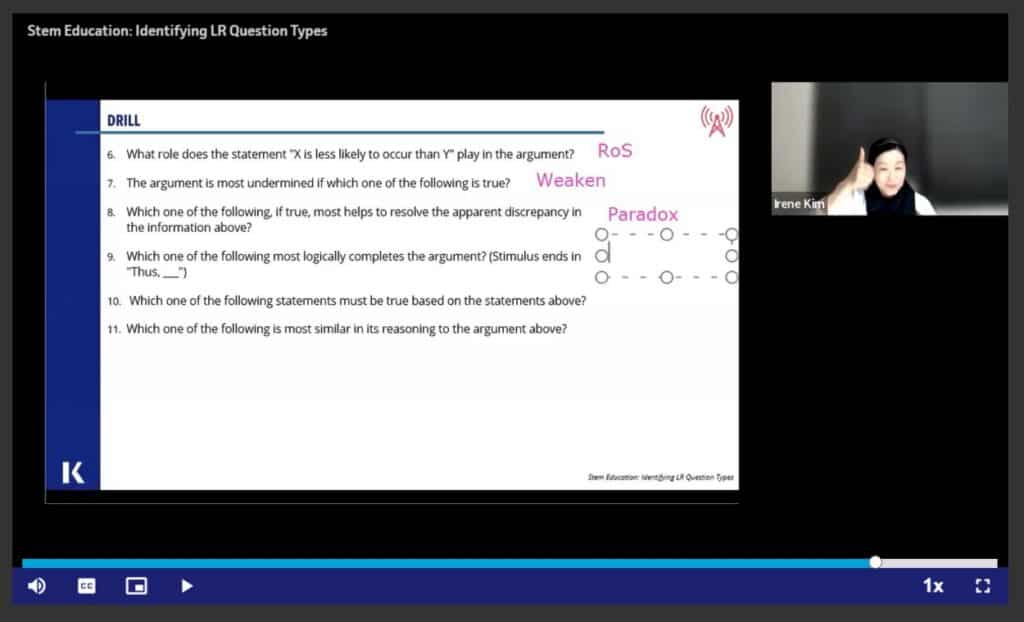
I could speed up, slow down, or jump ahead to a segment that is further along. The video lessons themselves alternate between an instructor who talks you through the lesson and a digital whiteboard that illustrates each concept with notes, highlights, and constantly changing graphics.
Another look at a Kaplan video lecture
Overall, I found the lessons to be genuinely insightful, and I took away a lot of solid actionable strategies. The instructors clearly know their stuff and chose great practice problems to exemplify their points, making it easy for me to understand complex concepts, like necessary versus sufficient conditions.
That said, my take on the online instructors was that they weren’t the most exciting individuals, particularly when compared to some other test prep companies’ instructors (like Blueprint LSAT). But “fun factor” aside, my instructor, Ged Helm, was obviously really knowledgeable and passionate about the LSAT. Plus, all of the instructors scored in the 99th percentile, and they’re very experienced at walking students through complicated reasoning.
One of my favorite new course features is Kaplan’s Interactive Practice. Here’s how it works. Instead of simply throwing you into review questions you have to solve entirely on your own, the course first provides a more guided walk-through where you’re clicking through a module of real LSAT questions that push you to apply the methods you just learned in the video instruction.
This feature provides a nice balance of critical thinking and structured support. I had a chance to first type in my own answers into the text box, but I could also click on different parts of the screen for tips and step-by-step help with solving each problem. A pop-up window than gave me instant feedback on my response, helping me understand not only what the right answer is but how I was supposed to get there.
No one else offers this type of personalized coaching as you learn to tackle each type of problem. To me, it’s like having a driving instructor in the passenger seat, talking you through each turn and transition until you’re ready to steer independently.
A pop-up message in Interactive Practice after clicking the wrong answer
In addition to the core instruction, Kaplan offers a “Practice Library,” which includes:
Assessments designed to help you master certain subjects and problem types
Timing drills
LSAT practice exams
This is where you really get your money’s worth from Kaplan, in my opinion.
A sample LSAT practice question from Kaplan
This section of the course is full of practice material that will keep you busy for literally hundreds of hours (if that’s what you want). The material is spot on, as it’s built entirely on official LSAT questions.
Plus, I liked the diversity of additional prep resources in this section. I never got bored and could bounce back and forth among the problem types.
To accompany the practice problems, Kaplan provides you access to explanations of every LSAT question ever released.
Although explanations appear for each practice problem that you work throughout the coursework, you can also download PDFs of all the explanations for a given practice set in one easy-to-locate place.
I particularly liked this feature for offline study, as I coul print it out and haul it along with me to kill time during a flight.
Overall, the Kaplan LSAT prep material is rock solid. The quantity of test prep study material is unparalleled among the courses I’ve reviewed, and the quality is top-notch.
Apart from the few small gripes I had above, the overall quality of Kaplan’s coursework is very strong, and I give them a high grade for core content.
Kaplan LSAT Prep Books
To supplement the live and digital lessons, every student that purchases a Kaplan LSAT prep course gets access to digital copies of the course prep books, with the option to purchase physical copies as well. I spent a lot of time marking up the interactive digital textbook with notes, bookmarks, and different colored highlighting. For me, having a way to track my thought process right on top of the text kept me engaged with the reading, instead of simply skimming or zoning out. The books align with the course lessons and provide strategies on each section, practice questions, and other drills.
I moved back and forth between the lesson books and practice problems constantly, which kept me engaged in active learning the whole time. You have to think about how you learn best, however, to make sure you’re getting the right textbook for you. If you’re the kind of person who likes to write out notes by hand and dog-ear the pages, the physical review book is worth the extra investment.
The Kaplan LSAT Channel
As I noted above, Kaplan’s LSAT Channel is a line of supplemental video lessons that take a deeper dive into certain concepts and problem types, with new videos released almost nightly. To me, this is arguably the best feature of the Kaplan LSAT course.
The instructors appear in the corner of the screen, giving their specialized daily lesson, with a digital whiteboard and large chat feature for students to interact, ask questions, or answer a teacher’s live poll.
I found these videos (which are streamed live and then made into on demand videos after the fact) to be pretty helpful when I needed a deeper dive on a particular subject, like parallel reasoning questions. Plus, I used the cool filter feature for the pre-recorded sessions to find LSAT Channel videos that fit exactly what I needed each day, whether that was a certain topic, level of difficulty, or even my preferred teacher.
Course Options & Pricing
Feature
On Demand
Live Online
In Person
Tutoring + Live Online
Price
$900
$1,300
$1,900
$2,000+
Core video lesson hours
30+
30+
30+
30+
LSAT Channel hours
60+
60+
60+
60+
Live class hours
None
24
24 (in-person)
24 + 10 hrs tutoring
Official LSAT practice tests (via LawHub, $120 not included)
59+
59+
59+
59+
Private tutoring
Add-on ($150/hr)
Add-on ($150/hr)
Add-on ($150/hr)
Included (10+ hrs)
Standard access period
4 months (extend to 6 or 12 mo. for an additional $200/$400)
4 months
4 months
4 months
Higher Score Guarantee
✓
✓
✓
✓
Kaplan offers four different course options from which to choose, each varying in format, price and features. Their packages include:
On Demand Course
Live Online Course
In Person Course
Tutoring + Live Online Course
The On DemandCourse is Kaplan’s starter, self-paced package and is reasonably priced at just under $900. This course includes most of the same materials that you will get with their more expensive options, such as video lectures, practice questions, simulated exams and more, but without any live class work or tutoring.
The Live Online Course is Kaplan’s go-to, flagship offering and costs about $1,300. This includes everything the On Demand Course does, but with 24 hours of live class sessions in a virtual classroom. While the accountability of live sessions is helpful for staying on track, you can easily make up any missed sessions.
And for those of you looking for personalized one-on-one instruction, Kaplan also offers a 10-hour Tutoring + Live Online Course starting at around $2,000.
Kaplan LSAT Channel session
The In PersonCourse is the exact same as the above-mentioned Live Online Course, but meets live in-person in a more traditional classroom environment. This package costs right around $1,900.
Though seemingly expensive, these price points are on par with other high-end LSAT prep companies, and can often be found on sale for less.
Most importantly, we found them to be right in line with the quality of course that you get. But if you are looking for something more budget-friendly, check out our review of Magoosh.
Kaplan LSAT Practice Tests
Similar to just about every other LSAT prep company out there, Kaplan utilizes LSAC’s LawHub subscription program to give you access to all official past LSATs.
This means that you will have access to 59+ real LSATs. While this is about the same benefit you get with most other prep courses, it is the best you can get.
The Kaptest Study Plan spells out exactly what to do each day
There is no better form of practice than using real LSATs under exam-like conditions. Now, there is one thing to note here: Kaplan doesn’t cover the $120 subscription cost, which is kind of a bummer. Still, I can’t overstate the value of these practice tests. They’re definitely worth the investment.
In addition, as part of Kaplan’s required study plan, you must take 4 full-length LSAT practice exams in the official test environment. After working through the program, I understand why. This is where I really figured out how to work on my pacing, and where I finally faced and worked through my test anxiety so I wouldn’t be crippled by it when I sat for the real thing.
Following each practice LSAT, you will get your test results in the form of a “Performance Report,” which gives you targeted and detailed feedback about where you performed well and where you, well, have opportunity for improvement.
I think this feature is of great benefit for zeroing in on where you need work. Almost everyone will need help in at least one particular type of problem, and the Performance Report will call that right out for you. Finding out that I was losing points due to confusing correlation and causation led me to spend more time working through the difference and zooming in on that specific question type until I was consistently getting those answers right.
The Performance Report provides a detailed analysis of your performance by question type and difficulty
In addition to the Performance Reports, Kaplan also provides you with personalized recommendations on where you need supplemental work. These recommendations come from Kaplan’s internal analysis of practice tests you have taken, as well as every single in-lesson practice problem and drill you encounter.
My personal opinion is that this additional personalized recommendation is helpful, but also somewhat overwhelming.
Unless you’re really strong on a subject, it’s going to recommend you give it more work. In theory, this is great and something I’d want to do, but with all of the material Kaplan already has you working on, it became a bit of a burden. I found that simply keeping up with the main coursework was already maxing out my calendar most days; I was only getting to the extra material when I had a few extra hours available on the weekend. If the recommendations were a little more narrow and sensitive to your true weaknesses, this would be a game changer.
The Kaplan LSAT prep course user experience and interface is just about what you would expect for a high-end course from a test prep behemoth: an intuitive and easy-to-use system that just about anyone can work.
This interface was obviously designed for the masses, with its clearly delineated sections and dropdowns. I say this as a good thing; I didn’t even have to think or hunt for any of the tools I wanted, as every feature was always right there in front of me.
Some prep courses offer a digital first approach with a fancy mobile app, snappy responsiveness, and a clean, modern look. Kaplan is not that. Rather, Kaplan has an above-average digital platform with good video quality, an easily navigable dashboard, and a clean appearance.
If I had to knock one thing, it would be that every time I clicked on a video lesson, assessment, or PDF, it opened in a new browser tab. By the end of a long study session, I had 20 different tabs open, which got a little annoying at times. I’d prefer the module simply appear within the same browser.
Kaplan LSAT Online Class Experience
Kaplan’s flagship Live Online Course offers a chance to meet with your instructor face-to-face online and engage with other students in a virtual class setting. For those of you that need structure in a study schedule or retain information better when taught in a live setting, this is the option for you.
My instructor was very enthusiastic and held us all accountable. If you didn’t get your homework done, he let you know he didn’t like that. I mean, he didn’t get on your case, but he’d joke around with you about it a little, just enough that you didn’t want it to happen again, which is the exact type of accountability that I personally need.
Now, I should point out that technically, there are always two instructors leading each session: one who leads the primary lesson, and a second expert who’s constantly answering questions in the chat. This efficient design really works for keeping class time moving forward while taking care of each student’s individual needs. I’m the kind of person who has a lot of questions but feels awkward interrupting class to draw attention to myself, so the chat feature worked really well for me. If I didn’t follow one of the logical steps within a certain problem type, I’d just send a quick message asking for a little clarification on how that step worked, and I always got a really clear breakdown pop up right away.
The pace of the course is very doable, though there were a couple sessions that were a bit of an overload. I would say that the homework assigned after each Kaplan LSAT class took roughly an hour to an hour and a half to complete.
All in all, if you need a committed study schedule and to be held accountable, or just plain learn better in a live environment, I’d strongly recommend the Kaplan LSAT Live Online Course.
Extra LSAT Resources from Kaplan
Outside of the resources I’ve described above, including the lessons, drills, practice tests, explanations and more, Kaplan doesn’t offer too much in the way of extracurricular resources.
Some other test prep companies like Blueprint LSAT and Magoosh offer some cool supplemental tools like law school admission estimators and bonus readings, but Kaplan mostly sticks to their tried-and-true material. The main coursework was enough for me, but if you’re wanting extra help with admissions, you won’t get that bundled with your Kaplan package.
The only real supplemental Kaplan tool worth mentioning would be the practice estimator tool. Basically, Kaplan takes your initial score assessment and runs it through their algorithm to show you how much studying you will need to do to achieve a certain score.
For example, if you want to score a 170, based on your initial baseline score, it will tell you that you need 120 hours’ worth of prep with their program (this is just a hypothetical). But it’s a handy tool for mapping out your study timeline.
To be honest though, I didn’t really mind that they didn’t offer many extra add-ons. Between the lessons, homework, LSAT Channel videos and more, I had plenty to do without any additional resources. Not to mention, some of the resources others offer have a coolness factor, but you only end up using them once or twice anyway.
Kaplan LSAT Tutoring: Our Thoughts
Although I didn’t hire a Kaplan teacher for some private tutoring, the option was available. All course options give you the opportunity to add on one to five hours of private tutoring during checkout.
In terms of price of tutoring, when compared to other test prep companies, Kaplan’s private tutoring rate is extremely reasonable at about $150 per hour.
Other courses we have reviewed offered supplemental tutoring at prices that ran $200+ per hour. Thus, at around $150 per hour, Kaplan is very affordable, particularly with just a few hours needed to lock in that rate.
And with respect to quality, Kaplan instructors are top LSAT scorers themselves and generally great communicators. I would not hesitate to engage the instructor I had for my in-class course, and would expect others to be of similar quality.
Online Content Access Period
Kaplan’s standard On Demand Course provides you with 4 months of online access, which for most students should be plenty sufficient to prepare for the LSAT.
However, if you want, there is the option to extend the content access period during checkout for an additional fee. For example, to extend to 6 months, it costs an extra $200, or you can extend to 12 months of access for an additional $400.
Does Kaplan Have a Mobile App?
Your Kaplan content is mobile friendly and can be easily accessed on your devices, however, there is not currently a Kaplan mobile app for LSAT studies.
That’s one way I’d like to see Kaplan improve their offering. I’m someone who’s frequently on the go, so it would be nice to have a targeted app specifically designed for mobile. Still, I will say, the main course is easy to access from any device on the go.
Does Kaplan Have a Score Increase Guarantee?
Kaplan does have a money-back guarantee if your score does not increase. If you complete your Kaplan program and do not score higher on your test, you have two options. You can either (1) request reactivation of your program within 60 days, which will give you an additional 12 weeks of free access to online resources, or (2) you can request a tuition refund.
Kaplan’s Refund Policy
If your circumstances change, or if you simply change your mind, Kaplan will refund your program tuition. But don’t delay. For a full refund, you have to request cancellation within 3 days of your purchase date. Cancelling 4-7 days after your purchase date gets you only 75% of your program tuition back. No refunds will be given for requests made after 8 days.
Kaplan LSAT versus Competitors
Here’s how Kaplan stacks up against other popular options, and who each company is best for.
Kaplan LSAT vs Blueprint LSAT
Kaplan has the more systematic curriculum and course framework, and we’re more impressed with their live class. There’s nothing like having two expert instructors handling both the content and questions at the same time. What we like about Blueprint is their dynamic video lessons, which include tons of visuals and an engaging delivery. Blueprint also has better analytics for making your study sessions as efficient as possible.
If you’re more of a structured personality wanting live interactions with instructors and accountability, choose Kaplan. If you’re a visual learner or you have a short window of time before your test date, go with Blueprint.
These are two of the most comprehensive LSAT programs out there, so they’re both good options for anyone who likes having tons of in-depth study resources to draw from. For independent learners who want to save money by taking the On Demand course, Kaplan has more engaging video lessons and a better review guide.
Princeton Review wins for having more practice tests and a longer content access period. If you want to spend a full year reviewing or you learn best by simulating the real thing, Princeton Review will be a good fit.
Kaplan offers a live course option that Magoosh doesn’t match, so Kaplan is better for anyone who wants more of a classroom experience. We also found the Kaplan video lessons to be more engaging, since you’re watching an actual instructor, whereas Magoosh’s videos feel more like watching a PowerPoint presentation. Kaplan is the pick for visual learners, people who need a little hand-holding, and anyone who wants a course with more of a personal touch.
Magoosh is our top recommendation for learners on a budget. They offer unbeatable value, especially when you consider how many practice questions, practice tests, and high-quality resources they throw in. Magoosh is good for people who learn by doing, since their in-depth problem explanations all come in both written and visual form.
We see Kaplan LSAT as the superior prep program, considering how many extra high-quality resources Kaplan provides: more study material, better written review books, more engaging video lessons, and actual deadlines to keep you on track. Most learners wanting in-depth, step-by-step review should choose Kaplan.
LSAT Demon is definitely more affordable, and the daily live classes provide a nice opportunity to check in whenever you have a quick question. But Magoosh is still our value pick, since they also give you timed practice tests and a score guarantee at a comparable rate.
Kaplan is the stronger pick for serious learners who want live classes and 60+ hours of LSAT Channel content. We see LSATMax as more of a convenience option, but it doesn’t match the depth that Kaplan gives you.
LSATMax’s strength is its mobile-first platform: bite-sized video lessons, flashcards, and full practice tests are all built to be done from your phone, which makes it a good fit for busy people looking for some on-the-go studying, but a lighter option overall when it comes to comprehensive review.
Verdict: Kaplan LSAT Prep Course Review
If you want to play it safe and know that you’re getting an LSAT prep course which will cover all the bases and get you the information you need, then this course is likely a great fit for you. It is the safe, conservative choice.
There are no frills or cool modern features that turn heads, but what you will get is an absolute ton of high-quality lessons, prep books, practice problem sets, drills, explanations, and practice tests, all designed by Kaplan’s team of LSAT experts.
Apart from a couple minor negatives, I give the Kaplan LSAT course a very high grade. I think that if you’re a student looking for a known commodity and you want a sure-fire score increase with no real risk, the Kaplan LSAT prep course is likely right up your alley. It’s a safe, solid choice.
The Kaplan LSAT prep courses range in price from around $900 for the On Demand Course all the way up to around $4,000 for their Law School to Lawyer Bundle.
Is Kaplan LSAT prep worth It?
Yes, Kaplan LSAT is worth it, as they combine tons of high-quality practice materials, some of the best textbooks out there, and live classes with small group sizes. The LSAT Channel also gives you unique workshops and pre-recorded sessions you can search through whenever you need extra work in a particular area.
Does Kaplan use real LSAT questions and tests?
Yes. Kaplan utilizes official, past LSAT material through a license with LSAC. This is more or less the same as other LSAT prep companies.
How much will Kaplan improve my LSAT score?
Kaplan is so confident in their LSAT prep materials that they offer a higher score guarantee. If you take the prep process seriously and complete the entire Kaplan course, our team would expect most students to achieve at least a 3 to 10 point increase, although Kaplan only guarantees that you will gain one point from your baseline score, unless you buy one of their premium packages with a higher score guarantee.