Test Prep Insight is reader-supported. When you buy through links on our site, we may earn an affiliate commission. Learn more
Kaplan Bar Review
Our in-depth evaluation of the Kaplan bar review course
When considering which bar review course to take, Kaplan is one of the first names that comes to mind. After all, they are one of the big three, right alongside Themis and BARBRI. With an appealing price point, included live online seminars, and a mountain of practice material, they have a lot going for them. But is this bar exam course right for you? We take a close look at the Kaplan Bar Review course and grade out all of its features in this detailed guide.
Given that this is a detailed review which covers a multitude of topics, we’ve added jump-to links above for easy navigation
Video Review: Is Kaplan Bar Review Worth It?
In the video above, Lara from the Test Prep Insight team walks you through the major pros and cons of Kaplan’s bar review course. She covers everything from course structure and practice questions to live seminars, pricing, and how it stacks up against other bar prep options in 2025. Keep reading below for our full written review and final verdict on whether Kaplan is the right fit for your bar exam prep.
Kaplan Bar Review Cost
To kick off this review, I want to briefly discuss pricing, as this is one of the biggest selling points for Kaplan when compared against its two main rivals, BARBRI and Themis.
While other bar review courses have several options to choose from, Kaplan has just one – the Complete Bar Review course. Well, technically, that’s not true. Kaplan also has a secondary package called the Convenience Package, but it is very costly and really geared towards test takers who plan on taking the bar in several states.
For 98% of bar takers reading this post, the Complete Bar Review course from Kaplan will be the best fit. It is their flagship bar review course that includes everything in one package. This course costs about $2,850 full retail, although you can often get hundreds of dollars off with the right discount.
For reference, the comparable packages from Themis and BARBRI both cost about $3,000. So right off the bat, you’re saving at least $150. That might not sound like much, but if your firm isn’t paying for your prep, that’s a big deal.
Beyond the primary course itself, Kaplan offers a few supplemental add-ons. The Bar Review Plus package, which costs an additional $500, is a semester-long course you take before jumping into the bar review course with weekly sessions plus tons of quizzes and practice work to set you up for success. For an additional $1,000, the MBE JumpStart program provides you with a session with a local director of legal education, a comprehensive diagnostic, a personalized study plan, and four hours of one-on-one tutoring.
You can also opt for one-on-one tutoring as a standalone add-on. Five hours of tutoring and a personalized consultation with a bar expert who will help you assess your goals and personal strategy costs about $1,000, while ten hours costs about $1,900.
Evaluation of The Kaplan Bar Coursework
When evaluating bar review courses, you need to look at each prep company’s overall bar curriculum. This is the critical test (at least for us). Are the lessons engaging and comprehensive? Are the prep books balanced between detail and brevity? Is the practice work high quality?
These are very important questions, and should all be answered in the affirmative before dropping thousands of dollars on a course. And fortunately for Kaplan, they get a solid grade in every one of these categories (unlike their peers).
Honestly, not to let the cat out of the bag too early in this review, they are our favorite among the big three bar prep providers.
Kaplan’s bar review curriculum is undeniably thorough and high-quality. They have a massive team of licensed attorneys, in-house MBE experts, and knowledgeable instructors, and it shows.
The syllabus (which doubles as the online dashboard) serves as the backbone of the course. It directs you to all of your daily tasks and serves as a jumping off point for practice.
The hand holding and clear direction in this interactive, online dashboard was one of my favorite aspects of the Kaplan course.
Every day, you will be assigned 5-7 hours of work across several tasks. These daily tasks generally span four main categories – Learn, Practice, Review, and Catch Up.
Kaplan’s materials are both engaging and well organized
The “Learn” section of the daily lesson plan centers around your daily lesson. It covers a particular bar topic (such as Torts II or Crim Pro III), and gives you a printout of slides from the lecture plan, as well as fillable notes. The notes are essentially just an outline of the relevant material with additional space to make your own comments.
The “Practice” section then serves to reinforce what you learned in the “Learn” section. It consists of a series of quizzes, practice problem sets, and sometimes practice essays and performance tests. Working practice problems and reading problem explanations takes up a large chunk of each study day.
The “Review” section provides a recap of the day’s material through reading assignments, exercises online and in your course books, livestreams, and other functions. It is a valuable means of looking at the content from a different perspective and helping it to sink in.
Finally, the “Catch Up” section is simply there to give you time to wrap up other modules that remain unfinished. Inevitably, you will have days where you can’t get to all of the assigned tasks for one reason or another. It happens; don’t freak out. That’s where this function actually came in handy.
Those tasks carry over as incomplete and populate daily for you to finish if time remains. I always hated seeing these “unfinished” assignments, worried that I was missing something that could be critical, so I never let them hang around for long.
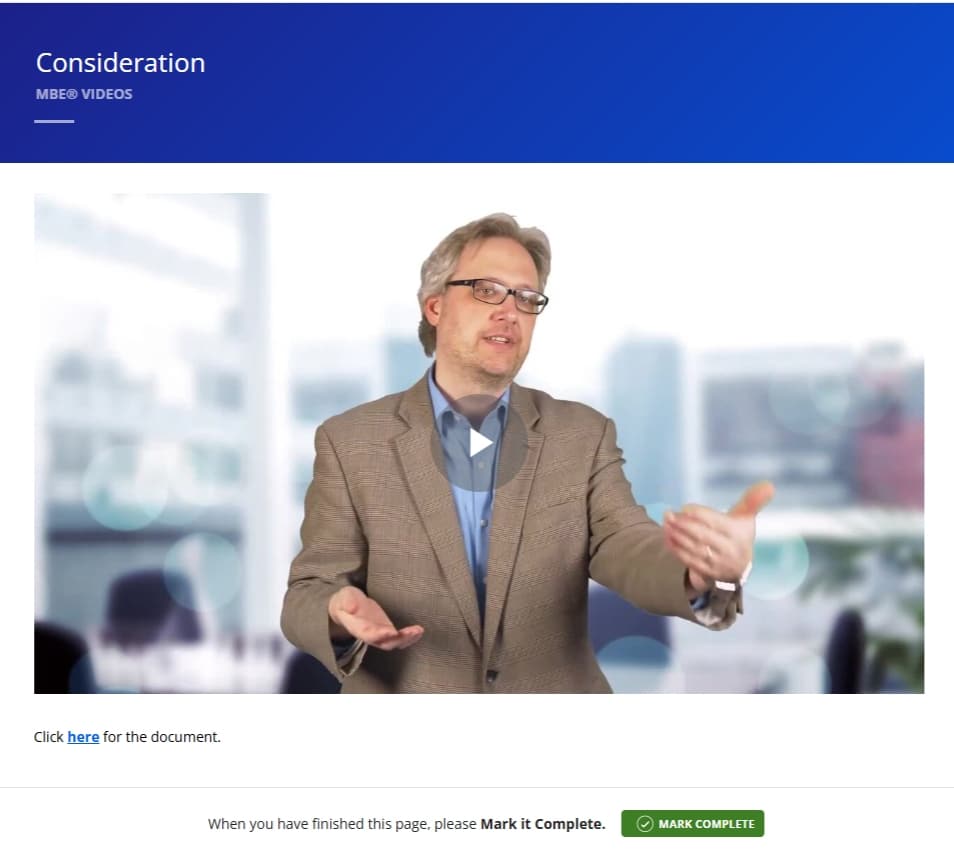
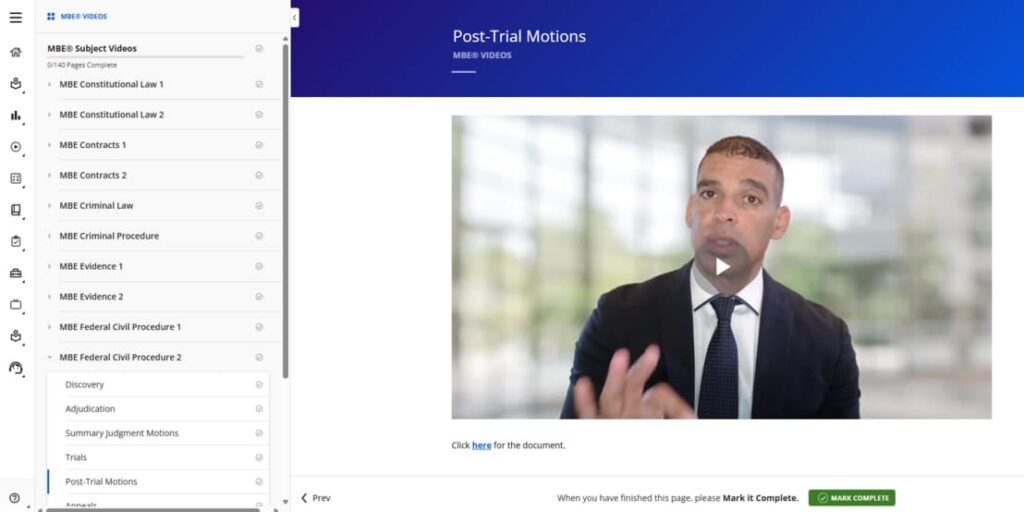
One of the strongest aspects of the Kaplan course is their video lessons. In my opinion, these Kaplan video lessons are extremely well done. They are thorough and generally very engaging.
Each features your Kaplan instructor on the left side of the screen delivering your assigned lesson in a fashion very similar to a law school class (minus the Socratic-style questions), while a PowerPoint slideshow appears on the right side of the screen. As the instructor speaks, the slides update and change, tracking with the verbal lesson.
One of the Kaplan bar review video lessons
In terms of quality, the overall production value is very strong. The picture is sharp, the slides are clean, and the lessons are wrapped up into nice little segments. If I had one complaint about the video quality though, it is that the audio was not great at times.
Sometimes the audio was sort of staticky, like you would hear over a microphone at a local pancake breakfast or something (sorry, that’s a terrible analogy, but the best I can think of). That audio element was just a little off in a good number of video lessons.
However, with respect to content, the videos are excellent. The lessons are extremely comprehensive and cover every little thing you’ll need to know for the bar. They were actually more expansive than the material in the course books at times, which I found to be an advantage.
Plus, I did find them to be generally engaging. I am not sure if it is because you frequently have different instructors, or the rotating slides, or the new material daily, or just what exactly, but my attention never really faded. Overall, I was personally very impressed with the Kaplan video instruction.
Beyond the video lessons, Kaplan provides stacks on stacks of practice material and study resources. Their question bank contains over 5,000 MBE questions, each with an accompanying explanation.
While not all of these are NCBE-licensed bar questions like you get with other bar prep companies (such as Bar Prep Hero and Quimbee), they are very good simulated questions.
Again, Kaplan has an army of in-house bar experts, who carefully craft these questions to mirror the real MBE as closely as possible. So the question quality, while not the real thing, is very good. I had a hard time deciphering between Kaplan simulated problems and real MBE problems.
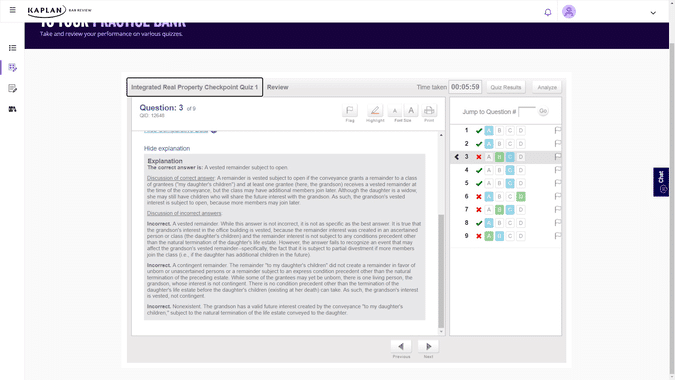
The text explanations that accompany each practice problem are also good as well (like those from AdaptiBar). These explanations are very detailed, providing a thorough analysis of each question.
The explanations all start by providing a general breakdown of the question and the reasoning behind why the correct answer is correct. They then go into further detail, explaining why each incorrect answer choice was wrong.
These explanations, when read as a whole, allow for a deep understanding of the legal principles at play in the question, as well as related issues that may commonly appear.
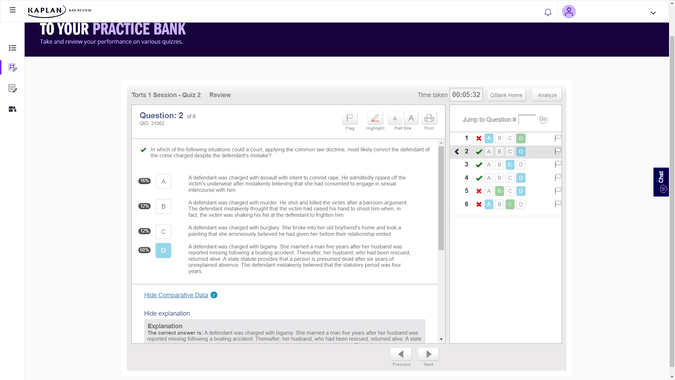
A typical Kaplan MBE practice question
These practice questions can either be accessed through your daily assigned quizzes and practice problems sets, or directly through the Qbank. The Qbank allows you to create customized practice question sets filtered by topic, difficulty, timing, and more.
This additional practice allows you to work on your skills in areas that need improvement. I found that while this function is useful, I didn’t use it as much as I thought I would.
By the end of every day, after having completed a ton of practice already, I just didn’t have it in me to proactively hit some bonus question sets. For those that have the gumption, that’s great, because this is a helpful tool.
In addition to the Qbank, you also get access to Kaplan’s essay bank. This is a library of past essay prompts with model answers. You can choose to just read and review the past essays for your own knowledge building, or you can work the samples yourself for practice.
If and when you choose to write some practice essays yourself, you can submit them to Kaplan for a free grading by one of the staff attorneys, as many times as you want. Yes, you get unlimited essay feedback.
I did this on a couple occasions myself and found it to be pretty helpful. The feedback I got on my essays was fairly brief, but did hit the major points I needed improvement on. To be honest, I actually think I got more out of just practicing the essay writing than I did from the feedback itself. But the feedback did help to some extent.
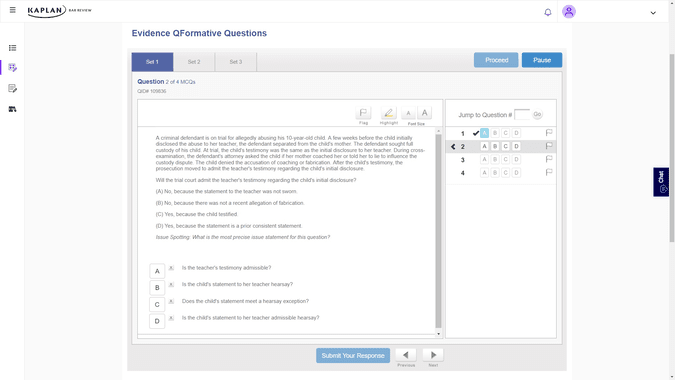
Another aspect of Kaplan’s practice that I liked was the “Qformative.” This function is essentially a series of exercises on a particular bar topic that tests a deeper layer of understanding. Rather than just giving you replicated MBE questions, it gives you one MBE question, followed by tangential questions around that one question.
These follow-on questions include queries such as, “What is the underlying main issue?” or, “What legal principle is being tested here?” These types of questions make you think deeper about the content being tested and help build a more comprehensive knowledge base.
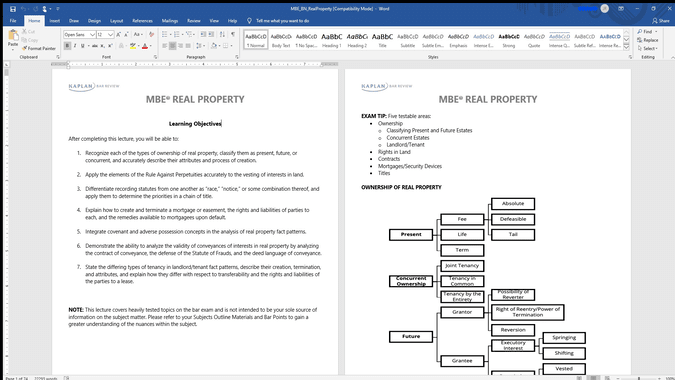
You can download your notes into Word and take notes as you follow along
All things considered, I was personally very impressed with Kaplan’s lessons and coursework. The video instruction is very high-quality and covers just about everything you need to know for the bar. The audio was a little lacking at times, but by and large, these video lessons are rock solid.
In addition, one of the greatest strengths of this course is Kaplan’s sheer abundance of practice material. The questions are well written, and though not all are real past NCBE problems, they are propped up by some stellar explanations. Altogether it makes for a great bar review curriculum.
Kaplan Bar Review Books
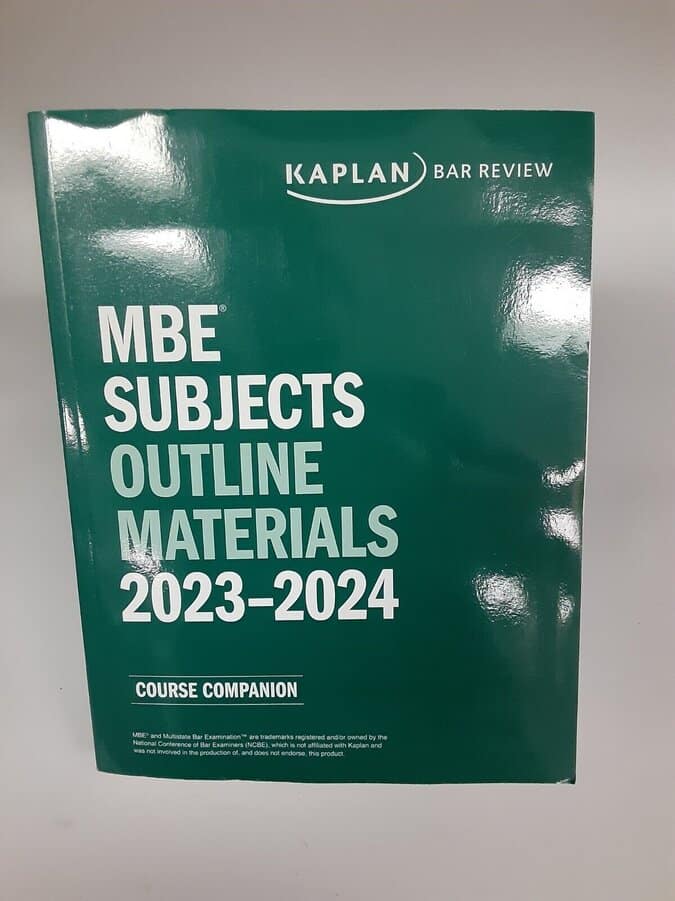
As part of their coursework, you will get four printed prep books when you sign up with Kaplan. If you’re in a UBE state, these books will include MEE-MPT Subject Memorization & Review, MEE Outline Materials, MBE Subject Memorization & Review, and MBE Outline Materials (the most useful for me).
If you’re in a non-UBE state such as California, rather than getting the MEE and MPT books, you will instead get two state-specific books keyed to your state’s essay and performance test subject matter.
These course books generally track with your daily assignments. They contain much needed content review, exercises, practice problems and drills.
The Kaplan bar review books are solid
To be clear, you don’t need all four each day. You will use them piece meal here and there, but they will get heavy usage.
Overall, I really like the Kaplan books. The content portions of these books are extremely well-written and provide some great acronyms and mnemonics to help you memorize necessary material. In addition, they aren’t filled with fluff (see BARBRI for that).
They cut to the most important parts of what you need to know and keep things concise while still delivering all the necessary detail. The books additionally contain really helpful exercises and drills. They are well-designed and serve as a really nice supplement to lectures and online practice. Overall, I give them a high grade.
Practice Tests & Diagnostics
At no point during your studies will you sit for a full-length, two-day practice bar exam. And frankly, you shouldn’t. While that could help you condition your mind and body for the grueling exam ahead, it wouldn’t be as effective at helping to learn the material.
Instead, Kaplan has you take periodic diagnostic tests to measure how you’re progressing and a couple simulated exams, but only in one-day increments. You will either have a day for a simulated MBE exam or a simulated essay/performance test, and not back-to-back.
One of the Kaplan bar prep quizzes
Kaplan wants you to be able to review each practice exam in detail and take away learning points. And doing full-length, two-day bar exams makes that tough. So you take the simulated exams in chunks and immediately review all your answers.
This is a tedious task, but very necessary. In total, you end up having around four simulated exam days. These are spaced out over 8 weeks, and they’re very helpful for preparing for the actual experience of the MBE day of the bar.
The quality of the diagnostic tests and practice exams is just like the practice questions in the Qbank. That is, it is very good. Not the best I’ve seen, but definitely above average. The questions you will see, while perhaps not official questions from past exams, are very close in resemblance to the real thing.
More importantly than the practice quality I think though, is the review sessions that follow. This is where the real learning and chance for improvement takes place. You will learn from every mistake you made and get a feel for where the bar examiners try to trick you with trap answers.
Digital Platform & User Experience
Given that you will spend a significant portion of time in Kaplan’s online portal, it’s important that their digital platform have a visually appealing and highly functional interface. And I would say that Kaplan’s platform is user-friendly for the most part.
Their various course materials and resources are housed in four primary and easy to find groups, categorized as Syllabus, Practice Bank, Writing Center and Support Center. Under each of these main tabs are easy to find subcategories like the Qbank, video lessons and flashcards.
The Kaplan interface in the context of a typical drill
Besides being very intuitive and nicely organized, the digital platform also offers a nice interface. The design is modern, yet clean and simple. And the functionality is great, with quick responsiveness and fast load times. In addition, all video quality is excellent, with the exception of a little grainy audio here and there.
They also recently updated the learning management system with a completely redesigned platform. One of my favorite new features is the adaptive calendar that continually updates your personal daily study plan based on your current progress, any days you need to take off, and how much you have going on each week.
If I had one complaint though, it is that in every video lesson a quiz pops up in a separate browser tab. While not a huge deal, it does get annoying when you spend a full day studying.
By the end of the day you have a dozen tabs open and need to jump back and forth across them, sometimes losing track. Again, a minor gripe, but worth noting.
Kaplan Bar Review Live Seminars – Some Thoughts
With Kaplan, you get live interactive seminars. Basically, you work through flexible video lessons and practice materials at your own pace, then check into these live seminars whenever you need a little clarification or a deeper dive.
While the material covered in the live sessions is generally the same as that covered in the video lectures, you get the benefit of being able to stop and ask questions, hear a different perspective on complex legal issues, and pick up a few extra tips from a bar exam pro.
This makes the live sessions feel deeper and more powerful. And for me at least, the seminars were much more engaging than just watching the video lectures by themselves. I do like the Kaplan video lessons, and found them to engaging in their own right, but not like the seminars. It just isn’t the same as independent self-study.
The sessions moved quickly, but still felt deep and offered a comprehensive review. And I thought the instructors were really good. We had a few different instructors rotate in and out based on the topics, but all were extremely knowledgeable and approachable.
By and large, our instructors did a great job managing those slowdowns and keeping things moving.
Unlike some other bar review courses that offer thin supplemental resources to the primary course, Kaplan offers a bunch of cool add-on tools.
The first of note is their AI tutor. If you have a question on any topic, you can ask the AI assistant anytime, day or night, and get instant feedback. This is a huge perk, as it means you’re never wasting time waiting around for an answer.
I actually found I was better off looking through their massive library of previously answered questions. Oftentimes that catalog already had the same question asked and answered, and I didn’t even have to bother sending in a message.
The next resource worth mentioning are the online flashcards. Kaplan provides thousands of digital flashcards covering every major bar exam subject. They are pretty much what you would expect – a term or legal concept on the front, and a detailed definition or explanation on the back.
I liked how Kaplan kept them succinct and clearly-articulated. I also was a fan of how you can bucket the cards based on how confident you are with them, making for easy review later.
The final resource worth noting is Kaplan’s data on topic weighting by state. Based on analysis of your state’s past bar exams, they will give you historical data on what concepts are tested and in what frequencies.
This is actually pretty useful when trying to decide where to allocate your time. Should you spend that extra hour on inchoate crimes or civ pro venue issues? Look to the chart and see what is tested more often, and let that guide you.
Online Content Access Period
Access to your online materials is generally tied to the length of your bar prep, so around three months. This makes sense. You’re really not going to need the prep materials much sooner than graduation, and then you shouldn’t (hopefully) need them again after you’ve taken the bar.
So the window in which to access the lessons, syllabus, practice materials and everything else online is quite short. The materials will unlock a few months prior to the bar date and you follow your syllabus until test day.
Does Kaplan Have A Mobile App?
No, they no longer offer a Kaplan bar app. Like many other bar review companies, Kaplan does not provide a mobile app to complement its course.
This isn’t a huge deal in my opinion, but it might be a bit of a drawback if you’re someone who is frequently on the go. This is one way I’d like to see them improve the program just to add a little more flexibility.
Kaplan’s Money Back Guarantee
Kaplan offers a really nice safety net through its bar passage guarantee. Complete a minimum threshold of work and they guarantee you will pass the bar, or your money back. The basic requirementsfor qualification are as follows:
Attend 90% of lectures
Complete all assigned multiple-choice questions, simulated exams, and quizzes
Complete required practice essays and personalized homework
That’s it. Do the assigned work you’ve already paid for and are going to do anyway, and get some nice insurance. This is a fairly generous policy compared to other companies.
Verdict: Kaplan Bar Prep Course Review
For those students seeking a full-scale, comprehensive bar review course, I was a huge fan of the Kaplan package. In fact, it’s my favorite among the big three (BARBRI, Themis, Kaplan).
The live interactive seminars are absolute money -and the video lectures that form the backbone of the course are equally solid. On top of that, Kaplan offers the largest Qbank available from any bar prep provider. Beyond their massive amount of practice material, they provide lots of useful bonus features, like unlimited essay grading and an AI-powered tutor for additional support.
Basically, Kaplan’s content review is top-notch. When combined with 5,000+ MBE problems and tons of MPT and MEE prompts, I really struggle to find things to complain about. Bottom line, I really like Kaplan’s bar course and give it the best grade of the major bar prep providers.
Kaplan’s bar review course is on the more affordable end among major bar review providers at about $2,850 MSRP, although you can save hundreds with the right discount. That package includes live online seminars, making Kaplan a pretty good bargain in my opinion.
Is Kaplan Bar Review worth it?
In my opinion, yes, Kaplan is worth it for bar prep. I had a great experience. They offer a very deep and robust curriculum, with tons of content review and practice material. While a little pricey, Kaplan gets results.
Does Kaplan write their own bar exam questions?
Yes and no. Kaplan’s team of in-house bar experts writes some of their MBE questions, while the essays in Kaplan’s essay bank have been previously used on past bar exams.