This hub is supported by our partners. While we may receive compensation when you click on links, our editorial content is independent and based on our own testing. We only recommend products we have actually vetted.
Trying to figure out whether to learn Mandarin or Japanese? We cover all the important details below
For a native English speaker, learning an Asian language, such as Mandarin or Japanese, is a big deal. Asian languages use completely different sets of characters than the Latin alphabet, and often have vastly different syntaxes and grammar rules. This means that you’ll need to make the decision carefully as to which one to learn since it will be a big undertaking. Many people decide between Mandarin and Japanese for their first Asian language—which one is best for you?
In Short: Mandarin and Japanese are both hard for English speakers, but they are hard in different ways. Mandarin often feels harder early because of tones and pronunciation, while Japanese often feels harder later because reading and writing uses three scripts. The best choice is the one you will actually use for travel, work, study, or family.
Similarities Between Mandarin & Japanese Languages
To some people’s surprise, Mandarin and Japanese are actually quite similar, and there is crossover between the languages.
Stepping back for a moment, Mandarin is the official language of China (one of the many Chinese dialects). Mandarin, however, gets its roots from both the Sino-Tibetan and Sinitic families.
Mandarin is written not with letters, as English is, but with characters called Hanzi. Hanzi characters are written similarly to how they have been for numerous centuries, but the spoken language has evolved a great deal.
On the other side of the equation, Japanese is, of course, the official language of Japan. It has three traditional sets of characters: hiragana, kanji, and katakana, with kanji characters being the most complex. Japanese is a Japonic language, and although it doesn’t originate with Chinese (or vice versa) they do share plenty of similarities.
In centuries past, Japanese was written with kanji characters—traditional Chinese script. However, these characters didn’t reflect the Japanese spoken language well, so hiragana and katakana (the phonetic alphabets) have evolved to better match the spoken language.
Nonetheless, both languages trace their writing systems back to common roots, even if their spoken languages are radically different.
In addition, both Chinese and Japanese are sometimes written top to bottom, then left to right. However, the modern script for both languages can be written left to right, then top to bottom, as well.
Differences Between Japanese & Mandarin Languages
As noted, Japanese and Mandarin hail from different linguistic families and use different phonetic systems and characters (although again, Japanese incorporates the Mandarin kanji characters).
Chinese is a tonal language, which means that one word often has many different pronunciations that confer completely separate meanings. Japanese doesn’t have this specification, and although you can intonate to convey meaning, the sound differences aren’t quite so sensitive.
Mandarin grammar can feel simpler at first because verbs do not conjugate the same way many European languages do. But Mandarin still uses verbs, and meaning is often expressed through word order, time words, and aspect markers. Japanese tends to feel more complex early because particles and verb endings carry a lot of meaning.
Interestingly, there are over 80,000 written kanji characters, but only about 3,500 spoken, so you can achieve spoken fluency much faster than written. In fact, most written kanji characters don’t have much use in everyday life. Japanese uses Chinese characters as kanji.
Japanese, although it shares features of Mandarin, such as writing direction and character form, is often considered a stand-alone language. There aren’t any other closely related Japonic languages. Its characters are based on pictures, so if your brain thinks well in this form, then Japanese could be enjoyable.
Which Language Is Easier To Learn: Mandarin or Japanese?
When linguists rank languages for ease of learning, both Japanese and Mandarin fall into Category 5. This means they are both especially hard to learn for native English speakers. In fact, each takes about 2,200 hours to master for English speakers.
As such, they’ll both be at about the samedifficulty level. The cold hard truth is that neither is easy to learn. The only real difference in difficulty is likely Mandarin’s tonal notes.
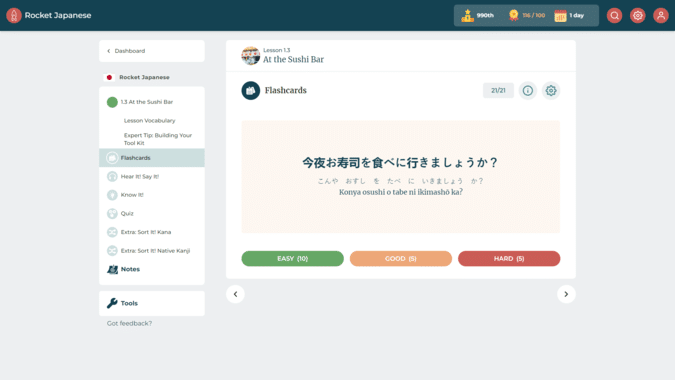
To make the Japanese language learning process easier, you may want to consider purchasing a language learning course from Rocket Japanese or Pimsleur Japanese. Short of immersion, you will need dedicated language learning tools like these.
Example of Japanese language course
The lessons from these companies help expand your vocabulary and improve your listening comprehension skills.
Reasons To Learn Japanese Rather Than Mandarin
Japanese is an important language to know if you’ll be going into any career that will have you traveling around Asia. Although Japan is one small group of islands, millions of people speak Japanese throughout the continent and the world.
Speaking Japanese will also come in handy if you have a Japanese background or family members who you’d like to connect with and speak to in their native language.
Japanese is in the top 10 languages spoken across the globe, so you’ll have plenty of places to go and people with whom you can practice. If, not you can also ways use an app like Rocket or Duolingo to help you practice the Japanese you have learned.
Once you’ve learned Japanese, it will open up doors to this rich area of world history and culture, too. Japan is known for its contributions to many areas, including art, dance, cuisine, social customs, and technology.
Reasons To Learn Mandarin Rather Than Japanese
If you plan on spending plenty of time in China or the surrounding areas, then learning Mandarin is going to be incredibly useful. Furthermore, Mandarin is the most spoken language in the entire world.
So, you’ll never be at a loss for people to converse with (there are over a billion Mandarin speakers the world over). Speaking Mandarin will give you a leg up in business, finance, and economic careers, too.
Mandarin will also be beneficial if you have friends or family members who speak the language. Learning Mandarin can also connect you with your roots if you have Chinese background or it can help you understand the culture if you’re pursuing East Asian studies.
Mandarin Chinese is also spoken in Brunei, Mongolia, Malaysia, Taiwan, Indonesia, Thailand, the Philippines, and Singapore.
Chinese culture is rich with history and influence, including literature, poetry, art, and even film. Learning Mandarin will give you a perspective on these contributions that you wouldn’t be able to get otherwise.
Conclusion
Overall, the choice of whether to learn Mandarin or Japanese is up to you. I cannot tell you which to learn, if that is what you are trying to decide. Think about where you envision yourself spending time, who you might need to communicate with, and which culture excites you the most.
Then, give it your all. The good news is that once you’re fluent in a second language, it will be easier to pick up a third (or fourth, or fifth). The linguistic possibilities are endless when you dedicate and apply yourself.
FAQ
Which language is easier to learn, Japanese or Mandarin?
Both Mandarin and Japanese are considered Category 5 languages for English speakers. In practice, each can take about 2,200 hours to reach a high level, depending on consistency and how much you speak and listen each week.
Is Mandarin harder than Japanese for English speakers?
Mandarin often feels harder early because tones and pronunciation matter a lot. Japanese often feels harder later because reading and writing uses multiple scripts. The better choice depends on your goals and what you will use weekly.
How long does it take to learn Japanese or Mandarin?
Both languages usually take years, not months, for most adult learners. The fastest progress comes from short daily study plus regular listening and speaking practice each week.
Should you learn Mandarin or Japanese?
This answer largely depends on your personal interests, hobbies, family history, and career aspirations. Which language to learn is totally personal and you should not let ease drive the decision.
Is Japanese writing harder than Mandarin?
Many learners find Japanese writing harder because it combines kanji with hiragana and katakana. Mandarin uses one primary character system, but learning enough characters for reading still takes sustained effort.