Test Prep Insight is reader-supported. When you buy through links on our site, we may earn an affiliate commission. Learn more
Best Apps To Learn Mandarin Chinese
We rank the five best apps we have found for learning Chinese
Learning to speak Mandarin is not an easy task. For most English speakers, it will take 2,500 hours or more of active learning to achieve a proficient level of fluency. That is in contrast to just 600 hours for languages like Spanish and Italian. The language learning program you initially select will have a huge impact on your success. Spoiler alert: Duolingo won’t get you very far. After testing dozens of apps for learning Chinese, we’ve review and rank the five best apps for learning Mandarin to help you figure out which one is right for you.
As we were using and reviewing all of these different Chinese learning apps and Chinese language apps over the past year, Rocket Chinese simply stood out as the most comprehensive, well-rounded, and effective program.
We found this to be the case for a few big reasons: (1) Rocket’s teaching framework (which is based on audio lessons and reinforcement drills); (2) their grammar instruction; and (3) their speech software. Let’s discuss these points in order.
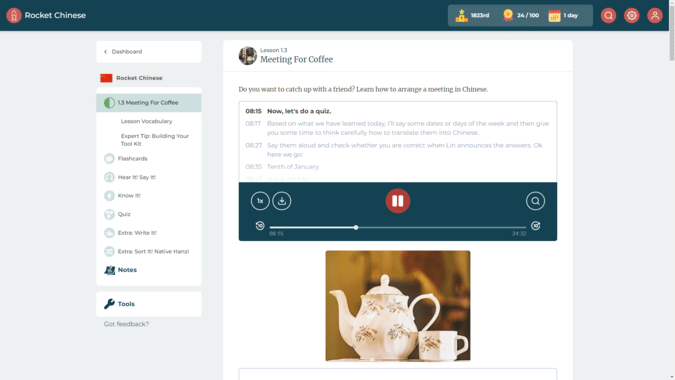
The clear highlight of the Rocket Chinese program is the interactive audio lessons. In these audio-based lessons, an English speaking moderator guides you through a conversation in Mandarin.
Typical Rocket audio lesson
The moderator explains key points and definitions, and has you participate by asking you questions, which makes you think critically and repeat phrases aloud. In essence, Rocket uses real world conversations as the basis of their teaching framework, which I think is much more effective than the teaching you get in drills from companies like Duolingo, which provide short, basic, and repetitive drills.
Those types of exercises offer no frame of reference, whereas Rocket focuses on the more important aspects of language learning: contextual listening and active participation. That’s the clear highlight of this app.
To supplement this teaching style, Rocket also follows each audio lesson with a mix of practice exercises to reinforce what you learned in the audio portion of the lesson. In a way, it kind of feels like class followed by homework.
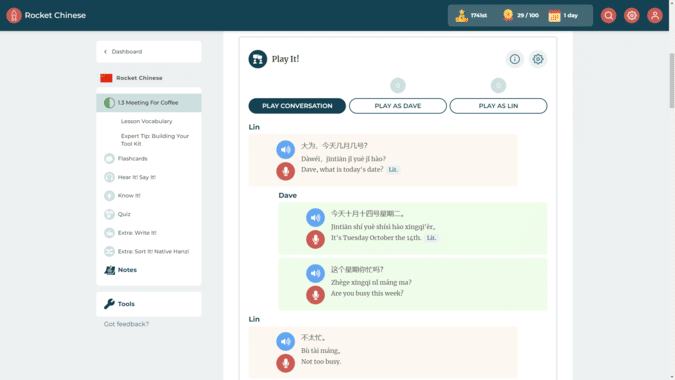
These drills include flashcards, listen-and-repeat exercises, quiz questions, and the chance to reenact the underlying conversation from the audio lesson by playing the role of one of the two fluent speakers (a highly effective aspect). It’s just a nice mix of more typical drills post-audio lesson.
Rocket Chinese mock conversation drill
Another feature of the Rocket Chinese course that we really haven’t seen with too many apps is dedicated grammar coverage. Most other programs try to weave grammar right into their main lessons, but Rocket has lessons fully dedicated to these topics.
The reality is that Chinese is wildly different from English, and these lessons give you a chance to better understand mainstay Chinese grammar principles, such as how there is no verb conjugation or tenses in Mandarin. That is almost always mind blowing to English speakers.
Some people don’t mind just having short grammar snippets layered right into lessons, but for others, these plain English explanations of grammar rules are fantastic. They also throw in survival kits, or vocab sets focused on specific real-world topics, to help you boost your foundational knowledge quickly.
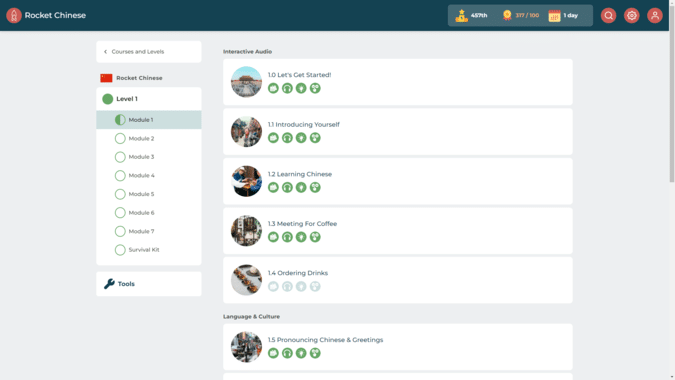
Then finally, the last thing worth noting about Rocket Chinese is their speech recognition software. As you work the reinforcement drills in the program and participate in the mock conversations, Rocket’s speech software will grade your pronunciation on a scale from 1 to 100.
The Rocket Chinese dashboard
It’s not the absolute best software package we’ve tested out and used, but it’s pretty far up the list and we thought it was really accurate. Moreover, it’s also super easy to use, with the function seamlessly integrated right into the drills, so that’s also a highlight of the program.
Those are the major strengths of the Rocket program and why we give them such a good grade. To be honest, there aren’t many negatives with this app that we could identify. They just do most everything really well. It’s a well-thought out and executed Mandarin language learning program.
If there is anything, the only real drawbacks we could find are that (1) the lessons are somewhat lengthy to complete (about an hour per lesson), and (2) the price point with Rocket Languages.
They only sell one-time purchase, lifetime plans and they are a bit more expensive than other apps on the market. Level 1, for example, costs about $150. However, the prices on their website are a little misleading because Rocket is almost always running some sort of deal or special promotion. So make sure to check for coupon codes and discounts.
If you want to learn Chinese by talking with a real human, Preply connects you with fluent Chinese speakers for personalized sessions. You can use filters to sort through Chinese tutors based on your goals. Let’s say you’re planning a trip to China. Within a few minutes, you can narrow the list down to tutors in Shanghai or Beijing who know which words you actually need for getting around and making friends with the locals.
If you try your first session and feel like the tutor isn’t a fit, you can rebook a free replacement lesson with someone else, so it’s easy to find a click.
Subscription Model Keeps You Accountable
With Preply, you decide how many sessions you’d like each week, then start your recurring subscription. There’s some flexibility, as you can reschedule up to 12 hours before a session for those times when something comes up, and you can even pause your plan for a few weeks if you’re out of town. Just keep in mind that the plan renews automatically until you cancel, which provides some accountability.
Unused sessions don’t roll over, so if you don’t use them, you simply lose the money. That might sound like a problem, but in reality, Preply is designed to keep you committed to learning, as having a little money on the line is what motivates many people to stay consistent and keep their language learning goals.
Most tutors charge between $15 and $25 per hour, depending on their level of experience.
Human Tutor + AI Tools
Preply provides many structured learning activities for tutors to draw from, so even if your tutor is pretty new, they’ll have plenty of resources to keep your session moving.
My favorite feature was all the AI tools built into the platform. I was able to fully engage in the conversation without wasting time to take notes, as the AI created both notes and a vocab list based on our session. Afterwards, I did some personalized homework to keep using Chinese over the next few days.
Preply works for learners at every level, since your tutor simply sees where you’re at with Chinese and then helps you build up from there. They’re a great resource for people wanting to build up strong conversation skills, prepare for a Chinese language exam, or use Chinese on the job.
Our second highest-rated app and the next program on our list is Pimsleur Chinese. The interesting thing about Pimsleur is that it’s nearly identical to Rocket Chinese. Well, perhaps it’s not identical, but it is very similar.
This is due to the fact that Pimsleur, like Rocket, is also based on audio lessons. Moderator-led audio lessons are at the heart of this program, and they’re similarly backstopped by reinforcement drills and exercises.
To be clear, however, there are some differences from Rocket Chinese. For one thing, grammar is a major difference. Recall from above that some apps prefer to weave grammar right into the main lessons rather than covering it separately.
A Pimsleur Chinese audio lesson
Pimsleur is one of those apps. Rather than providing dedicated grammar coverage, Pimsleur works it right into their primary audio lessons.
Another major difference is transcripts. In short, Rocket Chinese has a transcript of the dialogue in the audio lesson right on screen, while Pimsleur does not. This is a total matter of preference.
Some people don’t care to be distracted by the transcript (and that’s actually why Pimsleur says it doesn’t provide a transcript), while other learners prefer it so that they can follow along visually. That’s a key differentiator.
Then yet another contrast is that the Pimsleur audio lessons actually come with a special driving mode feature, so that you can make progress through lessons while you’re in the car commuting to work or taking a road trip. That could be a game changer for people that drive a lot.
And if you prefer gamified apps, Pimsleur’s Challenges and Rewards mode uses points and badges for a little extra motivation.
Typical Pimsleur Chinese speaking drill post-audio lesson
Finally, unlike Rocket, Pimsleur actually offers month-to-month subscription plans for about $20 per month. Thus, if you prefer not to commit yourself, Pimsleur is going to be the better option to start. Plus, Pimsleur even offers a free 7-day trial period so you can take their course for a test drive without having to drop any money.
Bottom line, you can think of Pimsleur as a more affordable alternative to Rocket Chinese. Their lessons overlap in a major way, but the programs do have some key differences, and Pimsleur just gets a slightly lower grade.
On an overall ratings basis, even though LingoPie isn’t necessarily our fourth highest-ranked course, because it is so niche and differentiated, I wanted to provide an option for different learners.
I’m sure a lot of you have heard from people who speak a second language that one of the ways they learned was watching TV in that language. This is often true. Watching TV everyday in a new language like Chinese will help you pick it up really fast.
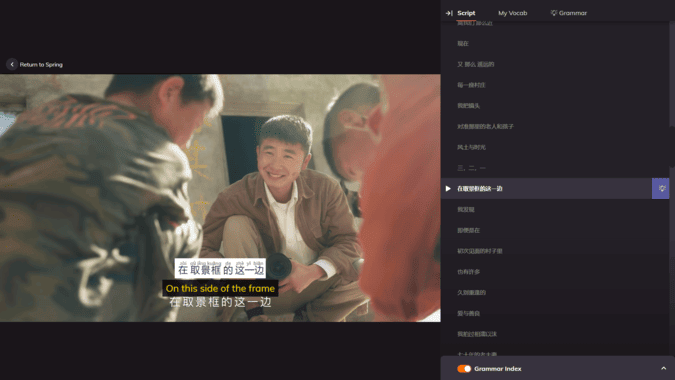
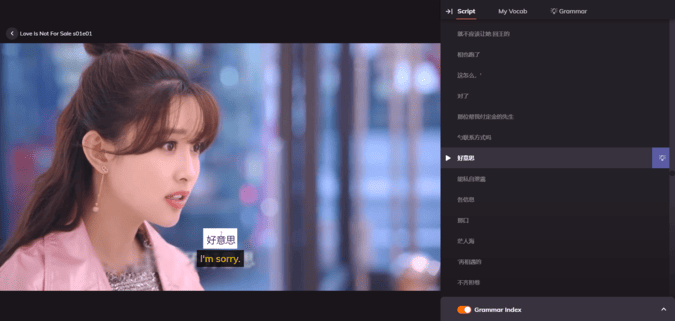
LingoPie offers lots of native Chinese shows
That’s exactly what Lingopie does. It is not a traditional language learning program with a clear curriculum and set lesson plan. Instead, it’s a video-on-demand platform which uses TV shows and movies to help you learn Chinese.
How it works is that once you start watching a particular show or movie, there are subtitles (obviously), but also a bunch of other features to help you understand and learn what’s being said by the characters.
Some of these features include a grammar coach tool (like an AI-based language tutor), loop and playback speed settings, color coding in the subtitles, and interactive video-based flashcards to help with material retention.
LingoPie is unique from other apps we tested
Plus, they have a YouTube integration so you can port over any Chinese content you like from YouTube, with all the Lingopie tools layered on.
Overall, we were super impressed by their platform and tools. Although a little non-traditional, it’s a very engaging and unique way to learn Chinese.
Plus, their subscription plans are surprisingly cheap—as low as $6 per month. Thus, if you want something other than a traditional language learning app, LingoPie is a good option, especially for those with a bit of a foundation in Mandarin.
The third highest-rated app we discovered is Rosetta Stone, although it is a completely different program from Pimsleur and Rocket Chinese. With a long history of successful language instruction, they recently launched Rosetta Stone Sapphire in 2026, the latest version with an updated interface, better usability, and more detailed progress tracking.
The Rosetta Stone learning framework is based on an immersive approach, which is further built almost entirely around imagery. In fact, almost every drill and exercise within the Rosetta Stone lessons contains some sort of image or graphic.
Typical Rosetta Stone Mandarin drill
It is by far the most image-heavy Chinese language learning program I’ve seen and used. Some exercises ask to you match spoken phrases to images; some ask you to match written phrases to images; and some have you speak aloud what you see in an image and their software grades you. It’s just a lot of image-based studying.
When combined with the fact that there is very limited use of English in the program, it gives your learning a very immersive feel.
Lesson dashboard
Plus, Rosetta Stone also provides a lot of good supplemental resources as well, such as on demand videos, short stories, and audio companions. These really help round out your learning. One more bonus: the new Sapphire Studio provides you with all kinds of AI tools for drafting work emails, building customized flashcard sets and matching games, and using Chat Missions to practice everyday conversations.
While they’re definitely image-centered, Rosetta Stone’s TruAccent speech recognition software gives really accurate feedback on your pronunciation. You’re not doing the same extensive conversation practice that you get with Rocket or Pimsleur, but you’ll definitely know whether you’re saying words correctly and how you need to improve.
Then lastly, in terms of cost, the Rosetta Stone subscription plans are relatively affordable. You’re looking at around $10 to $15 per month, which isn’t bad at all, especially considering that you get access to all 25 Rosetta Stone languages.
Verdict: Which Mandarin Language App Is Right for You?
When it comes to learning Mandarin, there are some good options for language learning apps. If you’re a visual learner, Rosetta Stone is a good choice with its immersive and image-based teaching framework. And similarly, Lingopie is also a good choice if you prefer a more active and engaging teaching tool, with its video-based instruction.
If you’re looking for personal sessions with fluent speakers, Preply gives you one-on-one tutoring sessions with AI tools. As for Pimsleur, you really can’t go wrong with this program. The Pimsleur method has been around for decades, and their audio lessons are great.
However, if you’re looking for the most comprehensive and effective app we’ve used, that would be Rocket Chinese. It’s the soup to nuts app which should take you all the way from total newcomer to a more advanced level of fluency. With interactive and contextual audio lessons featuring fluent Chinese speakers, clear and helpful grammar instruction, a diverse set of practice drills for material retention, practical speaking exercises, and accurate speech recognition technology, Rocket Chinese is the complete package.
FAQ
What is the best app to learn Chinese?
Of the 14 different Chinese language learning programs we’ve purchased and reviewed, Rocket Chinese has been our favorite by far. With in-depth audio lessons and detailed grammar coverage, it’s been incredibly effective. Preply is also good for connecting with a fluent Chinese speaker, and Pimsleur works for people who want to learn while driving.
How much do Chinese language learning apps cost?
The typical Chinese language learning app costs around $6 to $20 per month, although some cost about $150 upfront for a lifetime package. There are some free Chinese language apps, but they are never as good as premium paid programs.
Is there a good free Chinese language learning app?
We’ve tested a few “free” Chinese language learning apps, but most are clearly designed to suck you in with the free version, then have you upgrade to the paid version. Duolingo is a good example of this. The basic free version is alright, but not nearly as good as other paid programs.
 Editor's Choice