Test Prep Insight is reader-supported. When you buy through links on our site, we may earn an affiliate commission. Learn more
IXL Language Arts Review by Grade
Detailed IXL Reading and Language Arts review for parents: what it covers, how it works, and whether it's worth the cost
IXL Reading and Language Arts is one of the most comprehensive online learning platforms out there for K-12 students. The language arts lessons organized by grade cover everything from phonics and spelling to advanced literary analysis with read-aloud functionality, making it popular for families, homeschoolers, and teachers. But does IXL Language Arts actually deliver on its promises? As a parent and educator, I’ll cover how IXL works, what the lessons look like, cost, and my final verdict on whether it is one of the best options for kids who need literacy support.
Given this is a lengthy, comprehensive review, we’ve included jump-to links above for your convenience.
Video Review: Is IXL Language Arts Worth It?
In the video above, Lara from the Test Prep Insight team gives our full IXL Language Arts Reading review. She covers how the program works, key features, pricing, who it’s best for, and key pros and cons so you can decide if IXL Reading is worth it for your child. For more detail, be sure to continue reading our full written review below.
Quick Summary – Our Verdict
Who IXL Reading is best for: Homeschool families seeking standards-aligned curriculum with built-in documentation, strong readers wanting to push themselves, and struggling readers needing targeted skill practice with immediate feedback. Also great for parents, and teachers who want a structured supplemental English Language Arts program with detailed progress tracking.
Main strengths: Comprehensive K-12 coverage spanning phonics through AP literature, detailed analytics show exactly which skills they’re mastering and which need more practice, and adaptive scoring ensures true understanding (not just completion).
Key trade-offs: Straightforward drill-style format lacks games or avatars and isolated reading passages don’t replace the experience of diving into full books.
Our verdict: IXL works brilliantly for structured language arts skill practice and grade-level progress tracking. It’s really good at showing exactly where a student is struggling and filling those specific gaps, which is why homeschoolers and parents who want concrete data on their kid’s literacy progress love it. Just don’t expect it to replace direct instruction or provide the creative, story-based experience you’d get from apps designed purely for engagement.
How IXL Reading Works
IXL Reading is an online skill practice platform used by 17 million students worldwide and within all of the top 100 U.S. school districts. The program spans pre-K through 12th grade with targeted exercises in phonics, reading comprehension, vocabulary, grammar, spelling, and writing conventions, with lessons organized by specific skill rather than a sequential curriculum.
Sample IXL practice question
My kids have been using IXL for years. They first encountered IXL Reading in elementary school, and we’ve maintained a family subscription ever since. In fact, they still use it regularly now that they’re in middle and high school. After seeing how well the Reading program worked for filling knowledge gaps, we also added the Math subscription a few years back.
For this review, I spent several weeks diving deep into both the elementary and high school English lessons to see how the language arts side stacks up. Between my kids’ ongoing use and my own hands-on testing across grade levels, I’ve got a pretty complete picture of what IXL Reading actually delivers.
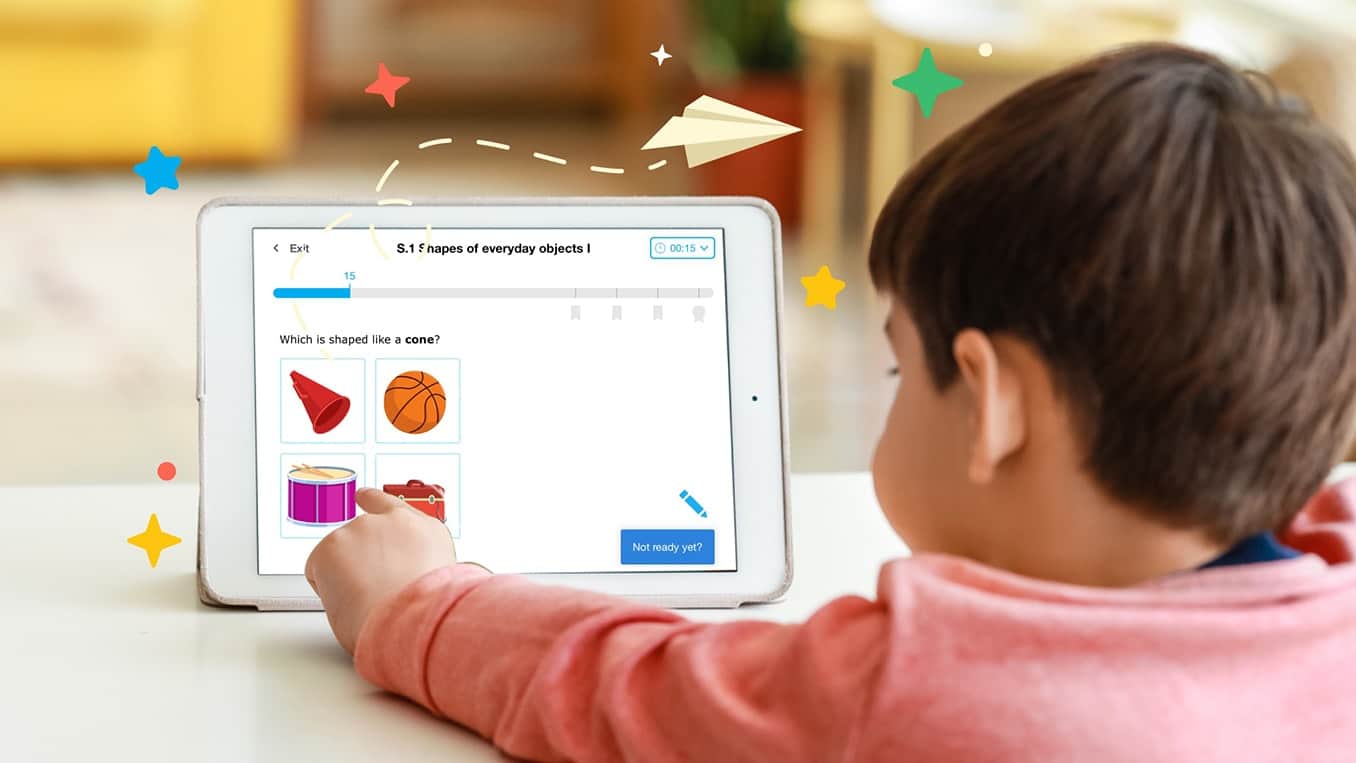
While I tested IXL primarily on a desktop, it’s worth noting they have a highly-rated app for iPad, Android, and Kindle Fire. The interface is optimized for touch, allowing kids to “write” their answers on the screen, which keeps kids engaged longer than clicking with a mouse. Progress syncs in real-time across devices, but there isn’t a full offline mode for travel.
Rather than starting with instructional videos, I jumped straight into targeted skills exercises and practice questions. If I got a question wrong, an answer explanation and a link to a quick refresher video popped up, while a series of correct answers unlocked more difficult questions. The program centers around the idea of responding to student work with immediate feedba ck -an approach that’s been found to be particularly helpful for low achievers. The result: rather than simply clicking through lessons, seeing a grade afterwards, and moving on, students truly learn from their mistakes.
It’s worth noting that IXL massively expanded its library in 2025 and now includes over 1,100 on-demand language arts video tutorials to provide actual instruction alongside the practice drills.
What IXL Reading is not: a complete literature curriculum with novel studies, a phonics program for teaching kids to decode, or a gamified app with elaborate storylines. Instead, think of it as skill practice with structure and accountability to keep students on track.
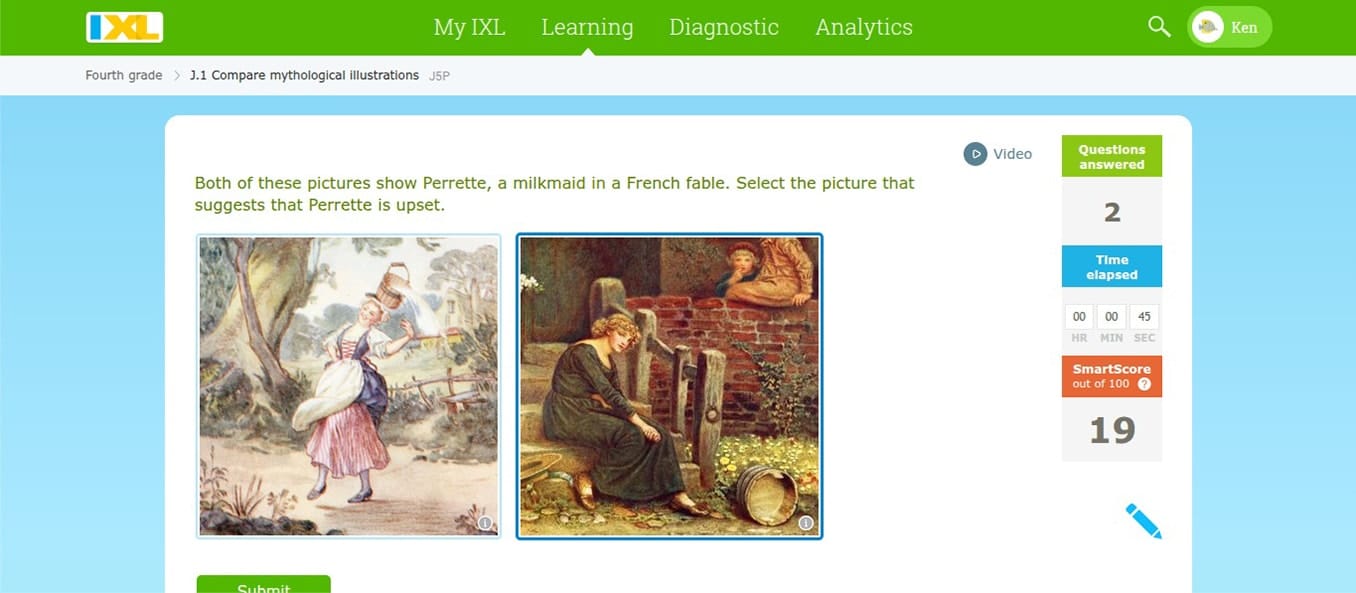
Early readers work on letter recognition, phonics patterns, and decoding. For independent readers, IXL reading comprehension includes identifying main ideas, recalling story details, and understanding story elements like character and plot. Middle and high schoolers work on analyzing literary structure and theme, evaluating author’s purpose, making inferences, and distinguishing fact from opinion.
IXL reading comprehension question
IXL Spelling, Grammar, And Vocabulary
Spelling work progresses logically from simple patterns through complex vocab and tricky homophones. Grammar practice drills everything from basic parts of speech through correcting sentence errors and mastering tricky comma rules, while IXL vocabulary drills help students master grade-level language plus skills like understanding word relationships.
To me, IXL’s use of grammar is one of the program’s best features. The repetitive practice genuinely helps students internalize concrete rules, providing a strong foundation to support overall literacy.
For students in grades 5 through 12, the new ‘Vocab Zone’ lets kids practice specific word lists from thousands of popular novels so they don’t get stuck on difficult language while reading.
Writing Support
IXL addresses writing mechanics like paragraph organization, transition words, and thesis statement identification, but doesn’t provide actual writing assignments or personalized feedback. Rather than having kids produce original essays, IXL writing is about practicing discrete writing skills through multiple choice and drag-and-drop.
Teacher’s Tip – Taking the Fear out of Writing: For many kids, writing is scary because they are afraid of ‘messing up’ the mechanics. I’ve seen some teachers try to relieve student anxiety by ignoring grammar altogether, but research shows that direct grammar and composition reinforcement can significantly increase students’ writing scores. IXL acts like a safety net. It lets kids practice sentence structure in a low-pressure environment where it’s okay to make mistakes. Once they feel confident with the rules, staring at a blank page becomes a lot less intimidating.
IXL reads questions aloud when you click the speaker icon, which is incredibly helpful for early readers and those learning English as a second language. Audio support extends to answer choices and explanations, though not every passage.
The program is also very accessible for various learner types. Younger kids can navigate the clean interface independently once their parents show them the audio button and “I don’t know this yet” option.
Grade Coverage and Standards Alignment
IXL English skills are organized by grade level (pre-K through 12) and aligns with Common Core State Standards, plus all 50 state standards. You can browse skills by grade or use the diagnostic to pinpoint exactly which skills your student needs to target.
Multi-syllable decoding, vocabulary in context, main idea, parts of speech, paragraph structure
8-11
6-8
Literary devices, text structure, complex sentences, research skills, argument analysis
11-14
9-12
Literary analysis, rhetorical strategies, advanced grammar, analysis of high-level texts (great for AP English prep), formal conventions
14-18
You’re never locked into grade-level content. A fourth grader reading at seventh-grade level can work on material that actually challenges them, while a ninth grader with gaps can backtrack without embarrassment.
I also liked the skill-by-skill customization option, which reflects how students actually learn, with individual strengths and weaknesses that don’t mirror any one grade level.
Diagnostic, Levels and Placement
After you create kids’ profiles, they can either go right into skills organized by grade level or start with the LevelUp Diagnostic. Introduced for IXL Reading in July 2025, this standards-aligned assessment identifies a student’s grade-level proficiency in about one hour.
What does a “good IXL reading level” mean? IXL uses scores from 0-1,300 that line up with grade levels. A score of 300 means your child is ready for third-grade material, 350 means they’re about halfway through third grade, and 400 means they’re ready for fourth-grade content.
Think of this as the initial calibration for your child’s education; the system puts together an action plan that focuses on areas where they need the most help.
IXL diagnostic
For ongoing assessment, you can also use Real-Time mode, where students spend 10-15 minutes weekly answering questions so the system can continuously update their scores and action plans. This ensures your child stays focused on what actually matters without repeating skills they’ve already mastered.
Progress Tracking and Parent Controls
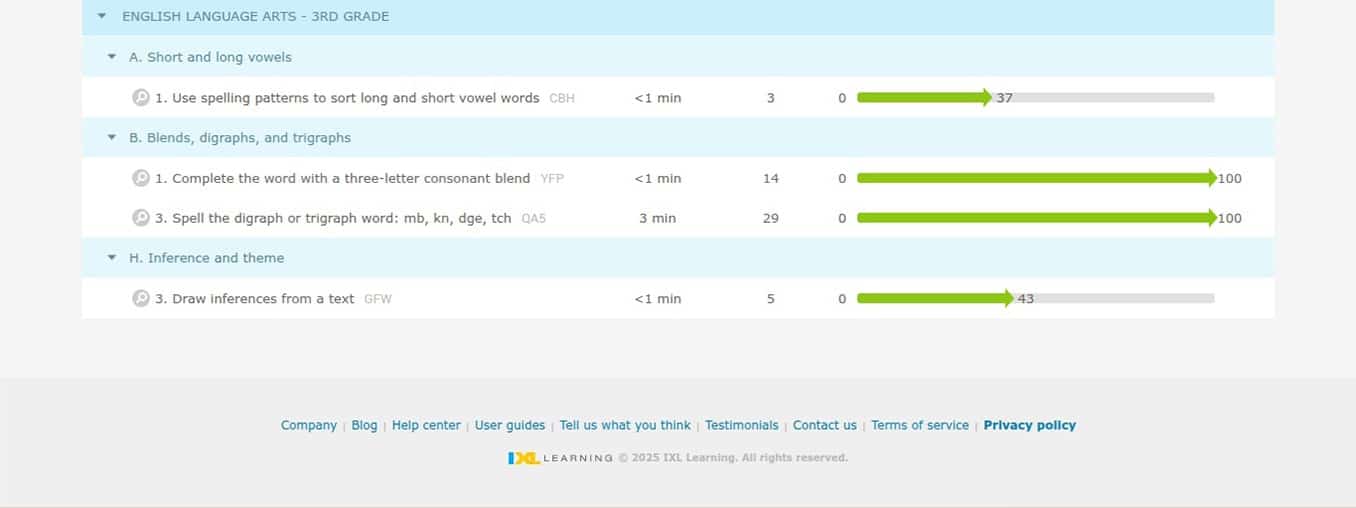
IXL’s analytics dashboard is one of the main reasons I keep renewing our subscription. The parent dashboard shows total questions answered, time spent, skills practiced, overall progress, and current diagnostic levels across all literacy strands. I can see at a glance how much time my daughter spent on each individual skill and where she’s reached proficiency. And I have to say, after testing out all kinds of educational apps, having detailed weekly updates show up in my inbox was a game changer. A little automation goes a long way in making sure I actually stay on top of my kids’ progress, without having to think about it.
Progress tracking in IXL parent dashboard
Detailed reports include:
Trouble Spots – flags skills where students repeatedly struggle
Scores – shows skill-by-skill performance and proficiency achievement
Usage – tracks time and questions over any date range
Questions – review which answer your child gave for any question to spot error patterns
For homeschoolers, this documentation is invaluable for showing progress. For everyone else, it provides concrete data about where your child stands.
👉 Wanting more quality educational resources? Check out our kids’ learning hub
Recommended IXL Practice Time
The key to IXL practice work is their unique SmartScore system for assessing kids’ progress on a question-by-question basis.
The SmartScore system starts at 0 and climbs toward 100 as students answer correctly, but those final 20 points are tough. Questions get progressively harder, and mistakes cause big score drops right when kids are close to finishing. While this keeps students accountable (no clicking through mindlessly), it can be frustrating. For kids who fixate on scores, watching their SmartScore climb to 90, then drop back to 75 after two wrong answers feels a little crushing.
The IXL SmartScore
Despite its challenges, I think the SmartScore system is actually valuable. That problem-by-problem feedback tells kids exactly how they’re doing in real time, which eliminates confusion and helps them see genuine progress. So how do you make it work for your family? You could work together on the last 10 points, give them a reward when they hit 80, or simply set the goal at 80 (proficiency) rather than 100 (mastery).
One more personal tip: I recommend 15-20 minutes daily, typically completing 1-2 skills. This prevents burnout while building consistency. If your child is melting down, stop. Force-feeding literacy practice can create resentment toward reading.
A child uses IXL Language Arts
Another bonus feature that helps with engagement is the IXL reading games for Pre-K through fifth grade (note – IXL isn’t a complete gamified app). There are only a few games per grade level, so this is definitely a side feature and not the main educational approach, but they are pretty high quality. My favorite is the old-school fantasy quests for drilling parts of speech – nothing beats defeating dragons and collecting coins along the way!
Pricing: Subscriptions, Free Trial and Cancellation
For a single-subject subscription, the IXL cost is about $10 per month or about $80 annually. The Combo Package (English language arts and math) costs roughly $16 monthly, while Core Subjects (math, English language arts, science, and social studies) runs just under $20 monthly. Each additional child costs $4 per month or $40 annually – which is great value for larger families.
Unless you have a teacher/classroom account, there’s no IXL free trial, though you can request a full refund if you cancel within 30 days. The 10 free daily practice questions do give you a small taste of the program, but honestly, it’s not enough for meaningful evaluation. You’ll need to commit to at least one month of a paid plan to really see if IXL works for your family.
How to cancel IXL: simply visit the account settings to cancel, without worrying about fees or complicated processes. You’ll keep access through the end of your billing period.
Bare-bones – no real features, tracking, or support system
Diagnostic test, personalized action plan, full parent dashboard, SmartScore tracking, awards and certificates, audio support, standards alignment
Number of profiles
One profile
Add up to 4 children for an additional $4/month each
IXL vs Other Reading and Language Arts Programs
Hooked on Phonics teaches phonics through physical books, workbooks, and digital content for ages 3-8. IXL provides broader language arts coverage including comprehension, vocabulary, grammar, and writing, but doesn’t include physical materials. Use Hooked on Phonics for intensive early reading instruction, while IXL is better for comprehensive language arts practice across multiple skills and grade levels.
Reading Eggs excels at making early reading fun with animated characters and reward systems for ages 2-7. If you’re looking for a gamified app, then kids will love this. However, an IXL subscription offers more precise diagnostic tools and stronger grammar and writing mechanics practice. Choose Reading Eggs if you need to build enthusiasm for learning to read; go with IXL for reinforcement of a broader range of language arts skills and accountability.
If you’re looking for a cross-curricular educational app covering reading, math, science, and the arts, check out ABCmouse.
Free language arts programs like Starfall and Khan Academy offer decent practice exercises but lack IXL’s diagnostic testing, detailed analytics, and adaptive SmartScore system. I’d only recommend Khan Academy when paired with IXL or Hooked on Phonics, which provide more structure and accountability.
What works well about IXL Reading and Language Arts:
Comprehensive skill coverage from phonics all the way through the advanced analysis skills needed for AP English exams.
Targeted practice lets you zero in on precise trouble spots rather than wasting time on already mastered skills.
Detailed diagnostic testing and reports provide concrete data showing exactly where students stand.
Immediate corrective feedback helps students learn from mistakes in real-time rather than repeating errors.
Clear practice structure works well for students who handle straightforward skill work without elaborate game elements.
Areas where IXL falls short:
Repetitive question format can feel drill-heavy and a bit boring compared to story-driven reading apps, although limiting sessions to 15-20 minutes goes a long way in reducing kids’ pushback.
Many kids find the SmartScore system frustrating without parental intervention to reduce the pressure.
Straightforward interface and practice questions not intended to spark creativity or build a reading habit – it’s designed for skills practice.
Requires baseline reading ability; not suitable for teaching complete beginners how to read.
Final Verdict – Should You Use IXL Reading?
Time for the verdict: is IXL Reading and Language Arts worth it? For most families with K-12 students needing targeted literacy practice, yes.
IXL excels at pinpointing exact skill levels, providing unlimited practice, and tracking every bit of progress. It’s also cost-effective for families with multiple kids, since one subscription covers everyone.
For focused skills practice, the traditional drill format truly works. The detailed analytics take the guesswork out of what to practice next, which honestly saves a ton of time.
Think of IXL as that reliable teaching assistant you’ve always wanted: it grades the work, tracks progress, and figures out what your child should tackle next. It works best for homeschoolers needing documented practice, parents of struggling readers targeting specific gaps, and families with advanced readers needing tougher material. After years of using it with my own kids, if you want measurable progress backed by real data, IXL delivers.
👉 Looking for a hands-on homeschool reading curriculum? Check out our review ofAll About Learning.
FAQ
Does IXL help with reading?
Yes, IXL helps with reading by providing targeted practice in phonics, comprehension, vocabulary, and grammar skills that support reading development.
Does IXL read aloud to students?
Yes, IXL includes audio support. Click the speaker icon to hear questions, answer choices, and explanations read aloud. This feature helps early readers, struggling readers, and English language learners.
How much does IXL cost?
There’s no free trial for families, but you can request a full refund if you cancel within 30 days. IXL costs about $10 per month or about $80 annually for single-subject subscription, with additional children costing $4 monthly.
How do I cancel an IXL subscription?
Log into the parent dashboard and cancel through account settings. You’ll maintain access through the end of your current billing period, and there are no cancellation fees.
Is IXL good for kids?
IXL is good for kids who need structured skill practice and respond well to immediate feedback. While not a video game like app, most kids would thrive on the clear progress tracking and adaptive questions.
How long should kids do IXL per day?
Kids should spend 15-20 minutes daily on IXL, which typically allows them to complete 1-2 skills. Shorter, consistent sessions prevent burnout and build better habits than longer, infrequent practice marathons.
What should parents do if a child is trying to cheat on IXL?
If your child is searching for answer keys, explain that memorizing answers only hurts them down the road; they’ll struggle on actual tests without the underlying skills. Instead of handing them the answer, guide them with hints or dial back to easier skills first to build confidence.