Test Prep Insight is reader-supported. When you buy through links on our site, we may earn an affiliate commission. Learn more
ABCmouse Review
Find out whether ABCmouse fits your child’s needs in this detailed review
Editor’s note: While ABCmouse is a well-known program, our latest 2026 testing shows that it often lacks the targeted focus needed for fast reading results. We now recommend Hooked on Phonics as a superior, more structured alternative for kids.
When it comes to early childhood learning apps, ABCmouse is a popular option for kids ages 2-8 need. Guided by a step-by-step learning path, kids have lessons across reading, science, math, art, and music with a mix of online games and offline printables. But is ABCmouse really one of the best learning apps for toddlers and kids? After doing some hands-on testing to see if ABCmouse is a good fit for kids, I wanted to share my thoughts (as a parent and teacher) about the app and my final verdict on whether I think ABCmouse is worth it. In this review, I’ll cover ABCmouse on safety, pricing, lesson content, engagement level, and whether it works as a homeschool resource.
As this is a pretty lengthy review that covers a number of topics, you’ll find a helpful jump-to table of contents above for your convenience.
ABCmouse Summary
• ABCmouse is often sought out byhomeschool families seeking support in a range of subjects. But for parents comparing free phonics games vs paid programs, you might be better off choosing a more focused phonics-first app.
• We see ABCmouse as a decent option for parents or caregivers of children ages 2-8 wanting general enrichment. The wide range of subjects, structured learning path, clear progress tracker, printables, and strong engagement system make ABCmouse work for some preschoolers through second graders. What you’re not getting: targeted academic growth in any particular subject.
• With a kidSAFE certification and 500k+ parent ratings, families consider ABCmouse trustworthy and safe for kids.
• Cons include a lack of advanced reading and math options, a need for parental oversight in order to maintain a regular learning routine, and absence of corrective feedback.
How ABCmouse Works
ABCmouse is an early learning app that gives kids ages 2-8 practice in reading, phonics, language arts, math, science, social studies, music, and art. Kids learn by traveling along a guided step-by-step learning path with 10 levels and 850+ gamified lessons. With over 10 million downloads and 70,000 teachers using ABCmouse in their classroom, it’s definitely one of the more popular choices out there for learning enrichment.
I used ABCmouse years back with my two kids. Looking back, however, it’s hard to say whether it contributed to my kids learning their letters and basic numbers before they’d entered kindergarten.
For this review, I signed up for a new membership and tested the program myself over the last few months to see what’s changed for parents of today. When setting up an account, you enter in your children’s names, genders, and ages, then select the learning level that best fits their ability (10 levels, from toddler to second grade). From there, you customize your child’s learning experience by selecting their cartoon teacher and picking or building an avatar. The app then launches you straight into your child’s learning portal, where you start exploring features.
I struggled to know where to even get started. ABCmouse includes so manygames, songs, stories, drawings, and puzzles that it’s honestly overstimulating. As both a teacher and a mom, I get where they’re coming from. I know how important it is to keep kids’ attention, and ABCmouse is hyper-focused on doing exactly that. They try to motivate learning by letting kids earn and redeem tickets for prizes and explore interactive environments like a zoo or farm at will.
With fun activities, a generous reward system, and a balance between structured lessons and free play, ABCmouse should make kids absolutely love learning… right?
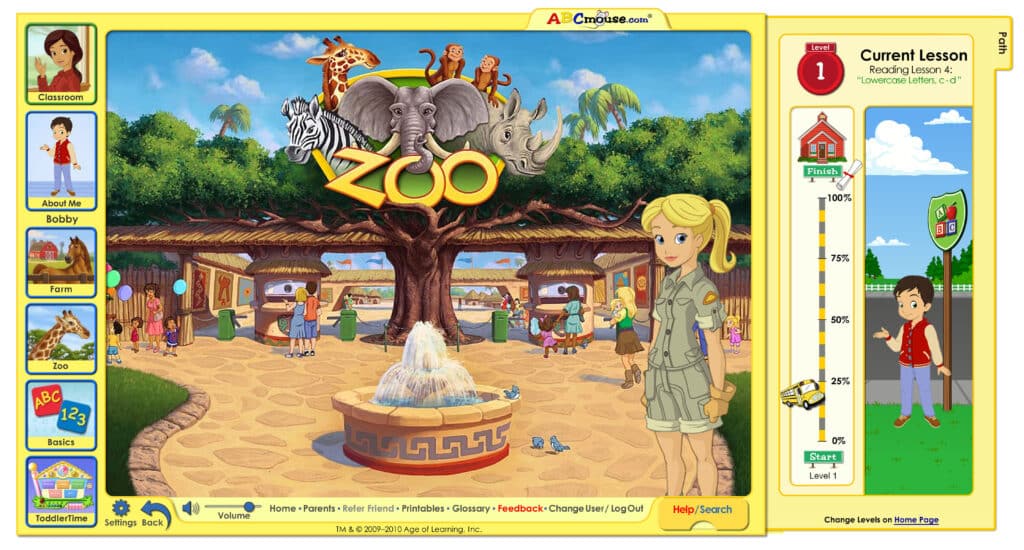
The interactive ABCmouse zoo area, with animal-themed lessons, stories, puzzles, and art activities.
It’s a nice theory. The question is, do all of these motivational strategies actually boost kids’ learning — or just keep them busy?
My take: ABCmouse functions so much like a video game that for many children, learning may come secondary to simply clicking through games and winning prizes. Sure, all the coloring activities and fast-paced games are fun. But if you’re wanting educational depth, that’s not what ABCmouse is designed for.
Pricing
The ABCmouse cost depends on which subscription option you choose. You can start with theABCmouse free trial, which lets you test out the app for 30 days with no money down, after which you’ll be automatically enrolled in the monthly plan for about $15 per month. If you want a more affordable option, you can pay about $45 upfront for the annual plan.
All plans come with a bonus subscription to an extra ABCmouse 2 app with further learning activities.
Compare Pricing Plans
Features
Monthly
Short term
Annual Best value
Free trial
30 days
None
None
Cost
$15 / month
$30 / 6 months
$45 / year
Automatically renews
Yes
Yes
Yes
Bonus subscription to app
Included
Included
Included
You can cancel at any point through your account settings. Instead of receiving a refund, you’ll have continued access to your ABCmouse plan until the final day of your current subscription period.
What Subjects Does The Curriculum Cover?
ABCmouse prides themselves on their research-backed curriculum and balanced lessons. To their credit, they cover just about everything. Young kids can work on letter recognition, numbers, shapes, and patterns, kindergarteners can dip into early reading exercises, and elementary students can practice addition, subtraction, measurements, and parts of speech. Beyond math and reading, ABCmouse integrates science, social studies, music, and art lessons.
ABCmouse lesson topics and activities:
Example Subjects and Skills
Subject
Example skills
Typical ages
Activity types
Language arts
Letter identification
2-4
Letter memory match, mazes, bubble popping, catching falling letters
Language arts
Phonics and early reading
4-7
Letter sound identification, syllable counting, word blends, rhyming, sight word recognition
Language arts
Parts of speech
7-8
Letter matching, drag-and-drop, puzzles, sentence completion
Original songs, music videos, creating a beat, making a unique instrument
Just understand what ABCmouse is for. An app that tries to cover everything ends up being a little thin in certain areas, like phonics. Your child isn’t getting in-depth instruction in any one subject. ABCmouse works if you’re just looking for basic enrichment across subjects. For a focused reading program or targeted math reinforcement, however, you’ll need to look elsewhere.
Lesson Breakdown
The ABCmouse learning path is split into 10 ability levels, with 850+ lessons combining animations, games, books, songs, puzzles, art, and printable worksheets. Each step on the path introduces a different activity type. As I previewed the second-grade curriculum, a child can do a quick matching activity on sentence types before reading a superhero storybook covering parts of speech.
ABCmouse learning path
If you’re looking for a toddler enrichment program or kindergarten reading app, ABCmouse has good usability features. The voice-led instructions help younger children navigate the site independently, and progression markers provide a sense of accomplishment.
Here’s my caveat. While the bite-sized sessions keeps kids from getting bored, they won’t build up the longer attention span necessary for developing strong readers. Yes, there are quick stories mixed in here and there. But for more structured phonics instruction and cultivating a real love of reading, you need a more serious reading-centered program,like Hooked on Phonics.
Do Kids Enjoy Using ABCmouse?
This is one of ABCmouse’s number one strengths: it’s definitely fun for kids. From both my past experience with my kids and my recent testing, children are drawn to the bright colors, cute cartoons, and soft music that make ABCmouse feel inviting. The app throws in a lot of fun extras, like customizable personal avatars and a pet hamster.
Kids earn tickets for every lesson they complete, plus extra rewards along the learning path. The virtual store then lets kids cash in their tickets for prizes, like tunnels for their hamster.
The ticket store, where kids can redeem their tickets for in-game prizes
But having fun and making concrete educational progress aren’t the same thing. ABCmouse definitely keeps kids hooked. The challenge is making sure they’re still actively learning, not just clicking through to collect quick prizes.
Learning Activities
Here’s a quick rundown of the more than 10,000 learning exercises kids do inside the app:
Watch animated lessons. Characters like Prospector Paul and King Grammar teach quick video lessons on topics including letters and grammar rules.
Games. You name it, there’s a game for it: the alphabet, phonics, new words, numbers, shapes, planets – kids are constantly learning through interactive and addicting games.
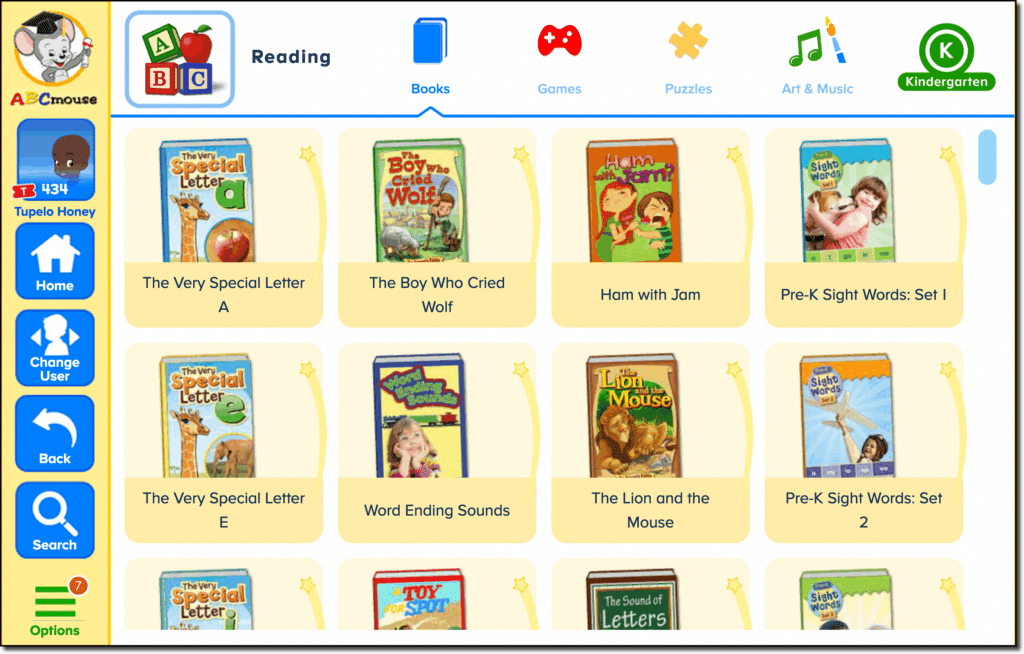
Books. A highlighter feature helps kids follow along with the text as a narrator reads one of the 450+ stories and nonfiction books that reinforce the lessons.
Songs. The educational songs are often a child’s favorite features – and thankfully, I didn’t find them too annoying.
Puzzles. Kids can complete all kinds of age-appropriate puzzles over topics they just covered, including jigsaws, cutouts, problem solving, and phonics puzzles.
Art. Coloring, paint-by-numbers, and traceables help kids develop creativity.
Progress Tracking And Parental Controls
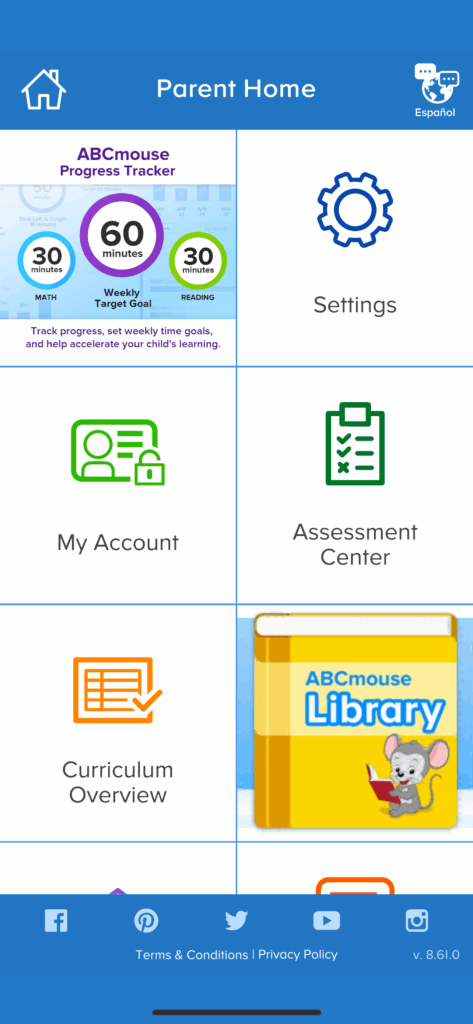
One other feature that works really well: the parent settings and controls. The graphs in the progress tracker showed how much kids were engaging in each subject. I could also see each lesson they worked through, and I found the suggested home activities pretty doable (like a counting game that only took a few minutes to play).
ABCmouse progress tracker and parent controls
My one issue with the parent dashboard is that the text is a little too small and hard to read on the website version of ABCmouse, but I will say that it loaded much better on my phone.
Here are a few tips for monitoring your child’s learning:
Set daily goals to ensure your kids are making good progress
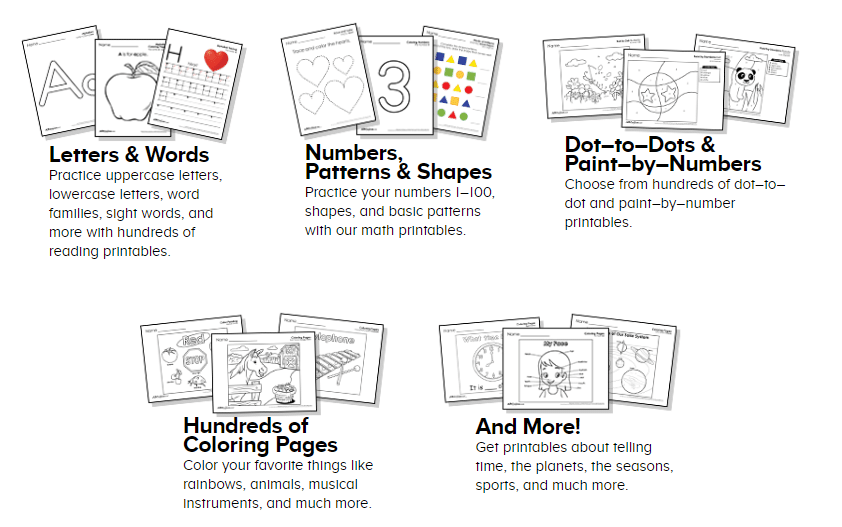
Use ABCmouse offline printables for off-screen learning
Pair songs with reading time for a cross-curricular learning experience
Homeschool And Classroom Use
If you’re looking for a homeschool reading curriculum, ABCmouse offers language arts resources that introduce skills like the alphabet and phonics. I know what it’s like to try to drag kids through boring drills and worksheets, so I do appreciate the ABCmouse games and activities that help you get through the day without constant battles. And for Spanish-speaking homeschool families, ABCmouse Spanish provides immersive language exposure at the click of a button.
Ultimately, though, I’m just not convinced that ABCmouse is the best resource for most homeschool families and educators. Topics are introduced — not explored deeply.
These days, it’s hard to find a phonics program without tons of engagement features and interactive activities. The question for me is no longer whether kids enjoy an educational app; it just comes down to which app provides the most academic benefit. And with so many serious options on the market, it’s hard to see ABCmouse as the best choice.
1. The learning path ensures balanced learning. I didn’t worry about kids getting stuck on one topic or activity; I knew the learning path would keep them bouncing between subjects.
2. Lots of printables make offline learning seamless. I considered the printable worksheets for kids an easy, ready-made resource that kept me from searching the internet for further learning activities.
3. Kids’ progress is visible via graphs and charts. It was nice to see progress at a glance without having to review individual lessons.
I also had some criticisms:
1. Lack of strong phonics and math focus. While there are reading and math lessons, they are thin and lack the depth needed to teach kids numbers, sight words, sounds, sentence formation, and letters. To me, phonics and math are my biggest focus area for kids, and ABCmouse is lacking in those departments.
2. The lack of corrective feedback may result in kids guessing and not learning from their mistakes. I felt like ABCmouse missed out on a huge learning opportunity by skipping straight to the next activity instead of pausing to walk kids through concepts they struggle with.
3. The storybooks may be too easy for advanced readers. I wish they had more advanced reading material in the curriculum to accommodate bookworms.
4. The navigation can be a little confusing. I love how many activities kids can explore within ABCmouse, but the app didn’t do a great job organizing all of those learning experiences. Sometimes, it’s hard to find your way around, especially for younger users.
5. Parents have to stay on top of the progress tracker to ensure continued learning. I had to regularly log in to track the learnings – an automated progress report email would be helpful.
6. The reward system can become a distraction from learning. While the in-game prizes, rewards, and games make kids actually want to log in, they may spend more time redeeming tickets than progressing through phonics lessons. Other apps, like Hooked on Phonics, are structured around literacy milestones, not game mechanics.
ABCmouse vs Other Free And Paid Apps
If you’re looking for the best phonics apps for kids, keep in mind that free phonics games tend to be limited. Free reading apps generally focus on one targeted phonics skill, like connecting letters to sounds, and only offer one game that kids will quickly tire of. I’d think of these programs as good supplemental activities if your child is struggling with one particular phonetics skill and needs a little reinforcement.
Parents looking for long-term phonics support are better off choosing a paid resource with a structured learning path and more activities.
Some ABCmouse reading lessons
Here’s how ABCmouse compares to other popular kids’ learning apps:
ABCmouse vs Reading Eggs:
Think of ABCmouse as a generalist. On the plus side, they cover everything from preschool math games to science and art. But you’re not getting very deep instruction in any one subject. When it comes to phonics, for instance, I see them as simply offering some light reading practice, rather than a really intentional program like Reading Eggs.
Reading Eggs’ sequential lessons build phonics skills one step at a time while working in constant reading practice through an extensive digital book library. Both apps use fun activities and prizes, but Reading Eggs has a stronger focus on reading.
If your child is struggling to read, Hooked on Phonics might be the best fit, as their multi-sensory learning activities and interactive videos and games focus exclusively on phonics and reading skills. Hooked on Phonics has it all: cute cartoons, quirky kid humor, even physical rewards like stickers and certificates. More importantly, it has a decades-long reputation for getting kids reading independently.
ABCmouse is decent for general enrichment. As a teacher, however, I have to say that reading is the backbone of learning. A strong foundation here is non-negotiable. If your primary goal is reading, go with Hooked on Phonics or Reading Eggs.
With both app and web access, you don’t need to worry about ABCmouse device compatibility. The functionality and usability are generally pretty good on any device.
Since I’m a pretty protective parent, child safety is one of the most important factors for me when considering any educational program. It means a lot to me that ABCmouse is kidSAFE certified, and that it’s been used by over 45 million families. You don’t have to worry about any third-party ads bringing in unknown content for your kids to view, either. Still, I err on the side of caution, so I recommend always supervising your kids’ sessions off and on. I’m also big on limiting screen time, so you can set a daily usage time limit for each child. To me, 30 minutes feels like a nice balance between making sure kids get enough learning in and preventing them from spending too much time online.
Final Verdict – Should You Choose ABCmouse?
At the end of the day, is ABCmouse worth it? For most parents, my answer is no, and honestly, we’d have given a different answer a few years ago. The kids’ learning app space has matured, and ABCmouse hasn’t kept pace. That said, ABCmouse still has its place. If your 3- or 4-year-old just needs structured screen time that isn’t YouTube, and your goal is broad exposure rather than hitting specific academic milestones, it’s a decent choice. Most kids enjoy it, and for that age group, enjoyment is half the battle.
But if your goal is a child reading confidently and on grade level, Hooked on Phonics or Reading Eggs offers a more structured, phonics-first path to get there.
It depends. Compared to free phonics games, ABCmouse provides a structured learning path and more well-rounded curriculum encompassing many subjects. But if you’re spending money anyway, you might consider investing in a more serious educational program that goes more in-depth into phonics or math.
Is ABCmouse good for homeschooling?
ABCmouse is an okay supplemental resource for homeschool families, but it isn’t a substitute for a more focused curriculum. For structured phonics lessons, you’re better off going with Hooked on Phonics or Reading Eggs.
Is ABCmouse safe for children?
Yes, ABCmouse is kidSAFE certified.
How do tickets and rewards work?
Kids earn tickets and rewards for every lesson and activity they complete. They can redeem their tickets for in-game prizes, like accessories for their virtual pets.