This hub is supported by our partners. While we may receive compensation when you click on links, our editorial content is independent and based on our own testing. We only recommend products we have actually vetted.
The Rise Of Online Language Learning: Growth And Innovation
The online language learning industry is evolving fast - we look at what’s driving growth and who’s leading the charge
🕓Estimated reading time: 6 minutes
At Test Prep Insight, we’ve been tracking shifts in education for years, and one trend has consistently stood out: the explosion of online language learning. According to Technavio, the global market is projected to hit $82 billion in 2029, with annual growth around 28%. Those numbers reflect something real: more people than ever are turning to apps and online platforms to learn new languages. The bottom line? Online language learning isn’t just growing. It’s booming.
Why The Surge Is Happening Now
Education Technology Is Growing Faster Than Ever
There are a few big drivers behind this expansion, and from testing these apps ourselves we see them reflected in real usage.
Globalization And Migration: Millions of people are learning English for work, study abroad, or immigration. At the same time, English speakers are branching out into Spanish, Mandarin and German for career and travel.
Mobile-First Adoption: Internet penetration and smartphone ownership keep rising, especially in Asia Pacific and Latin America. A phone is now seen as ‘the classroom’.
Affordability: Subscriptions for apps like Rosetta Stone often cost less per month than a single hour of in-person tutoring. That price point changes the game.
AI And Gamification: Apps are racing to add smarter tutors, adaptive learning paths, and game-style incentives that keep people hooked.
COVID legacy: The pandemic forced schools and individuals to try online tools. Many have stuck with them because of the convenience and results.
Breaking Down The Market
The report data paints a clear picture of how the market splits out:
Self-learning apps: Still the largest segment. Think Duolingo, Rosetta Stone, Memrise. These apps thrive on flexibility, short lessons, and gamification.
Tutoring and blended learning: Forecast to be the fastest-growing segment through 2030. Learners are increasingly looking for live conversation practice alongside self-study.
Individuals vs institutions: Individuals make up the largest user base, driven by mobile access. But schools and universities are rapidly scaling digital tools into curricula. For example, the University of Hong Kong recently launched a platform for primary school English learners.
Corporate training: Companies are investing in language training for staff, especially multinationals. This is a quieter but growing slice of the pie.
Regional Breakdown
The Global Market On A Map
The Market Is Global But Uneven:
North America: Holds about 36% of global revenue. Strong demand for Spanish among US learners and heavy investment in edtech.
Europe: Long tradition of multilingualism, with steady adoption of online platforms for both schools and adults.
Asia Pacific: The growth engine. Rising demand for English in China, India, and Southeast Asia is driving a huge uptake of mobile-first learning.
Latin America: A hot spot for English learning apps, particularly among younger, mobile-first users.
Middle East & Africa: Smaller share today, but a young demographic and expanding internet access suggest strong long-term potential.
Tech And Innovation
The real story here is how technology keeps reshaping what learning looks like.
AI-powered pronunciation coaching: Rosetta Stone uses its TruAccent speech recognition to give you real-time feedback on your accent and pronunciation, making targeted speaking practice accessible without needing a live tutor.
Gamification: Duolingo popularized streaks, levels, and badges. Others now integrate quests, challenges and competitions.
Immersive media: Lingopie teaches through TV shows, Glossika focuses on listening drills, and AR/VR pilots are emerging.
Personalization: Adaptive engines now shape lessons in real time based on your errors and progress.
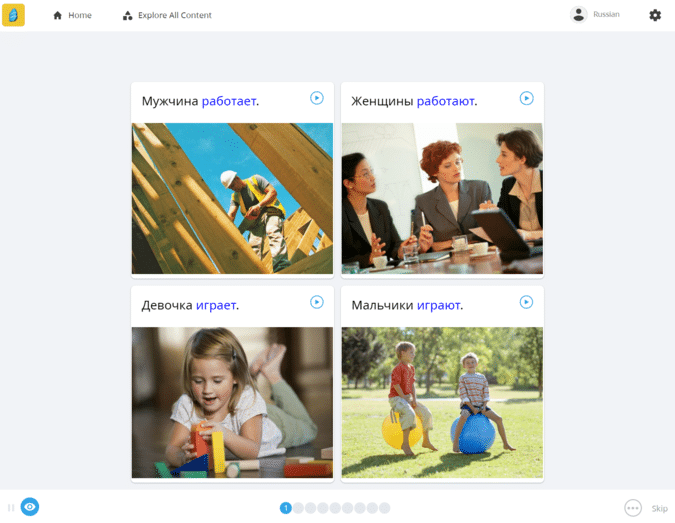
Rosetta Stone Russian grammar lesson
Big Players And New Challengers
The usual names dominate: Rosetta Stone, Duolingo, Babbel, Busuu, Lingoda, Memrise and so on. Each has carved a niche, from Rosetta Stone’s image immersion focus to Lingoda’s live classes. But there is also an emerging class of platforms using innovative teaching methods:
Speak raised $78 million to expand its AI-powered English tutor.
Talkpal has over 1 million downloads, growing fast with its AI powered conversation partner.
Preply is valued at $1.2 billion with its marketplace approach.
Lingopie is winning fans with binge learning through shows and movies.
From a learner’s perspective, this growth is all upside. More competition means more free trials, sharper pricing, and feature innovation. You don’t have to lock into a single method anymore. You can build a stack: Lingoda for live classes, Babbel for grammar, and Rosetta Stone for immersion.
➡ Want to understand how long is takes to learn a language? Click here
At Test Prep Insight we see this firsthand when we review and compare apps. Two years ago most platforms were still heavy on flashcards and static grammar lessons. Now we’re testing tools that hold full conversations with you, adapt to your accent, and gamify the entire experience.
The choice can be overwhelming, which is why we spend so much time testing and publishing reviews. But the takeaway is simple: if you are learning a language in 2026, you are in the right place at the right time.