Test Prep Insight is reader-supported. When you buy through links on our site, we may earn an affiliate commission. Learn more
Memrise vs Babbel
A detailed comparison of the language learning apps/courses from Babbel and Memrise
Memrise and Babbel: you’ve heard of both of them, but you’re not sure how to decide between these two popular language learning apps. Which one actually fits your learning style? Our team has tested both language programs, and now we’re ready to break down the strengths and weaknesses of each company’s lessons and learning approach so you can decide which one is right for you.
Given that this is a lengthy, detailed comparison, we’ve included jump-to links above for quick navigation.
Video Review: Babbel or Memrise?
In the above video, team member John provides a detailed analysis of where we see each of these language apps winning over one another. For a more detailed evaluation, please keep reading.
Verdict: Memrise vs Babbel
So, which is the better app: Memrise or Babbel? To me, Babbel is a more effective language learning program, especially for people who do well with a structured curriculum and clear explanations.
I do like that Memrise incorporates videos of native speakers into their lessons, and their vast library of user-generated courses provides some fun niche content to keep things interesting. But for beginner and intermediate learners wanting to learn from the ground up, Babbel’s emphasis on grammar and speaking practice is much more helpful for making real progress. If you want to build a solid foundation in a language, go with Babbel.
To kick this comparison off, let’s discuss the strengths of Babbel in relation to Memrise.
Grammar Content and Instruction
The first advantage in favor of Babbel is that they prioritize grammar instruction, whereas with Memrise, grammar takes a backseat.
Plus, I like that Babbel doesn’t overwhelm you with long, boring explanations of grammatical principles.
Babbel’s exercises are fun and fast, taking only 10 minutes per lesson
Instead, Babbel integrates grammar instruction into their lessons in a very manageable and efficient way.
For example, one grammar exercise might include a brief one- or two-sentence explanation in English about a concept like feminine nouns or adjectives. After that, you do a little work filling in blanks in example sentences to help everything sink in.
I have to give Babbel two thumbs up for going out of their way to emphasize grammar within their lessons and make it easy for users to understand (this holds true across all Babbel languages, including Spanish, German, and French).
Better for Developing Conversational Skills
Next up, I think Babbel does a better job than Memrise of developing your speaking skills. Their verbal exercises are more robust than the Memrise speaking activities, which simply ask you to repeat words and phrases in isolation. This isn’t truly speaking, just imitating a phrase here and there. Babbel actually has you think through what to say and practice putting words together on your own.
Plus, the Memrise speech recognition technology is just average. I definitely think Babbel wins in that regard as well. When it comes to practicing your conversational skills, I’d give Babbel the edge over Memrise (but Pimsleur beats both).
Then there’s Babbel Speak, which is their AI-powered speaking trainer. This tool provides guided practice for real-world conversations, with plenty of visual cues and structured support so you’re never at a loss for words. It’s great for getting started with listening and speaking so that whenever it’s time for you to have conversations with real people, you truly feel confident and prepared.
Keep in mind that since Babbel Speak is still a relatively new feature, it’s currently only available for Spanish, French, Italian, and German.
Between the two programs, we found Babbel to be better for developing speaking skills
If I’m being honest, I wouldn’t consider either Babbel or Memrise to be industry leaders in terms of speaking practice. If your top goal is to get conversational, you may want to check out Pimsleur or Rocket Languages.
Their language programs do a good job of encouraging you to practice using your target language by responding to native speakers within the context of simulated conversations.
Now that you some background for what Babbel has to offer, let’s talk about what Memrise brings to the table.
Videos of Locals
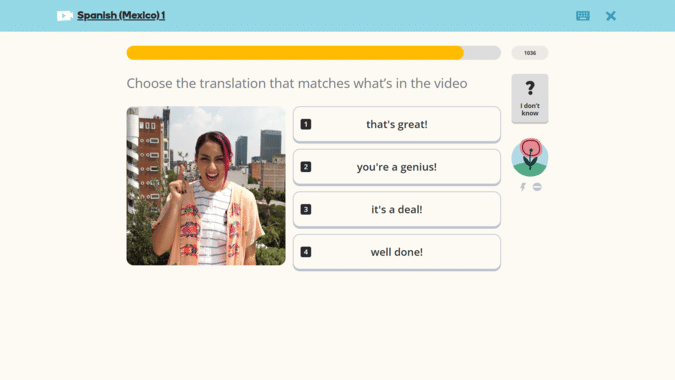
The first thing Memrise has going for them are the videos they incorporate into their lessons. This is a unique feature that you don’t see very often in the language learning industry (apart from the Busuu app).
For example, with Babbel, there are no videos, only audio, text and images. Memrise actually lets you watch video clips of locals speaking the target language, which feels much more intimate and personal.
We love that Memrise uses short video lessons of native speakers
You can observe their body language, their hand gestures, and their inflection when they pronounce new words and sentences. Watching a real person speak helps you understand subtleties within the language and learn the target language faster.
Hundreds of Courses Covering Unique Topics
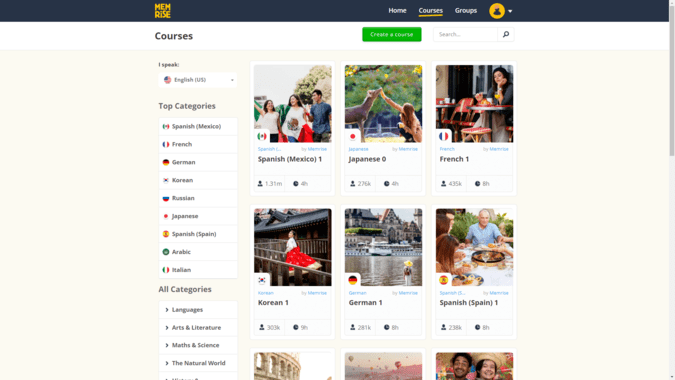
Now, this next point is a little nuanced. In the past, Memrise was known for offering their users access to hundreds of user-generated courses in addition to the company’s own proprietary courses.
The idea was that you could go beyond the standard lessons and dig into specific topics that interest you (similar to Mosalingua).
For example, if you’re learning German, you could find courses covering local soccer leagues, car racing, musicals, and more.
Memrise offers hundreds of user-generated courses
What I really liked about this feature is that you’d likely never run out of content with Memrise. I also enjoyed finding super unique courses that match your specific interests, hobbies, and passions.
Now, here’s the downside: Memrise has since officially discontinued their user-generated courses and completely removed them from the app. The archive still exists on a separate website that you can access with your Memrise login, so it isn’t a total loss. Still, there are no more new courses being created, and the preexisting user-generated courses are no longer integrated into the Memrise platform.
If you want to take advantage of this niche content, you’ll have to seek it out on your own, rather than being able to build an entire language program around your individual likes and dislikes to keep you motivated.
Customize Learning Sessions
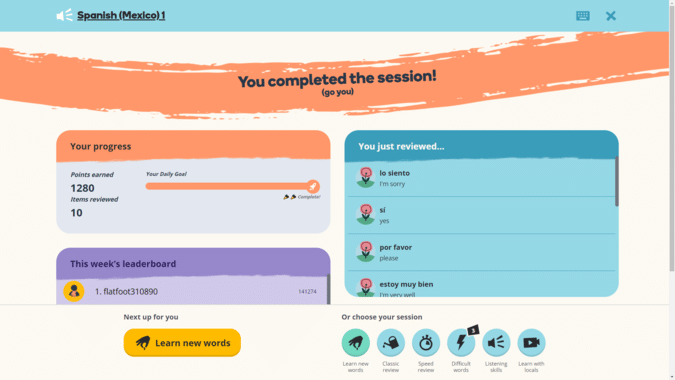
The last advantage in favor of Memrise is the fact you can customize the length of lessons and learning sessions, and mold the program around your schedule.
If you have a lot of free time, you can crank up your words per review session to 100 and quickly make a lot of progress.
Memrise’s lessons can be as short or as long as you want
Conversely, if you have a full-time job or you’re a busy parent who only has a few minutes to spare each day, you can set your words per review session to 5 and slow things down to fit your individual calendar. That way you can learn Japanese, French, or German on your own time.
Now, let’s compare pricing, starting with Babbel. They offer a few different plans, ranging fromaround $8 to $15 per month.
Memrise, on the other hand, offers a free version. However, the free version is somewhat limited. As a result, many users end up switching to the Pro Plan, which unlocks all Memrise content and features across their 20 or so languages.
The Pro Plan costs around $300 if you want to pay up for an entire year, or about $330 for a lifetime plan.
It’s clear Babbel is the cheaper option if you’re on a tight budget. I should also mention that Babbel does offer a 20-day money-back guarantee if you’re not satisfied, so that’s a nice insurance policy.
Which language app/course is better, Memrise or Babbel?
After testing the apps/lessons from both companies, our team thinks Babbel is the more effective language learning program. We like certain aspects of the Memrise program, but Babbel is more well-rounded.
Which app is more affordable, Memrise or Babbel?
The subscription plans from both companies are affordable; however, Babbel is cheaper than Memrise.
Do Memrise and Babbel offer money back guarantees?
Yes, both Babbel and Memrise offer customers money-back guarantees if they are not satisfied for some reason.
What is the difference between Memrise and Babbel?
Compared to Memrise, Babbel’s lessons are more comprehensive and well-rounded. For example, the Babbel lessons make grammar more of a priority and do a better job of developing your conversational skills.
 Editor's Choice