Test Prep Insight is reader-supported. When you buy through links on our site, we may earn an affiliate commission. Learn more
Best Apps To Learn Korean
Discover the best Korean language learning apps/programs for you in this detailed guide
Learning Korean offers an abundance of options, catering to various preferences and needs. Many learners opt for language apps initially due to their affordability, convenience, and effectiveness. Yet, with numerous online Korean programs available, selecting the most suitable one can be daunting. This article explores the top five Korean language apps, highlighting their unique features and the ideal user for each.
To help you navigate this detailed guide, we have included jump-to links above for your convenience.
Our Video Guide to the Best Korean Apps
In the above video, team member Lara boils down everything you need to know about the best available Korean language apps. Please keep reading for more info.
Comparing various Korean language apps, Rocket Korean stands out as a clear leader in the field. Their program is widely regarded as the most effective and comprehensive. To illustrate this, let’s discuss four key highlights.
Engaging Audio-Based Exercises
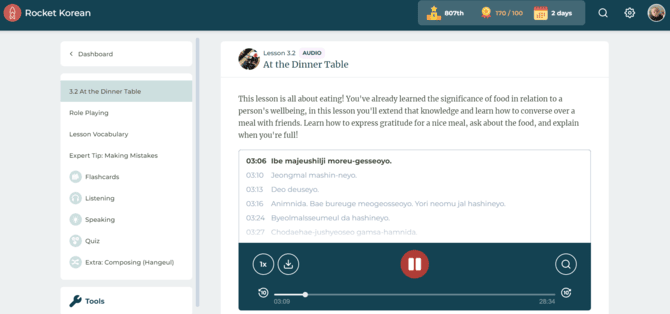
Rocket’s approach to learning is centered around interactive audio lessons, where an English-speaking moderator guides you through conversations between fluent Korean speakers in audio clips.
Example audio lesson from Rocket Korean
This active, contextual learning method, in our view, is highly effective for enhancing both receptive and expressive language skills. Few Korean apps, apart from perhaps Pimsleur, come close to replicating real-world conversations.
These audio exercises form the core of each Rocket lesson, distinguishing it from competitors like Duolingo. While other Korean apps offer basic, repetitive drills without context, Rocket prioritizes contextual listening and active engagement, making it our top highlight.
Variety of Practice Drills
Another key aspect is Rocket’s use of practice drills to solidify the content from the audio lessons. These drills cover essential language skills such as reading, writing, listening, and speaking.
However, the most remarkable and beneficial drills, in our opinion, are the mock conversations. After each audio lesson, Rocket allows you to replay the conversation and take the role of one of the speakers.
This exercise provides an opportunity to use the language in a more challenging scenario, which we believe is crucial for effective learning.
Accurate Speech Software
As you engage in the mock conversations and other speaking exercises described above, Rocket’s speech software listens and evaluates your pronunciation, providing a score from 1 to 100.
Overall, our team found this tool remarkably user-friendly and quite accurate. It’s powered by Google’s Web Speech API, known for being one of the most sophisticated speech tools available.
Rocket Takes Grammar Instruction Seriously
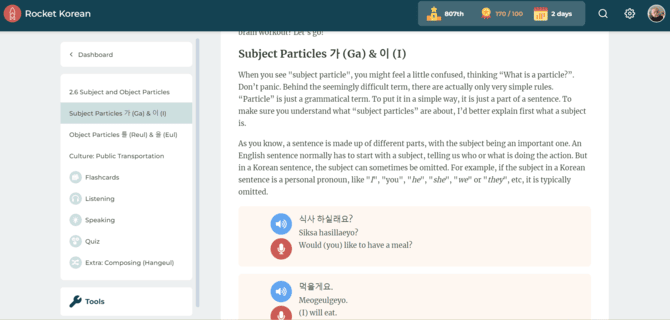
Lastly, I want to touch on Rocket Korean’s fourth highlight: dedicated grammar lessons. These lessons offer insights into the Korean language’s subject-object-verb order, verb endings, and the use of particles to indicate word functions in sentences.
Example grammar lesson from Rocket Korean
Bottom line, if you prefer straightforward explanations of grammar rules, you’ll appreciate these lessons.
Verdict
To be honest, our team struggled to find any significant negatives with the Rocket Korean program. They excel in nearly every category. If we had to nitpick, the lessons are somewhat lengthy, taking about an hour each to complete.
Additionally, the pricing structure might be a concern for some. Rocket only offers lifetime plans, which can be pricier than other options. Level 1, for example, costs about $150 upfront. However, it’s worth noting that Rocket frequently runs deals and special promotions, so the prices on their site can be a bit misleading.
In most cases, you can expect to purchase a lifetime plan for around $60 after discounts, which is actually quite reasonable.
If you want to learn Korean by talking with a real human, Preply matches you with fluent Korean speakers for personalized sessions focused on your goals. You can use filters to quickly sort through tutors and find someone who’s a good match. Let’s say you’re planning a trip to South Korea. Within a few minutes, you can narrow the list down to tutors in Seoul who know which words and phrases are most important for getting around and connecting with the locals.
If you try out a session and feel like the first tutor you chose isn’t a fit, you can rebook a free replacement lesson with someone else at no charge, which takes the pressure off of trying your first tutor.
Subscription Model Keeps You Accountable
With Preply, you decide how many sessions you want each week and commit to a recurring subscription. There’s a little flexibility built in: you can reschedule your session up to 12 hours beforehand, and you can even pause your plan for a few weeks if you’re out of town or you have a lot going on.
The plan renews automatically, which provides some accountability. Sessions don’t roll over, so you’re losing money if you fall behind or don’t use all your regular weekly sessions. Some people think that’s frustrating, but if you’re serious about language learning, it can be motivating. For me, it’s what kept me sticking with Korean instead of burning out or making excuses.
Most tutors charge between $15 and $25 per hour, depending on their experience.
Human Tutor + AI Tools
Preply provides tons of structured learning activities that tutors can use during sessions, so even if you go with a newer tutor who has less experience, they’ll have plenty of resources to keep things moving.
What I liked best about Preply was all the AI tools included in the platform. I didn’t have to get distracted by taking notes, as I knew the AI would generate notes and a vocab list based on what we talked about. That meant I was able to totally focus on the conversation and get more out of it. At the end of each session, my tutor assigned me personalized homework, which made it easier to keep using Korean over the next few days.
Preply works for learners at every level, since your tutor simply sees where you’re at with Korea and then helps you make progress from there. They’re a great tool for people wanting to build up strong conversation skills, prepare for a Korean language exam, or use Korean professionally.
Ranking second on the list is Pimsleur, a program that stands out for its unique learning approach. Designed for auditory learners, Pimsleur’s Korean curriculum is centered around engaging audio lessons, similar to Rocket’s methodology.
Pimsleur and Rocket excel, in our opinion, in enhancing listening comprehension and conversational skills within the Korean language sphere, rivaled only by direct tutoring.
The Pimsleur lessons are similar to those from Rocket
However, Pimsleur distinguishes itself from Rocket in several ways. First, it offers a convenient “driving mode” in its audio lessons, allowing learners to progress while commuting or on long trips. This feature could be transformative for individuals who spend a lot of time behind the wheel.
And if you’re someone who learns best through gamified apps, you’ll enjoy their new Challenges and Rewards feature, which lets you earn points and badges as you progress.
Additionally, Pimsleur provides monthly subscription plans for about $20 per month, making it a more accessible and economical choice for those preferring a gradual approach or constrained by budget limitations.
A Pimsleur Korean speech exercise
Furthermore, Pimsleur offers a risk-free 7-day trial, providing an opportunity to experience the course without financial commitment.
Overall, Pimsleur presents a more budget-friendly option compared to Rocket, offering comparable lessons but lacking the same comprehensive approach in their Korean course.
Reasons to Choose Lingopie to Help You Learn Korean
If you’re more inclined towards video-based learning rather than static pictures, Lingopie comes highly recommended by our team. Unlike traditional language learning programs, Lingopie operates as a video-on-demand platform, using real TV shows and movies to facilitate Korean language learning. In 2025, Lingopie added hundreds of new TV shows and movies to their content library to keep everything fresh and make sure they offer something for everyone.
It’s akin to a streaming service, with the added benefit of letting you import content from YouTube.
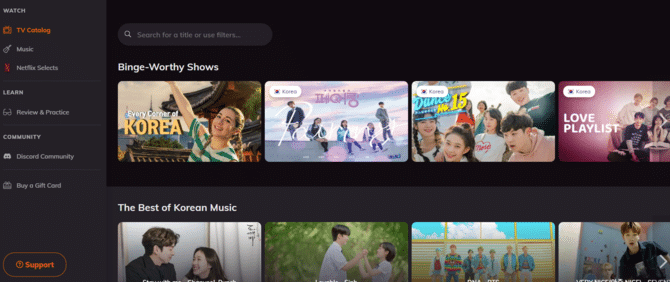
A look inside the Lingopie Korean program
Here’s how it works: as you watch a show or movie, Lingopie provides color-coded subtitles in both English and Korean and various tools to help you understand the dialogue. The aim is to make the learning process enjoyable by integrating it into entertainment, potentially increasing your commitment compared to other language learning apps.
In addition to subtitles, Lingopie offers a grammar coach tool and interactive video-based flashcards to aid in material retention, plus an AI explainer to help you understand words in context. The platform impressed me with its content library and tools, and its subscription plans are surprisingly affordable, starting as low as $6 per month.
In conclusion, if you’re seeking a departure from traditional language learning apps and crave something novel and engaging, Lingopie is an excellent choice.
Why Rosetta Stone Korean Is a Great Choice for Visual Learners
Now, shifting gears to cater to visual learners, let’s explore two options tailored to this learning style. The first contender is Rosetta Stone (or Rosetta Stone Sapphire, as the newest 2026 version is called), known for its immersive approach that heavily incorporates imagery.
In fact, nearly every exercise and drill in Rosetta Stone’s lessons feature some form of visual aid, making it the most visually intensive Korean course our team has reviewed. If you find that you comprehend and retain information best through visual cues, Rosetta Stone could be an excellent fit for your learning preferences.
Example practice drill from Rosetta Stone
Additionally, Rosetta Stone offers a wealth of supplementary resources, such as short stories and phrasebooks. The Sapphire Studio gives you access to all kinds of AI tools. You can draft a quick work email, use Chat Missions to practice conversations related to real-world topics, or even generate your own personalized flashcard sets and matching games on any topic of your choosing. Their speech recognition technology, TruAccent, is also really accurate, although keep in mind that the conversation practice is limited compared to Rocket and Pimsleur.
Rosetta Stone Korean units
Finally, although there isn’t a driving mode like Pimsleur offers, the mobile app is easy to use and gives you full access to every course feature. Plus, they updated the interface in 2026 with better progress tracking and a more intuitive interface. Everything is sharper, cleaner, and more modern; it’s a smooth user experience.
In terms of pricing, Rosetta Stone’s subscription plans are quite reasonable, ranging from $10 to $15 per month, making it an affordable choice for many learners.
Verdict: Which Korean Language App Should You Choose?
The answer to the best Korean language app for your situation depends largely on your budget and learning style. Rocket is our #1 pick for most people looking to learn Korean, as they’re great for building up strong conversation skills.
If you want to learn from a real person, go with Preply. Pimsleur is good for auditory learners, Rosetta Stone works for visual learners, and LingoPie is the most entertaining way to pick up new words in Korean.
However, if your primary goal is to achieve proficiency in Korean and you’re looking for the best overall app or course to achieve that, then Rocket Korean is the top recommendation.
Rocket Korean offers a comprehensive package that includes interactive audio lessons featuring fluent Korean speakers, clear grammar instruction, a variety of practice drills for retention purposes, practical speaking exercises, accurate speech recognition technology, and more.
It provides everything you need to reach an intermediate level of fluency, making it the complete package for serious Korean learners.
Korean language learning apps generally range in price from about $6 to $20 per month. Additionally, some companies provide lifetime plans, which may cost about $150 to $450 upfront as a one-time fee.
What is the best way to learn Korean?
The most effective way to learn Korean is by using a language learning app with a structured curriculum that advances from beginner to intermediate or advanced levels. Another option is to engage a Korean tutor to assist you in learning the language.
What is the best app to learn Korean?
Having evaluated close to a dozen different Korean language apps, our team has concluded that Rocket Languages is the top choice for learning Korean. Its comprehensive audio lessons, along with its effective learning framework and overall curriculum, make it the most effective option for learning Korean.
How long does it take to learn Korean?
To begin engaging in basic conversations in Korean, you’ll likely need around 100 hours of study time. However, to achieve an intermediate to advanced level of fluency, you should anticipate dedicating more than 500 hours in total.
 Editor's Choice