Test Prep Insight is reader-supported. When you buy through links on our site, we may earn an affiliate commission. Learn more
Memrise vs Duolingo
Find out which language learning app is better for you in this detailed comparison of Duolingo vs Memrise
Duolingo is quite possibly the most popular language learning platform in the world, being used by millions and millions of people each month. While slightly lesser known, however, Memrise has quietly grown to become a major player in the language learning industry. As a result, people often have a tough time deciding between the two. In this comparison, we dig into the details so you can figure out which language app is right for you.
We’ve included jump-to links above so you can quickly navigate through this article.
Video Review: Memrise or Duolingo?
In the above video, Lara (from the TPI team) covers everything you need to know about how the language apps from Duolingo and Memrise compare. For more detail, feel free to continue reading below.
To kick this comparison off, let’s discuss what the lessons from both companies are like first starting with Duolingo. Their lessons are fairly short. Each one is only about five to ten minutes long.
The lessons are made up of a dozen or so quick-hit drills and exercises that span listening, reading, writing and speaking. These drills include fill-in-the-blanks, matching pairs, sentence puzzles, and translating sentences.
Those are the primary exercises you’ll complete, just in different variations and difficulty level. That’s one of my biggest problems with Duolingo. You could spend years working through one language course, but you would never move on to more challenging material. You’re simply repeating the same simple matching exercises with new vocabulary, without ever having to use what you’re learning in context.
A typical drill from Memrise
Now moving onto Memrise, their lessons are similar to Duolingo’s in several ways (i.e. a lot of quick-hit drills and exercises). However, there are two main differences.
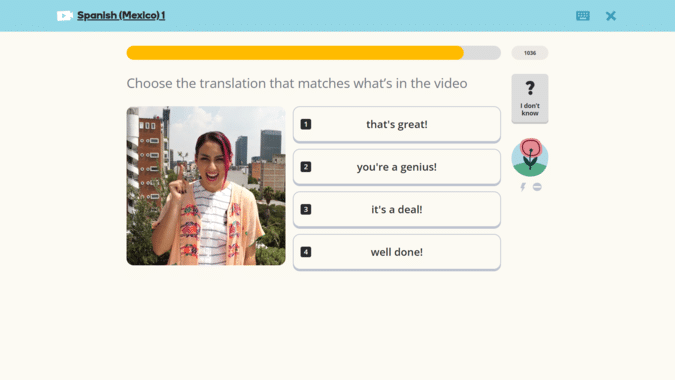
First, the Memrise lessons typically start with a string of short videos featuring locals speaking in your target language who introduce you to new words and phrases (I’ll talk more about the benefits of video later in this comparison).
A Duolingo drill
Second, with Memrise, you can adjust your preferences to control how long you want each learning session to be.
If you want to keep the lessons short, you can set your words per review session to 10. Alternatively, if you want to stretch each lesson out, you can alter the settings to 50 new words or phrases per session in order to quickly make some big strides.
Pricing and Subscription Options
Next up, let’s compare pricing and affordability. Both Memrise and Duolingo offer a free version, but as you might imagine with anything that comes with a free price tag, there are some drawbacks.
To cut to the chase, the free accounts from both companies are pretty limited, and as a result, most people choose to upgrade to a paid plan.
With Memrise, the upgrade would be the Pro Plan, which unlocks all content and features across their 20 or so languages. This costs around $25 per month, or about $330 if you’re seeking a lifetime pass.
With Duolingo, their premium subscription is called their Super Plan, which costs around $13 per month. The top tier, Duolingo Max, includes video calls with AI characters and a Roleplay feature but costs a shocking $30 per month, which is pricey for a basic matching game plus the same AI tools that most language apps now include standard.
Why Memrise Is Better Than Duolingo
Now that you have some background regarding lesson format and subscription options, let’s cover the areas in which Memrise is superior to Duolingo.
Lessons Incorporate Videos of Native Speakers
As I alluded to earlier, Memrise incorporates video into their lessons, which I’m a huge fan of as this is something you don’t see very often in the language learning industry.
For context, the Duolingo lessons do not incorporate any video clips. You essentially listen to your computer or phone speak words and phrases.
The Memrise exercises frequently use video
On the other hand, with Memrise, you get to visually watch and listen to locals speak the target language, which feels a lot more intimate.
You can observe their body language, hand gestures, and voice inflections as they pronounce words, phrases, and sentences. You’re not hearing German in isolation; you’re connecting the words and accent to a real person. In my opinion, this is much more valuable than blind audio. The visual components help you understand the nuances and learn the language quicker.
Effective for Learning New Vocabulary
Overall, I found Memrise to be a useful tool for learning and memorizing vocabulary. Not to say that Duolingo is not, but I found Memrise to be better in this department.
Memrise utilizes a spaced repetition learning system, which essentially means that as you complete lessons, you’ll be introduced to a word or phrase for the first time and then seconds later you’ll be asked to recall it, then minutes later, then days later.
This ensures the words transfer from your short-term memory to your long-term memory. It’s your long-term memory that allows you to use what you’ve learned in real native conversations.
The other cool feature about Memrise is that they use adaptive technology in the background to personalize your sessions and readjust your lessons as you learn.
Thus, if you’re having trouble with a particular phrase or a specific word, Memrise will prompt you to review it more often until it gets imprinted into your long-term memory.
Bottom line, I found Memrise’s repetition system and their adaptive technology to be effective for learning new vocabulary.
Natural Language
Lastly, I found that compared to Duolingo, Memrise is better at using natural language and phrases. With Duolingo, this seems to be a lingering complaint among consumers, and I even noticed it a couple times myself.
Now to play devil’s advocate, it does seem like Duolingo has improved in this area as of late, but you still occasionally come across an awkward sentence or phrase that sort of makes you do a double take.
A couple examples of unnatural sentences or incorrect translations I noticed “the bed is food” and “it called my fat.” It’s funny at first, but eventually, you realize that translating nonsense phrases doesn’t help you order dinner in the real world. This is a big reason why we eventually quit Duolingo.
Memories uses videos of fluent speakers
To be clear, this doesn’t happen all the time, but it can disrupt and muddle your learning process occasionally.
Memrise seems to be more accurate when it comes to the language and translations used within its lessons. I will say, however, that the Babbel courses are also spot-on when it comes to accuracy, but they provide a lot more depth than Memrise in 10 to 15-minute lessons you can easily fit into a busy schedule. Babbel keeps things quick and easy, like Memrise, while giving you the direct grammar instruction you’re missing with Memrise, making them a better choice for most beginners wanting to build a strong foundation in a language.
Now that you have an idea of what Memrise brings to the table, let’s talk about the strengths of the Duolingo app/program.
Extra Resources for Learning
Duolingo offers users a bevy of extra resources for language learning. With Memrise, there’s not much beyond their standard lessons.
Duolingo simply has more stuff. You can go on a quest, earn rewards, and ask for hints or support in English whenever you need it. Plus, I enjoyed the Duolingo Stories; they’re funny and good for reading practice. But that’s also the catch.
It feels like the content is designed to keep you in the app, not necessarily to get you speaking in the real world. It’s great entertainment, but it often feels like you are consuming content rather than practicing conversation.
Speech Recognition Technology
Lastly, I like Duolingo’s speech recognition technology a little more than Memrise’s. Not only did I find Duolingo’s more accurate most of the time, but there are also a couple small quirks with Memrise’s speech technology that I wasn’t fond of.
Duolingo’s speech recognition tech is a little better
Most notably, in order to speak, you have to click the microphone when you start, and then click it again when you’re finished, which can become annoying. I know this might sound hypercritical, but it does make a difference over time.
With Duolingo, the auto-detect is much snappier: you just tap and talk. Plus, the interface is simple and easy to use, like a mobile game.
But let’s be honest about the limitations. The free version’s Energy System caps you at two or three lessons a day, which is frustrating. In both apps, the speech recognition is incredibly forgiving. You can often mumble your way through a sentence and still get a “Correct!” ding.
While it can be satisfying, it won’t prepare you for a real conversation. For accurate pronunciation coaching that corrects you, Rocket Languages is leagues ahead of both.
Rocket and Babbel also both include direct grammar instruction, which you won’t get with either Duolingo or Memrise. Instead, you’re expected to simply figure the grammar out for yourself, which I found confusing. I’d rather get a straightforward explanation so I know how to put phrases together or choose the correct verb ending, but you’re totally on your own if you go with Duolingo or Memrise.
I spent six weeks maintaining a Duolingo German streak, and I felt like I was making real progress. Then I met an actual German speaker, and I couldn’t keep up with the conversation or put my own thoughts together out loud. That’s when it hit me that being good at Duolingo doesn’t mean you’re getting good at your target language.
After testing each program, I like certain aspects of each app. For example, with Memrise, I like that their lessons incorporate videos of native speakers, so you’re learning from native speakers of Spanish, French, or Italian.
But here’s the problem with both apps. Memrise taught me vocab much faster than Duolingo, since it used better adaptive technology, but neither program taught me to build original sentences. After using both Memrise and Duolingo, I still couldn’t speak up or hold a conversation.
That’s why I wouldn’t recommend either Duolingo or Memrise for people who want to become proficient in a language. There are much more robust and effective language learning apps available. For serious language learners, check out Rocket Languages, Babbel, and Pimsleur.
Which language app is better, Memrise or Duolingo?
After testing the lessons and apps from both companies, our team likes certain aspects of each, but ultimately wouldn’t recommend either one for people who are serious about learning a new language. Check out Rocket Languages or Pimsleur if you’re wanting an effective language learning app that teaches you to speak a language.
Is Memrise cheaper than Duolingo?
While companies offer free plans, the premium subscription plan for Super Duolingo is cheaper than Memrise Pro.
What is the difference between Memrise and Duolingo?
Although the lessons from Memrise and Duolingo are similar in several respects, Memrise differentiates itself with videos of native speakers and adaptive technology to help you memorize vocabulary faster.