This article unpacks what Chat GPT Study Mode does, why it matters for U.S. students in 2025, and how to combine it with tried-and-true resources.
🕓Estimated reading time: 6 minutes
We spend every day reviewing all the apps, platforms, flashcards, books, resources and study programs that students rely on to prepare for big exams. Increasingly, those tools are weaving artificial intelligence into their features, from adaptive learning algorithms to AI-driven flashcard apps.
That’s why the launch of ChatGPT’s new Study Mode feels like a natural moment for us to weigh in. It’s not just another tech headline; it connects directly to the future of the products we review and the way students study. By looking at how AI is reshaping habits right now, we can help learners cut through the noise and understand how these developments fit alongside trusted prep resources.
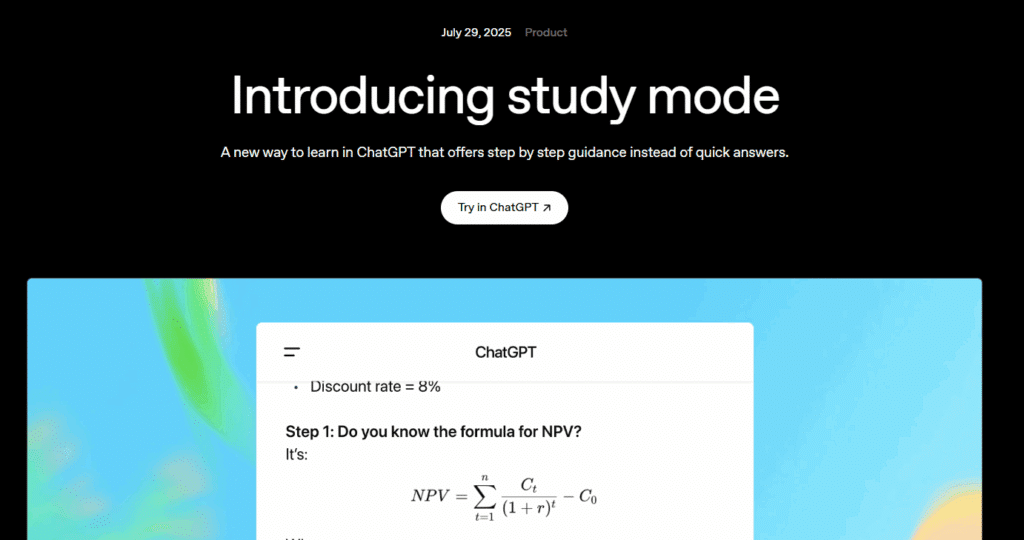
AI and ‘education tech‘ (ed-tech)has been remaking education for years, from adaptive online courses to gamified language apps. The Study Mode is basically a learning-focused feature that walks students through problems step by step. The release of this mode on July 29, 2025 gives us a good idea on where AI-driven study tools are headed AND raises questions about how learners and educators can use them responsibly.
What Is ChatGPT’s Study Mode?
The GPT interface is clear
OpenAI describes Study Mode as a way to turn ChatGPT from an answer engine into a personal tutor. Instead of spitting out full solutions, the chatbot prompts users to think through problems. In demonstrations, ChatGPT asks students about their comfort level and goals before guiding them through concepts like Bayes’ theorem, effectively transforming a prompt into a Socratic lesson!
The feature sits under the “study and learn” option in the ChatGPT tools menu and is available across free, Plus, Pro and Teams plans. According to OpenAI, the tool was developed in consultation with pedagogy experts from more than 40 institutions and draws on Socratic methods to encourage deeper learning, according to thistech review.
Designed To Encourage Active Learning
Education leaders at OpenAI say the goal is to make learning friction‑filled rather than frictionless. Leah Belsky, the company’s vice president and general manager of education, explained that building Study Mode involved asking ‘how can we guide students toward using AI in ways that encourage true, deeper learning?’ It uses interactive questions, scaffolding prompts and quizzes to help students make connections and test their understanding. Teachers like math instructor Nick Phillips see value in this approach because it offers students the kind of step‑by‑step guidance they often need outside of class.
Built As A Response To Misuse
There has been a sharp rise in academic integrity violations involving generative AI.
Surveys show that 90 percent of U.S. college students had used ChatGPT for assignments by early 2023, barely two months after its launch (Source: Axios).
By 2025, that figure had climbed even higher, with one study noting that 92 percent of university students now use AI tools, up from 66 percent in 2024 (Source: DemandSage).
More than half of students admit openly that they rely on generative AI for essays, quizzes, or exam prep (Source: Freewrite).
For administrators, the concern is obvious: this scale of adoption risks blurring the line between legitimate study aids and outright misconduct.
Educators Report Shifts On The Ground
59% of University leaders (according to the American Association of Colleges and Universities) – say cheating has increased in the past year. Meanwhile, three-quarters of higher-ed CTOs now see AI as a significant risk to academic integrity Interestingly, students themselves don’t necessarily reject AI in education – 53 percent would rather see clearer rules and ethical guidance on how to use these tools than blanket bans or surveillance software. This tension between widespread student adoption, institutional anxiety, and the emerging norms around “responsible use” sets the backdrop for why features like ChatGPT Study Mode are so important to watch.
OpenAI’s leaders say they don’t want ChatGPT to be misused and see Study Mode as a way to promote responsible academic use.
We actually got GPT to create this image -can you tell?
Why This Matters For US Students
AI Adoption Is Mainstream
Generative AI is no longer niche. Guardian reporting notes that more than a third of college‑age young adults in the US use ChatGPT, with roughly one quarter of their messages relating to learning, tutoring or schoolwork. With students already turning to AI tools for study support, any change to how those tools behave could influence study habits across universities and high schools. Study Mode’s emphasis on interactive guidance may encourage more students to use ChatGPT as a tutor rather than a shortcut for answers, potentially reducing misuse and promoting deeper learning.
Aligning With Evolving Assessment Strategies
Educators are rethinking assessments in light of AI. Jayna Devani, OpenAI’s international education lead, has said that the conversation about AI misuse requires a ‘whole industry conversation’ about changing assessments and establishing clear guidelines.
Potential equity implications
OpenAI positions Study Mode as a tool to close the gap between students who can afford private tutors and those who cannot. Belsky argues that AI tutors might democratize access to high-quality instruction. Early testers said the mode made studying more enjoyable and some even suggested they would pay for it.
How to use Study Mode effectively
We have put together a few helpful tips for any student eager to try Study Mode:
Use it as a supplement, not a substitute
AI can help explain concepts and prompt you to think, but it should not replace textbooks, lecture notes or verified study guides. Even OpenAI admits that the tool may make mistakes. When in doubt, cross-check answers with trusted sources.
Be transparent with instructors
Many educators encourage students to use AI for brainstorming or practice questions but expect disclosure when assignments involve AI assistance. There are currently no administrative tools to enforce Study Mode, so honesty and adherence to honour codes remain important.
Stay engaged with the questions
The mode works best when you answer its prompts thoroughly and reflect on your reasoning. If you skip the interactive prompts, you may revert to passive consumption of answers, undermining the tool’s purpose.
Leverage image support
Upload diagrams, graphs or homework sheets to get step-by-step explanations. Visual learners may find this particularly valuable.
Combine AI with expert-curated resources
Pair your AI sessions with high-quality study materials: textbooks, online courses and practice exams for more robust learning.
Using AI With Our Trusted Study Resources
Generative AI can be a powerful companion to traditional study tools, but students still need curated materials and expert guidance. We offer detailed guides and reviews to help learners choose the right resources:
Dental Admission Test (DAT) courses Our guide to the best DAT prep courses ranks programs like DAT Bootcamp as the overall best, Kaplan for live classes and Princeton Review for its score guarantee. Combining these structured courses with AI‑generated practice questions can reinforce concepts and build confidence.
NCLEX review books Aspiring nurses can find our recommendations for the top NCLEX review books, based on evaluations of more than a dozen titles. Use Study Mode to unpack tricky nursing concepts, then turn to these books for comprehensive practice questions and content summaries. We have a nicely curated Test Prep book round up here, too.
SAT preparation Preparing for the SAT can be stressful, but there are many excellent SAT prep books available. Study Mode might help clarify algebra or reading passages.
Language learning Many students use ChatGPT to practice foreign languages. To decide which app to pair with AI conversations, see our comparison of Babbel vs Rocket Languages, which analyzes differences and recommends the better option depending on your goals.
MCAT course comparisons If you’re preparing for medical school, our comparison of Kaplan vs Blueprint MCAT notes that both companies receive rave reviews from students. The same thing is true of Kaplan vs Magoosh. The articles break down the strengths of each program to help you choose the right fit. Why not use AI to reinforce science concepts, but rely on expert‑curated questions and explanations to master the exam.
By linking to these resources, we aim to ensure that students who experiment with Study Mode also have access to rigorous materials vetted by educators and subject‑matter experts. This aligns with our broader commitment to in‑depth research, analysis and expert reviews across test prep and lifelong learning.
Finally
For students in 2025, the key is balance. AI tutors like ChatGPT’s Study Mode can make studying more engaging, adaptive and accessible. But they are most effective when paired with high‑quality course materials, supportive teachers and a healthy dose of curiosity. Test Prep Insight will continue to monitor developments in AI‑driven learning and update our resources accordingly. In the meantime, explore our guides, experiment with Study Mode, and remember that enduring learning comes from active engagement, not shortcuts.