We tested Babbel to see if it actually motivates you to learn
If you’ve ever tried to learn Spanish and completely lost interest by week three, you know that the most important feature of any language learning app is whether it actually makes you want to log in. I’ve spent months learning on Babbel, and it was one of the more engaging apps I’ve used. Here’s an honest breakdown of Babbel’s approach to motivation and whether it will work for you.
While some apps hold your interest by using overly gamified features, like points and prizes, Babbel motivates you with streaks, effective review sessions, and a powerful curriculum to help you make quick gains in the language. Tools like progress reports and completion certificates let you measure your growth, which is what ultimately pushes you to keep using the app.
Babbel uses lots of images to keep things interesting
Who Does Babbel Work Best for?
Here’s who Babbel is a good fit for:
Learners who want more structured language instruction, including grammar, vocabulary, listening, and speaking practice
Busy professionals who only have 10 to 15 minutes a day for language learning
Users who want a forgiving streak system that allows for occasional missed days
Anyone who gets bored easily and wants lots of variety to mix things up
On the flip side, here’s who might do better with a different approach:
Competitive types who need social pressure and leaderboards to stick with learning
Learners who rely on gamification and rewards to make progress
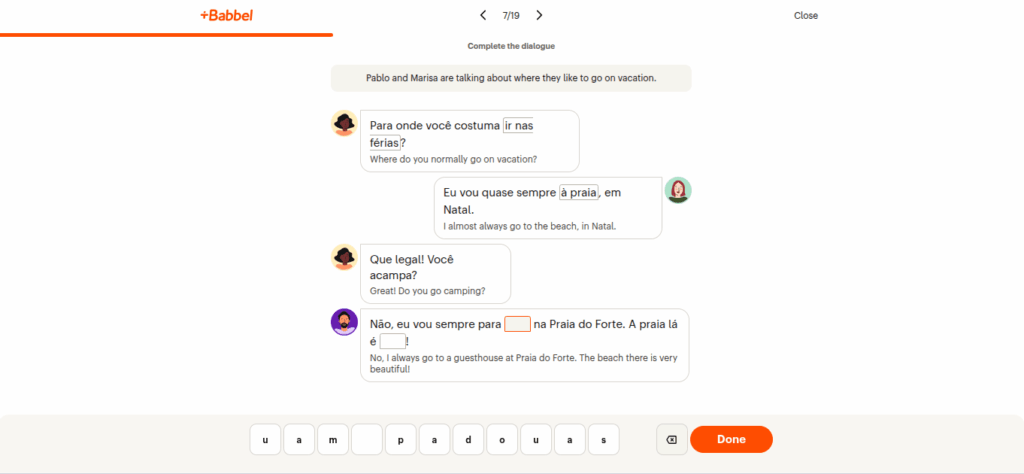
A Babbel Portuguese mock conversation
My two cents: give Babbel a month before you decide whether it’s working for you. Those first few weeks of establishing a new habit are the hardest, but after you’ve built a regular learning habit, it’s a lot easier to keep it up. I felt much more excited about learning about five weeks in, when I was remembering far more phrases than I’d expected. Once you start seeing real progress, it becomes much easier to stay motivated.
Yes, Babbel uses streaks to keep you logging in daily. Every time you use the Babbel app, there’s a small flame icon in the top right corner of the dashboard with a number that shows how many days in a row you’ve completed at least one learning activity.
Any activity within the Babbel program counts, even if you didn’t work through an actual lesson that day. For example, maybe you simply listened to a podcast or spent a couple of minutes chatting with the AI tool, Babbel Speak. The idea is that you’re better off getting in some regular language practice every day, even if it’s just for 10 minutes at a time, rather than waiting until you have an hour available to study and barely using the program as a result.
If you miss a whole day, the streak counter resets to zero at midnight, but the system is a little more forgiving than it sounds upfront. It’s not about perfection: every Monday, you start out the week with two Streak Freezes, and if you miss a day, one automatically applies to protect your count. Unused freezes don’t roll over, which means you’re expected to work on language learning five days a week, instead of seven. In my experience, that’s the right balance to keep me regularly using Babbel most of the week, without getting too discouraged by a busy day throwing me off my usual schedule.
A Babbel Italian drill
While Babbel won’t send you an urgent notification letting you know that you’re about to lose your streak, you do have the option to schedule regular learning reminders that pop up on your phone at set days and times. This extra accountability comes in handy for forgetful types or anyone who has a lot going on.
Every time you open the app, you jump into a short review session, usually 2 to 3 minutes long, before moving on to new material.
Babbel’s review system uses spaced repetition, which brings vocabulary back right before you’d naturally forget it. The program walks you through six memory stages, cycling each new word or phrase back into review sessions at increasing intervals as it works its way into your long-term memory.
Babbel keeps things quick and doable
Here’s what made the review sessions so motivating for me. Logging in and immediately seeing how much vocabulary I’d already mastered (and still remembered!) gave me a real sense of accomplishment. When you feel like you’re making progress in a new skill, you want to keep putting in the reps to see how much further you can go.
Babbel also gives you the freedom to choose how you want to review each round, whether you’re in the mood to flip through flashcards, push yourself with some speaking or writing practice, or simply sit back and do some listening to get a feel for the different accents.
If you’re someone who likes to be in charge of your learning instead of always being told what to do, being able to customize your learning experience is a big reason why you’ll want to keep using the app long term.
Babbel vs Duolingo: Which App Keeps You More Engaged?
While Duolingo relies heavily on points and leaderboards, Babbel keeps you motivated by helping you make meaningful progress through a fun, structured course.
Babbel includes more direct grammar instruction than Duolingo
With Duolingo, you earn gems and points you can redeem, compete in leagues against other users, and pair up with friends to do a quest together. Personally, however, I’ve found that those quick-hit coins and prizes get old pretty quickly, and the bigger problem is that I never learned much with Duolingo. Even when I was having enough fun to keep logging in, I wasn’t making much progress in Spanish, as the course never really covered grammar much or pushed me to practice freestyle speaking.
Duolingo’s free plan makes it easy to get started, but I found the ads and usage limits interrupted my momentum. Babbel requires a subscription, but it offers much better value for me than Duolingo’s paid plan if you care more about structured instruction than extra game features.
Babbel keeps lessons short and doable, just like Duolingo, so both programs should feel accessible, no matter how much you’ve got going on. Both apps also use plenty of images, making them a good fit for visual learners. Other than that, the two apps handle motivation pretty differently. I found Babbel a lot less gimmicky. Instead of constantly chasing another dopamine hit, you stick with the program because you’re seeing real growth measured by progress bars and course completion certificates.
The Babbel lessons cover all the bases: a little speaking practice, listening drills that help you build an ear for a variety of dialects, and quick grammar tips mixed into every lesson. That’s why I ultimately found Babbel a better tool to learn a language from scratch.
Babbel’s listening practice exposes you to accents from a variety of regions
Sure, the Duolingo games were fun for the first few weeks, but feeling like I’d barely learned anything a few months in made me want to give up. Babbel’s review sessions, on the other hand, were actually working. I could remember more of what I had learned, which gave me a reason to keep going much longer than Duolingo.
Is Babbel Good for Intermediate and Advanced Learners?
In my experience, Babbel isn’t the best platform for advanced learners moving towards proficiency. Here’s what to do once you hit the wall.
When you reach B1/B2 level, Babbel doesn’t have as much to offer. It’s great for getting started in a language, but after you’ve worked through the Babbel curriculum, it’s time to switch to another platform that’s more appropriate for your current ability.
Our best all-around pick for advanced language learners and anyone wanting to become good at speaking and listening is Rocket Languages. Their audio lessons have you work through extended conversations where you’re both listening to native speakers and frequently joining in to voice your own thoughts.
LingoPie is also worth a look for people who want an entertaining way to build up their listening skills. This is a streaming app that gives you interactive tools for picking up language naturally while watching high-quality TV shows and movies. You can wait until you finish the Babbel program to get started with LingoPie or use both apps together for a multimedia learning experience.
Is the Babbel Group Plan Worth It?
Babbel’s group plan is great for keeping you motivated, as you can sign up for a shared subscription for up to six learners. Each user still gets a fully customizable experience, where you’re each studying your own preferred language at your own pace.
I added three of my friends as learning partners, and it honestly helped me push through and reach an advanced level of Spanish. Just having someone else I could check in with about my progress and occasionally practice with over dinner made Spanish more real to me. It kept me feeling encouraged, since I wasn’t doing this on my own.
The Group Plan can also offer good value when several people participate, with the annual cost working out to less than $3 per person per month when split among six users. Just remember that Babbel gives everyone a separate account and does not track the group’s progress collectively, so the accountability comes from checking in with one another.
The Bottom Line
Babbel makes it easier to stay consistent with manageable lessons, short review sessions, and a forgiving streak system.
It doesn’t feel like playing a video game with points, gems, and competitions, which might be a bit of an adjustment for learners who are used to more gamified apps. Stick with it for a few months, however, and the satisfaction of making significant progress is what will keep you logging in.
Whether you’re a serious learner wanting a solid curriculum or a beginner needing a flexible program you can use from anywhere, Babbel is an effective app you’ll actually want to use.
Yes, Babbel uses streaks to keep you motivated. The app tracks consecutive days of learning activity with a flame icon and counter, and it resets at midnight local time if you miss a day. The system is rewarding without feeling overwhelming, as you get two Streak Freezes every week, sort of like two skip days. You’re essentially held accountable to complete a learning activity at least 5 days per week, which is a pretty good rhythm for making real progress.
Does Babbel have leaderboards or leagues?
No, Babbel doesn’t include leaderboards, leagues, or in-app currency, as it relies more on the personal pride of seeing real gains to keep you motivated. Babbel’s solid lessons packed with vocab, grammar tips, and useful review sessions mean you’ll notice real improvement if you stick with it.
Is Babbel or Duolingo better for motivation?
While Duolingo’s gamified approach is better at getting you addicted to the app upfront, Babbel’s stronger learning system will keep you motivated long term. While some new users love Duolingo’s leagues and notifications, doing the same simplified activities gets boring after a few weeks. Babbel gives you much more variety so you’re not doing the same exercises over and over, and the reward of learning a new language rather than playing a game makes logging in worth it for most users.
How long is a typical Babbel review session?
Babbel opens each session with a short review round, usually 2 to 3 minutes, before moving into new lesson content.