Test Prep Insight is reader-supported. When you buy through links on our site, we may earn an affiliate commission. Learn more
Best Phonics Apps for Toddlers
Our parent-tested breakdown of the top phonics apps for toddlers
With so many early reading apps on the market, how do you know which one isn’t just a ‘digital babysitter’? If you have children ages two to four, you want a program that builds a strong reading foundation. I spent weeks testing programs like Hooked on Phonics, Reading Eggs, All About Reading and IXL to find the best phonics app for toddlers.In this review, I break down the top learning apps for toddlers based on my experience as both a teacher and a parent.
In the video above, Lara from the Test Prep Insight team runs through the best phonics apps for toddlers. She covers top picks, what makes each app effective, key features, pricing, and pros and cons so you can decide which phonics app is the right fit for your little one. For more detail, be sure to continue reading our full written guide below.
Opening Thoughts On Phonics Apps For Kids
Rather than simple games, give your 2-4 year old a head start in reading with intentional tools that build real skills. We evaluated phonics apps for effective early reading instruction, engaging features, ease of use, and child safety. These picks work for toddlers now but aren’t short-term solutions — each offers a “Grow-With-Me” curriculum. Download for ABC practice today, then keep using the same interface for reading support through elementary school.
Hooked on Phonics
(Best Overall / Editor’s Choice)
Summary:
Best for: Young children needing systematic phonics instruction.
Key strengths: Combines digital app with physical kit, structured curriculum with logical learning sequence, highly engaging activities perfect for small children.
Age range: 2-8 (Pre-Reader program shines for ages 2-4).
Trial and pricing: 30 days for $1, then $7-13/month plus shipping.
How Hooked on Phonics Teaches Phonics
The Hooked on Phonics Pre-Reader program uses direct phonics instruction with lessons that build on each other. Songs, animated characters, and games use lots of repetition while introducing letter sounds systematically, and constant review ensures retention. The focus is sounding words out, not memorizing sight words. I think this approach builds a strong early reading foundation. I used it with my kids – they loved it – and it really helped set them up for long-term literacy.
What Toddlers Do
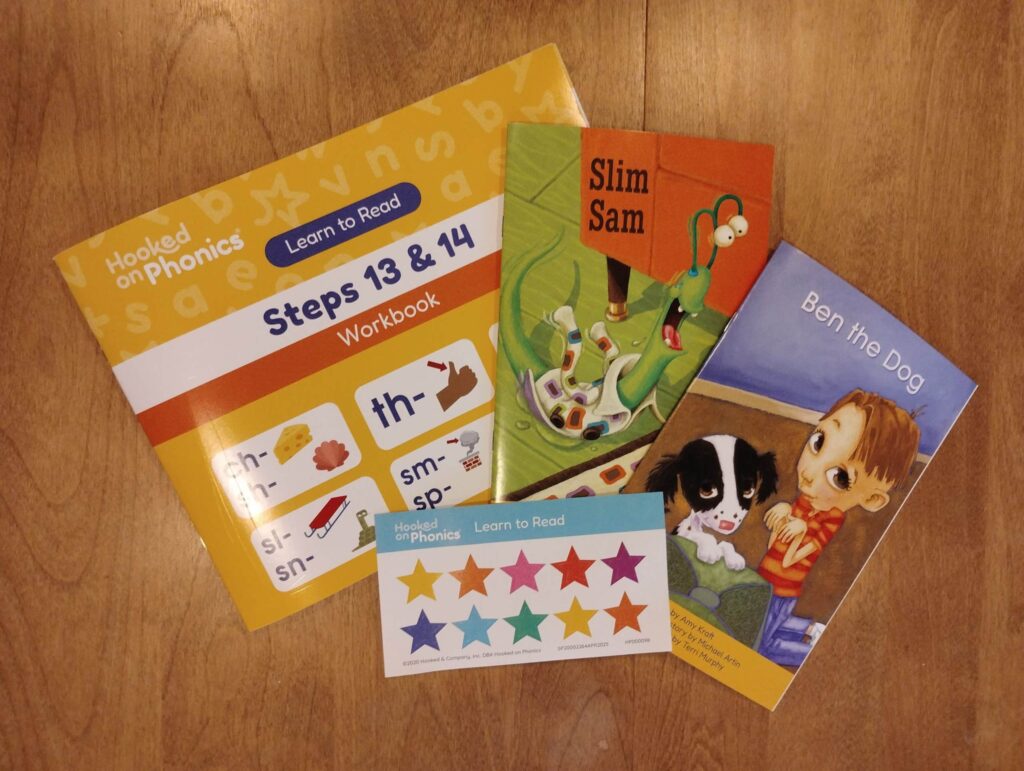
After watching animated characters introduce new letter sounds, children play games like dragging letter pairs onto seesaws, read physical storybooks, and do hands-on tracing activities and cut-out games. What I liked best: the high-energy videos and songs, plus the physical validation of stickers and certificates kids can display.
Pricing
You can try the full program for 30 days for just $1 before paying about $13 per month, plus a $3 shipping fee for the physical kit. Save by paying $80 upfront for an annual subscription (plus $3 monthly for shipping).
The Hooked On Phonics Workbook
Verdict
If you’re looking for the best learn to read app for toddlers, this is it. The structured approach works perfectly for kids who need clear, step-by-step guidance, rather than just random games, and the monthly storybooks were huge hits in my house. That’s why Hooked on Phonics is our highest rated kids program. If you want a proven preschool phonics app, Hooked on Phonics is worth every penny.
Best for: Toddlers ages 2-4 learning letter sounds and early phonics
Key strengths: Research-backed phonics and overall literacy instruction, 4,000+ digital books, excellent progress tracking
Age range: 2-13 (with Reading Eggs Junior specifically designed for ages 2-4)
Trial and pricing: 30-day free trial, then $6-10/month
How Reading Eggs Teaches Phonics
Reading Eggs Junior program approaches phonics for kids ages 2-3 by focusing on phonemic awareness and letter recognition. As children progress into the main Reading Eggs program around ages 3-4, they begin blending letter sounds to decode simple words. Beyond phonics, Reading Eggs also emphasizes vocabulary and comprehension, especially once kids hit elementary school. What Reading Eggs lacks: physical storybooks, workbooks, and stickers. This is a great learning app – but that’s about it.
What Toddlers Do
Short attention spans are normal. Reading Eggs was designed to keep little ones engaged as they bounce between catchy phonics songs, alphabet games, and printable activities. I’m big on learning through stories, so I loved the nursery rhymes that build phonological awareness, plus the interactive stories where preschoolers identify the sounds within words.
Pricing
The Reading Eggs 30-day free trial lets you test whether lessons engage your toddler before committing to paying about $10 per month, or $70 upfront for the annual subscription. One subscription covers up to four children, making it solid value for families with multiple kids. Plus they offer a math supplement for a little more, and a homeschool version with additional features for $25 a month.
An interactive Reading Eggs phonics game
Verdict
There aren’t many apps like Reading Eggs, which nails the balance between education and engagement. It has a massive digital library and you’re getting a solid reading program at a reasonable price (note – no physical kits if that’s what you are looking for). Reading Eggs isn’t just a solid phonics app for children ages 2 to 4 – it’s also an excellent literacy app supporting readers through age 13, so kids won’t outgrow it quickly.
All About Reading
(Best Hands-On Learning Alternative)
Summary:
Best for: home-school families, children with learning delays, and hands-on learners wanting a structured approach to phonics, fluency, and spelling
Key strengths: Research-backed curriculum, highly effective for kids with dyslexia, parent-led with detailed scripts (screen-free)
Age range: 4+ (Pre-Reading starts around age 4)
Trial and pricing: $164 upfront for Pre-Reading complete kit, reusable for siblings
How All About Reading Teaches Phonics
All About Reading physical kit
As the best screen-free option, All About Reading (AAR)is a hands-on program that uses a multisensory approach that connects with visual, auditory, and hands-on learners. Based on the Orton-Gillingham method, AAR is perfect for toddlers with speech delays or trouble recognizing rhyming words, who need a structured start.
Note: The parent company (All About Learning Press) creates two separate programs: All About Reading and All About Spelling. For children ages 2–4, you only need the Pre-Reading level of the reading program; spelling comes much later. This review focuses on their reading curriculum.
While the other apps on this list are great for independent play, All About Reading is for actively involved parents. It’s the #1 choice for homeschool families because it works – and you don’t need to be a teacher to follow the scripted lessons.
All About Reading letter tiles
What Toddlers Do
This is a physical curriculum, not a tablet app. It requires you to sit with your child for 15-20 minutes a day. Phonics activities for toddlers include letter tracing, crafts like forming letters with twigs, and cutout games. The program includes bare-bones companion apps for pronunciation and digital letter tile practice, but these are supplements, not the core curriculum.
Pricing
The biggest drawback to AAR: it requires a significant upfront investment. The Pre-Reading kit costs around $164 and includes a teacher’s manual, student workbook, letter tiles, review box, puppet, and physical readers. Thankfully, some materials can be reused as your child advances to higher levels, and younger siblings can also use them, saving money.
Verdict
AAR’s phonics instruction isoutstanding, particularly for toddlers with speech delays or trouble recognizing rhymes who need a structured start. It is perfect for homeschool parents who prefer hands-on teaching over screen time. If you’d love to bond with your child over a puppet and a book, buy this kit.
IXL Language Arts (Best for Targeted Reinforcement)
Best for: Children who could use additional practice in phonics and early reading
Key strengths: Practice problems help kids drill one specific skill at a time, mastery-based approach ensures children only move on when they’re ready, in-depth parent dashboard provides detailed progress data
Age range: 3-18 (with targeted phonics lessons for Pre-K through second grade)
Trial and pricing: $10-20/month
How IXL Language Arts Teaches Phonics
Rather than directly teaching phonics, IXL serves as a learning supplement focused on providing kids with additional practice in early reading skills. Children start by doing a detailed diagnostic that then generates a hyper-specific action plan outlining exactly which review sets they should prioritize. After that, toddlers simply work through one skill at a time, answering questions on the same topic until they’ve achieved a score indicating mastery or proficiency.
What Toddlers Do
Children primarily engage with IXL by doing practice problems repeatedly until that specific concept really makes sense to them. The focus at this age is mostly letter recognition, phonics patterns, and decoding. As children get older, they’ll start building sight word recognition and simple sentence reading, usually starting with 2-3 word sentences before progressing to longer passages.
Voice instructions guide kids through question sets, helping them navigate independently. If kids get stuck on a certain concept, they can watch a quick refresher video, although IXL isn’t designed as a child’s primary learning curriculum. You’ll want to keep a close eye on the detailed parent reports to assess whether your child needs further instruction in any concepts.
Pricing
IXL Language Arts costs about $10 per month, or you can save more by spending about $80 annually. You can also bundle it with IXL Math for about $16 per month, choose the most well-rounded Core Subjects package for just under $20 monthly, and add additional children for $4 per month, per child.
Sample IXL practice question
Verdict
To be clear, IXL isn’t a traditional phonics app, since it doesn’t actually teach children to read. As a reinforcement tool, however, it’s hard to beat. IXL Language Arts is top-notch for parents who appreciate detailed reports, children who learn through repetition, and anyone who wants the extra security of a secondary program to help your child truly grasp every single phonics concept. Personally, we’ve had great success using IXL in our family, so we definitely recommend it as an educational supplement for mastery-based learning.
Search for kids’ learning apps and these two will find you before you even finish typing. Many parents have tried them. But popular doesn’t always mean effective, especially if your real goal is teaching your child to read.
Starfall has been around forever, and that’s kind of the problem. The graphics are dated, and there’s no real structure guiding a child from one skill to the next. It’s more of a digital sandbox than a curriculum — fun to poke around in, but don’t expect a clear path forward.
ABCmouse is the opposite in almost every way: slick, massive, and packed with stuff. Maybe too packed. The phonics instruction is in there, but it’s easy to miss when it’s competing with art projects, digital pets, and about a thousand mini-games. Toddlers will gravitate toward the fun stuff every time, which means letter sounds often get skipped entirely.
Bottom line: treat both of these as possible supplements – but neither one is going to get your kid from A to Z the way a focused reading program like Hooked on Phonics will.
Comparison of Phonics And Early Reading Programs
Phonics Program Comparison
Features
Hooked on Phonics
Reading Eggs
All About Reading
IXL Language Arts
Ages
3-8
2-13
4+
4-18
Phonics approach
Structured phonics with app plus physical materials
Structured phonics with app plus physical materials
Research-backed approach with parent-led instruction
Phonics practice questions with limited direct instruction
Price
$7-13 / month plus shipping
$6-10 / month
$164 upfront
$10-20/mo
Free trial
30 days for $1
30 days
N/A, 12-month guarantee
N/A (request full refund within 30 days)
Best for
Toddlers aged 2-4 who benefit from both digital and physical phonics materials
Families looking for a holistic and engaging reading program
Homeschoolers wanting hands-on teaching, toddlers with speech delays
Children who learn best through skill-specific practice
Verdict: (and How To Choose A Phonics App For Your Child)
After testing all five programs, Hooked on Phonics is the clear winner for toddlers ages 2-4. The research-backed, systematic phonics activities genuinely engage young learners, and the physical storybooks keep kids reading long after the lesson ends.
Hooked On Phonics – One of Their Phonics Games
That said, choose the program that best fits your family. Reading Eggs excels for structured phonics plus holistic reading support, and All About Reading is outstanding for homeschoolers and delayed learners who do well with hands-on instruction.
Bottom line: invest in Hooked on Phonics if you want one app that will take your toddler from first letter sounds through independent reading. Even better: combine Hooked on Phonics with IXL for a strong phonics focus plus targeted drills.
The best phonics apps for toddlers are Hooked on Phonics, Reading Eggs, IXL and All About Reading, depending on your child’s needs. Starfall isn’t ideal as a standalone program.
At what age can toddlers start phonics?
You can start introducing letter sounds as early as age two or three. At this stage, keep it playful – focus on songs, rhymes, and recognizing the first letter of their name. Formal phonics lessons usually stick better once a child is around age four, but early exposure is huge.
Are phonics apps safe for young kids?
Always use a vetted early reading app that’s ad free and COPPA compliant. kidSAFE certified programs also provide that extra level of security.
Can toddlers learn phonics on an iPad?
Yes, apps make it easy to teach phonics at home! Targeted phonics app for two-year-olds often include voice instructions and swipe-based navigation so little ones can play independently. Short, 15-minute sessions are all it takes to introduce letters and sounds.
 Editor's Choice